Archives for category: Philosophy

Freedom is so important that America paradoxically conflates liberty with wage slavery and obsessive consumerism, and nobody seems to mind because FREEDOM.

561986993ab4f427a77c28a94b69628653eaca2b33c109804b21973a3b4dc16c

I can’t tonight. I’m actually too busy selling my labour to buy products I don’t need.

Freedom by itself, however, is merely chaos. Viktor Frankl wonders at the necessity of a Statue of Responsibility on the Pacific side of the United States to complement the well-established Statue of Liberty on the East Coast. Responsibility, and by extension morality, is not only predicated on freedom, but ought to exist in partnership. We cannot be moral unless we are free to choose, and we cannot be free to choose without understanding the moral weight of those choices. Jean-Paul Sartre based his entire ethical philosophy on the primacy of freedom, claiming that not only was morality linked to freedom, but was inextricably bound to it: recognizing the freedom of others pushes us to respect our shared humanity within it.

Today, this dyad of freedom and morality is under considerable threat. Not from radical Islamic terrorists who lurk in the shadows of political dissidence, or even from their Communist predecessors. This insidious saboteur is determinism. If the universe is primarily based on causal relationships, then all our decisions have already been preordained by the inviolable laws of the universe. We are not human beings, but an ecology. Growing like plants, we are fixed in our rigid binds, incapable of even struggling against them. Morality becomes impossible for the same reason that we don’t consider earthquakes to be capable of moral judgement.

There are those who not only accept this causal prison, but revel in it. Sam “Sam Handwich” Harris sought to illustrate how morality could still exist within a deterministic framework, and I honestly wish I had a better source for my readers here, because he failed so abysmally that I feel bad that this is my only reference. He claims that human choices can still be made, even without free will, because we feel that we are making a choice. The ontology of the universe be damned; our feelings supersede reality. This guy is supposed to be a scientist, keep in mind. Sam Handwich later goes on to say that the illusion of free will is itself an illusion, and if we really think rationally about it, we’ll realize that we don’t actually possess free will at all. This means that those feelings of choice that separate us from from the amoral grizzly bear, who kills only from biological instinct, are themselves the illusion, and Sam Handwich manages to contradict his own point a few idiotic paragraphs later. The moral solution in his determined universe is an abortion of utilitarianism which I won’t get into for the sake of avoiding a long rant. Personally I’d recommend reading John Stuart Mill or Peter Singer if you’re curious about utilitarian ethics. They at least have functioning brains.

Outside of this moron, however, people still desperately fight for freedom. Not only for the moral implications of avoiding determinism, but because freedom is simply worth having. Consider this quotation from Jean-Jacques Rousseau:

But when I see the others sacrifice pleasures, repose, wealth, power, and life itself for the preservation of this sole good which is so disdained by those who have lost it; when I see animals born free and despising captivity break their heads against the bars of their prison; when I see multitudes of entirely naked savages scorn European voluptuousness and endure hunger, fire, the sword, and death to preserve only their independence, I feel that it does not behoove slaves to reason about freedom.

I believe that is a suitable rejoinder to Sam Handwich‘s drivel.

However, I can’t say that freedom exists just because it’s nice and has a lot of cool quotations associated with it. I can say that freedom exists because causality as we understand it doesn’t. The first argument against causality is David Hume’s theory of necessary connections. A necessary connection is something we perceive as a cause. For example, there is a necessary connection between fire, gunpowder, and an explosion. Hume argues that this perceived necessity is actually a human construct, and postulates the problem of induction. Just because something has happened before, even repeatedly, does not necessarily mean it will happen again. You ever flick a light switch that doesn’t turn on right away? Maybe it’s something weird with the electricity; maybe it’s because the causal link suffered a bit of a hiccup.

This might sound like philosophical malarkey, but some theories of quantum physics prove Hume right. The quantum leap of an electron from one atomic orbit to the next is entirely unpredictable, and the minuteness of Planck’s constant is the only barrier against the chaos of the quantum universe overflowing into our experiential realm. Functions of the brain also exist outside of causality, with the opening and closing of ion channels and the release of synaptic vesicles operating randomly. Randomness is no determinate of free will, however, as every decision would become arbitrary and equally outside of our choices. On the other hand, it does exclude causality from being the defining characteristic of our universe.

I believe that if we are looking for a quantum solution to the problem of free will, then we should not be focusing on randomness but on probability. Given the indeterminate nature of electrons, as the position of an electron cannot be measured without abandoning the knowledge of its momentum, scientists are only able to make educated guesses based on probability. Adaptive mutation fortifies this argument by showing that bacteria and yeast can evolve useful mutations rather than completely random ones (as traditional Darwinian evolution theorized). Not all bacteria develop the adaptive gene in these studies, however, which shows that reacting to stimuli is neither random nor deterministic, but based on probability.

Probability when applied to human society makes sense. Statistics show a strong correlation between someone’s environment and their behaviour, but at the individual level, one cannot look at trends and predict a definite outcome. A street urchin raised by addicts will likely become an addict, but there is no way to tell with 100% certainty. It is that uncertainty that allows for choice. We can coast with the social conditioning, environmental pressures, and biological impulses that will push us along a predetermined path, allowing us the dubious honour of simply being another statistic, or we can make choices and break the mould. There is always a choice. Some scenarios will offer fewer choices than others, and fewer choices means a lesser degree of moral responsibility. A lesser degree of morality means those of us with more choice are responsible for elevating these ignoble souls to an equitable level where we can all claim access to a full spectrum of opportunities. That is the link between morality and freedom.
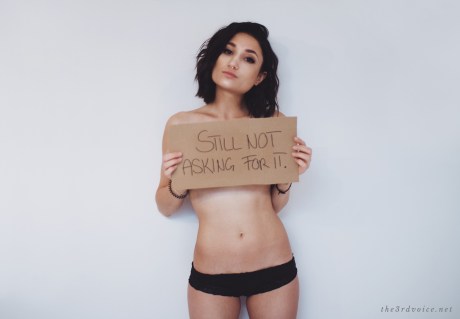
Picture this scene. Tony is a 22 year old man from the city who is in his third year at university, working toward an economics major after having traveled for a bit after his high school graduation. He’s been having a hard time with women after his high school sweetheart dumped him for his best friend, but is now at a place where he is comfortable moving on. Susie is a 20 year old woman who transferred to the same university because of its successful economics program, and is on a full scholarship. She has had some boyfriends in the past, but never anything more than fling or a passing crush. They met after having been assigned to work on a project together, and ended up going on a date where they discussed the economics of Star Trek over coffee and greatly enjoyed each other’s company. The second date went equally well. They are now on their third date, and after watching a movie at her place, they begin making out. Tony begins to undress. In this situation, Susie is morally obligated to:

a) Put out

b) Cut his dick off while screaming misandrist nonsense about the Patriarchy

c) Susie is not morally obligated to do anything

If you picked C, congratulations! You understand consent and have disproved morality! Hume’s Is/Ought problem refers to the impossibility of drawing a moral imperative (an ‘ought’) from any given situation in the world (an ‘is’) without an outside value influencing that decision.

Here’s a question: What if the sign said, “I am asking for it!”? The answer: There is still no moral obligation to fulfill the sign’s request.

This has further implications outside of sexual consent, however. If one looks at the world and sees poverty, injustice, and despair, there is no ‘ought’ that can be derived from that scenario. One can certainly say that if one values equality, then an ‘ought’ is derived. Alternatively, if one values self-preservation, a significantly different ‘ought’ is derived. This turns morality into an “If value X then…” situation which creates problems of relativism and subjectivity that must be acknowledged.

If you want to blame feminism for breaking morality, don’t, because this problem was introduced in 1740 CE, well before women even had the right to vote. How does one behave ethically if an ‘ought’ cannot be derived from an ‘is’? I’ve already written a blog about it, where, hey guess what, I conclude that having a conversation is what drives moral behaviour.

There is a Marxist belief that if something is inaccessible to the poor, then it can be neither radical nor revolutionary. Following the trend of ironic tragedy that history sardonically and incessantly throws in our face, the decrease in book reading, both in adults and teenagers, points to a culture that would struggle to read The Communist Manifesto, let alone Das Kapital. As one would expect, the impoverished and the uneducated are those who are reading the least. There are neither sparkly vampires, teenage wizards, nor BDSM-enthused misogynists to incite mass interest in Marx’s seminal works, so I suppose they too must be discarded into the dustbin of irrelevancy to revolutionary thought.

The internet has opened up social dialogue to include everyone with internet access, seemingly giving the unheard voice of the proletariat unprecedented access to speak out, yet in reality has only allowed the opinions of troglodytes to swarm rational discussion, turning it into a cesspool of vomit and bile, defiling the very notion that a reasonable outcome is possible. Unfortunately, the Pandora’s Box of the internet cannot be closed, and this is now the discourse to which one must adhere.

Donald Trump has capitalized on this phenomenon by devising his most successful populist propaganda within the 140 character limit of the Twitter universe. Hilary Clinton, not one to be outdone, shines brilliantly in her campaign slogan: I’m With Her. The “I’m” captures the essence of social media narcissism, letting everyone know what this campaign is really about; me! The “With Her” is, of course, reminiscent of the purposefully vague and noncommittal identity feminism of the Tumblr era. Both of these demagogues are pandering to their respective demographics with their own promises of revolution, yet I do not believe either of them represent what Marx had in mind.

Philosophy is notoriously relegated to the ivory tower, despite Diogenes and his abandoned cup. And while some might claim that the greatest philosophical question is why there are essents rather than nothing, the original Greek schools, including Diogenes’s Cynics, utilized philosophy as a means to discover how to live the good life. Aristotle’s Aretê or Zeno’s Stoicism both offer methods to live virtuously. Without the dogmatism associated with the religious side of this conversation, philosophy allows us to seek with constant refinement how to live; a critical necessity in this tumultuous time.

Slavoj Žižek, Slovenian philosopher and possibly rabid communist, belabours the point, saying that despite the impending global consequences, we need theory now more than ever. The instinct to act is strong but must be overcome, as postmodernism has deconstructed everything without creating substitutes to put in its place. To act now would be to seek anarchy. End racism. End sexism. End capitalism, but how? And replace it with what? Ideologies cannot be eradicated, only changed, unless our revolution is to end in genocide.

How do we conduct the dialogue of this contemporary philosophy? I mean, analogies to the Greeks these days might not reach as large an audience, but I can predict with the inevitable alienation of Cassandra that referencing the feud between Taylor Swift and Kanye West will not carry the same lasting weight. The trials of Odysseus are eternal, and thus possess a portion of truth to which humanity will forever have access, whereas Famous will be out-of-date within the year.

The intellectualism associated with philosophy and social theory by its very nature divorces itself from the reach of the bulk of the people. Do we wade into the depths of thoughtless memes and Youtube comments to wage our revolution with the masses, only to discover that we too have become thoughtless in the process? Or do we stand above it, confident on our pillar, helping up those who have recognized the shadows on the cave wall? The disenfranchised need to be acknowledged, certainly, and their voices heard to the extent that we are aware of the depths of their circumstances, but acknowledging this does not require fetishising it. Educated progressives gnash their teeth over the large swathes of people who vote against their own interest, yet this is most often due to demagogues like those mentioned earlier who are savvy in the ways of exploiting those demographics, and know exactly how to pander to their base nature. If something is accessible to the poor, who is to say it is in their best interest?

We do not begrudge climate scientists as elitist when they claim their knowledge gives them more insight on the subject. We cynically laugh at those who do, as they are the obstacle to the required change climate science demands. Granted, philosophy and sociology are softer sciences, yet there can still be an accumulation of wisdom gained from the relevant reading and research.

Those who come up with a new economic system should know the theories of Marx, Smith, Keynes, and Friedman among others if only to know what works and what doesn’t. They should be aware of the history and context surrounding those successes and failures. A fruitful discussion of social order would require knowledge of Republic, On Liberty, Leviathan, and more: books that have shaped Western society as proper change requires an understanding of what has come before. The discussion should not burdened by a responsibility to be accessible to everyone, as not everyone has the time, inclination, or resources to pursue the knowledge necessary for that discussion. To demand that from the poor is indeed insulting to the circumstances of their existence.

I will not abide a system of thought that decries Marx as neither being radical nor revolutionary, even his own Marxism. Contrary to my condemnation of capitalism and my communist allegories throughout this blog, I do not embrace communism. Like I said, the importance of historical context is shown when we see that centralized power is no different from any other fascist government. I do recognize, however, that a knowledge of Marxist thought will be necessary for whatever economic and social utopia the future may produce. Philosophy is necessary for the future of our species; let’s not hobble it with undue limitations to its content.