Archives for category: Politics

Power is typically seen as the capacity to act – with obviously varying degrees. A prisoner can pace their cell, do push-ups, and so on, but can’t act outside the limits of their cage. The President of the United States might not have the power to verbalize a complete thought, but he can do all the things the prisoner can, and more besides. They both have power, but one of them has far more power than the other.

I think this is a narrow view of power that is lacking one of its key components: need. The variations in power aren’t so much across the capacity to act per se, but the capacity to act without considering the needs of others. The prisoner must accommodate the needs of the warden, the guard, the parole board, and so on. His needs are ranked quite low when contemplating which actions to take. The President of the United States, on the other hand, can skate by without acknowledging the needs of most of the planet. He might have to consider the needs of Benjamin Netanyahu, to a degree, as the Israeli Prime Minister has considerable power in this regard as well, but he certainly does not need to consider the needs of the Palestinians who are, for all intents and purposes, power-less.

How power is depicted goes a long way

Taking this needs-focused perspective of power opens up further understandings of how power works, and how impotent our approach to it actually is. If we consider our human needs (using Maslow’s hierarchy for the sake of simplicity), what we consider powerful can really only help us meet our most basic needs: food, water, safety, shelter. This can also help us define what might be considered ‘power’ as anything that can help us obtain these things without considering the needs of others – money, celebrity, access to opportunity (think Harvey Weinstein), and so on.

In case you need a refresher

There are way more needs than the basic ones, and power is useless in obtaining them. Love is elusive to those whose identity is based solely in their power, and this is highlighted in the common trope of the rich person worrying over whether they are loved as themselves or if those close to them are only after their money. Similarly with esteem: we think we respect power, but we really only respect what one does with it. Elon Musk isn’t respected because of his money, but because of his advocacy for free speech and his pursuit of a better world for humanity through clean energy and space exploration; or, he’s not, because of his advocacy for racism and his massive ego whose projects offset any climate good his cars might produce. His power is irrelevant; he is judged by his actions based on the capacity that he has to act – as anyone would be. Self-actualization goes without saying.

Someone with only their very most basic needs being met – such a thing to strive for…

So why is there this fixation on power? Why do so many people strive for it, often at the cost of their other needs? Why do we delude ourselves that power is somehow going to fulfill our lives when it literally cannot? The answer is obviously capitalism, you goons; it’s always capitalism.

Capitalism as an ideology requires an underclass to use their labour to produce the things needed by the more powerful. This required scarcity forces people into a situation of never having enough power, so our most basic needs can never be met. A housing market that makes shelter out of reach; low wages to make food and security luxuries; a “flexible labour market” (i.e. gig work) to make the underclass even more precarious in their ability to meet their basic needs.

We are then told that in order to get our needs met, we must compete laterally with others in our class. We must gain power by any means necessary, and that’s the only way we’ll be able to afford rent. Do not consider the needs of your neighbour; they are in competition with you! The only way for society to function is if there are winners and losers, and winners don’t need to accommodate anyone. This is the way.

Baby Yoda’s famous catchphrase, “Fuck you. I got mine!”

This isn’t to say that power didn’t exist prior to capitalism. Feudalism obviously had lords going head to head to obtain more power – it’s just that the regular people didn’t give a shit because they had their basic needs met. More people had access to a more diffuse power: land. If you had access to land, you had food, security, family, and so on, and didn’t see the point in striving for anything else. If you didn’t have land, there was still the commons which allowed a degree of needs to be met. There wasn’t as much wealth as we understand it today, but there didn’t really need to be; people had enough. Industrialization created urbanization which increased inequality and poverty which reduced the average person’s power, and the shrinking of the commons increased commodification which reduced normal people’s ability to get their needs met as basic needs became more and more unaffordable. As the West went through this transition, we peasants and proletarians gained political power through the institution of democracy, but lost it economically as the means of production shifted more and more to the ownership class.

This blog is technically more anarchistic than communistic, but Party Marx will always be welcome for discussions around the ownership of the means of production

This manufactured scarcity and proselytized ideology has deluded us into thinking that with power, we’ll finally be able to live the lives we want to have. To a degree this is true: we cannot achieve anything without our basic needs being met, and power is required to obtain them. The delusion arises when we forget that our goal is to get our needs met, and not power in-and-of itself. We want money in seeming ignorance that the entire purpose of money is to buy stuff – do we want the money or do we want the stuff? Do we want the power or do we want to have our needs met?

Also, wasn’t this article supposed to be about superheroes?

It has been this whole; you just had no idea!

Superheroes have superpowers which would include them in this analysis. It’s a little campy, but being more powerful than a locomotive is technically a power. As David Hume said, “Strength is a kind of power; and therefore the desire to excel in strength is to be considered as an inferior species of ambition.” Could Superman achieve his basic needs without taking into consideration the needs of others? Absolutely! That’s how we get Injustice and Homelander. This shit counts, however nerdy an ambition it might be.

Superman, of course, would never do such a thing in the traditional canon. That’s what makes him heroic. He doesn’t use his power for himself, and I’m going to argue that he doesn’t do it for the people of Metropolis either. The people of Metropolis don’t exist – they’re fictional. Superman doesn’t technically exist either, but the story of Superman does. The writers are producing this power, and the power of Superman is used to meet the needs of person reading his story. We feel secure against the threat of Zod. We feel safe from the machinations of Lex Luthor. This is how empathy works.

If our needs don’t supersede the needs of the hero, they become the villain. This is why the villain Homelander is still seen as a hero in an ever-increasing fascistic America – the people who watch The Boys don’t see any issue with what he’s doing, and their needs remain met by his actions. But traditional villains rob banks and try to take over the world, using their superpowers to meet their own needs. Disney’s new “sympathetic” Marvel villains have high ideals, but don’t consider the needs of others in their quest for it – this is how their villainy is displayed despite the validity of their ideology.

The face of accommodating the needs of others

The thing is, this glomming on to the powerful with the assumption that they’ll meet our needs exists outside the world of the superhero as well. In the traditional model, women (who are limited in their power) will seek out powerful men as a means of linking themselves with his power to help them get their own needs met in a world that wouldn’t allow them to be met otherwise. If there is abuse or violence, it is often endured out of a fear that her needs won’t be met without him – his power is all she has to keep herself from becoming powerless.

Under capitalism, there are more powerless people than just trad wives. Many of us live our lives with the bare minimum of power, scraping by as best we can. Wouldn’t it be nice to attach ourselves to some hero who would use their power to uplift our own? This is the allure of the tyrant. Surely I’ll be taken care of if we give more power to this person with whom I identify! Surely my station will be reduced if they are overthrown! We connect to the tyrant as we would to Superman, as some of us bizarrely do with Homelander – they will use their power to keep us safe. Our needs will be considered; the needs of the outsider be damned. But is the solution to our abusive boyfriend to make sure we land a nice one, or to adjust society so that women and men are equitable in their power, limiting the potential for abuse to happen in the first place? Such a world appears to be possible!
People are alive today who have witnessed significant changes in systems of power

The thing is, power is the capacity to act without considering the needs of others. The powerful don’t need to consider us, so why would they? That’s how power maintains itself, so why abandon the working model? We, however, as a collective have more power than any individual. This is why platitudes are made about how the powerful will take care of us, as a manipulation. We are given speeches and scraps to delude us into thinking that we are better off with them having all the power, with us remaining powerless and allowing them to go unchallenged. Superman is a propagandic myth: the boyfriend who tells his girlfriend to never leave him, he’s going to take care of her, trust him.

Power cannot escape what it is; we have to escape power. We have to recognize the value of our neighbour and accommodate them accordingly. We have to recognize the life beyond our basic needs. Both of these perspective require giving up our pursuit of power. Power will never go away, our basic needs will always need to be met, but we can diffuse it. Just as democracy diffused political power, we must identify other aspects of power and diffuse them as well. Power where it exists today must be counterbalanced – this is often the project of the Left as we try to convince governments to allow the otherwise powerless access to their basic needs. It’s a faulty system as power remains relatively undisturbed, and this liberal redistribution does not address the root causes of the concentration of that power, but it’s what the system currently allows. We still have room to dream for more.

To quote a super-villain (notably, one later purchased by Disney), “When everyone is super, no one will be.” And we’d be better off for it.

Part IPart IIPart III

I have outlined in broad terms why Aaron Gunn’s propagandistic pseudo-documentary fails to even begin to address the drug crisis in Vancouver. It ignores the actual causes of drug use, it cherry-picks data from already irrelevant sources, and it does not even attempt to rebut the massive amount of evidence supporting harm reduction, and, to a lesser extent, safe supply (mostly because it is a new, statistically small project with little data currently available). Instead, it demonizes drugs and through them the drug user, painting them as violent and unpredictable. He films tent cities, likely without consent, and never actually asks any of the residents how or why they’re in that situation. Drug users are a pornographic threat, dirty and alluring, and the only solution he offers is to utilize state violence to enforce abstinence by any means necessary.

The pornographic content that I know you’re here for!

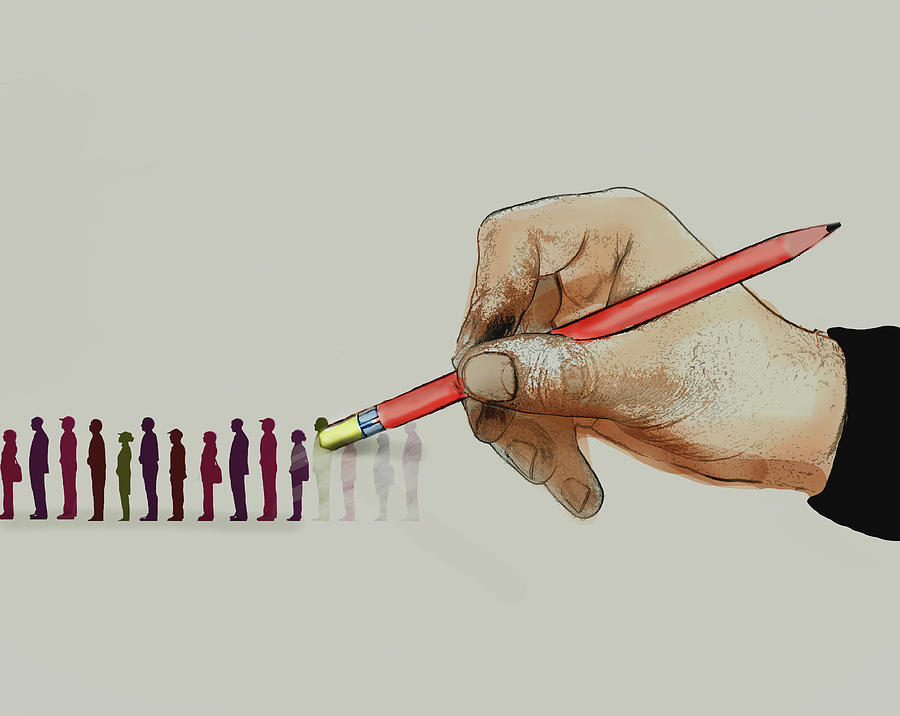
Gunn suggests that he and those ideologically akin to him are the only ones who actually care about drug users. He claims the Woke Left want to keep drug users in the slums, stuck in addiction, stuck in poverty, and it is only by making drug users “better” that they can be saved. Much in the same way that infamous LGBT antagonist Anita Bryant claimed that she didn’t hate homosexuals, Gunn seeks salvation for the morally fallen. This is why there is so much emphasis in the real world of right-wing politics to force people who use drugs into treatment – they need to be saved! Of course, there aren’t enough beds out there for those who want to go into treatment voluntarily, but despite this miniscule logistical anomaly, we must force these sinners into repentance for their own good. You’ll hear talk of treatment beds as a panacea to the drug crisis without anyone actually pointing to solid evidence that bed-based/residential treatment actually works any better than anything else people are doing, with some evidence showing that the risk of overdose increases after treatment because the person’s opiate tolerance has evaporated. This is because treatment isn’t treatment in this context; it’s conversion therapy. “Beds” are only a measure of our capacity to eliminate sin. The goal is erasure, and erasure on a massive scale does not consider pesky irritants like research, studies, or the voices of the people being erased.

When the threat of hellfire isn’t enough!

This is why analyzing this kind of propaganda is important. Gunn released this trash leading up to the Vancouver municipal election, and the right-leaning ABC Party under Ken Sim won a solid majority on a platform nearly identical in ideology to that of Vancouver Is Dying – we need law and order to combat drug use and random violence! Interestingly, in trying to find years old news coverage about Sim’s platform, I stumbled on a fun little update to all those stranger attacks so prominent in the film – apparently there was a massive decrease in stranger attacks when the pandemic was winding down in 2022, and the police just didn’t release those statistics during the election campaign of the right-wing candidate they had endorsed. Remember how Gunn neglects the pandemic when talking about crime? Perhaps the fear of crime was sensationalized by opportunists hoping to push emotionally-driven policy with no regard for what the truth actually is. ANYWAY, I DIGRESS!

Who could have guessed??

So what does erasure look like in real world scenarios? Perhaps the event that received the most news coverage was the police sweep that cleared the encampment from Hastings Street which Gunn so callously captured in his more voyeuristic shots. This was completed without any thought as to where these human beings might go, and as expected, the problem didn’t go away – people just didn’t have their tents and meager belongings anymore. But there’s more: Vancouver’s ABC party shut down a street market that many homeless people utilized to acquire cheap secondhand goods, moving it to a less accessible indoor location with fewer stalls for vendors. These goods could be the result of theft and organized crime, dontcha know, which is scary! Getting rid of the observable and centralized market is obviously not going to reduce theft, but there is only one outcome that matters: erasure. The city of Vancouver also chose not to renew the lease for the Thomus Donaghy Overdose Prevention Site which has a centralized location close to an abundance of drug users. With overdose deaths through the roof, it sure would make sense to have a space where it could be done safely with some medical oversight! But alas, erasure demands the elimination of anything that might support the scary and bad thing. There’s more: Vancouver downsized CRAB Park – the only sanctioned tent city – for safety reasons. Tent cities are the never-ending symbol of erasure as they pop up and are cleared off with metronomic consistency, from Oppenheimer to Strathcona Park to one that popped up and was shut down near to where I live – all eventually cordoned off by the blue metal fence.

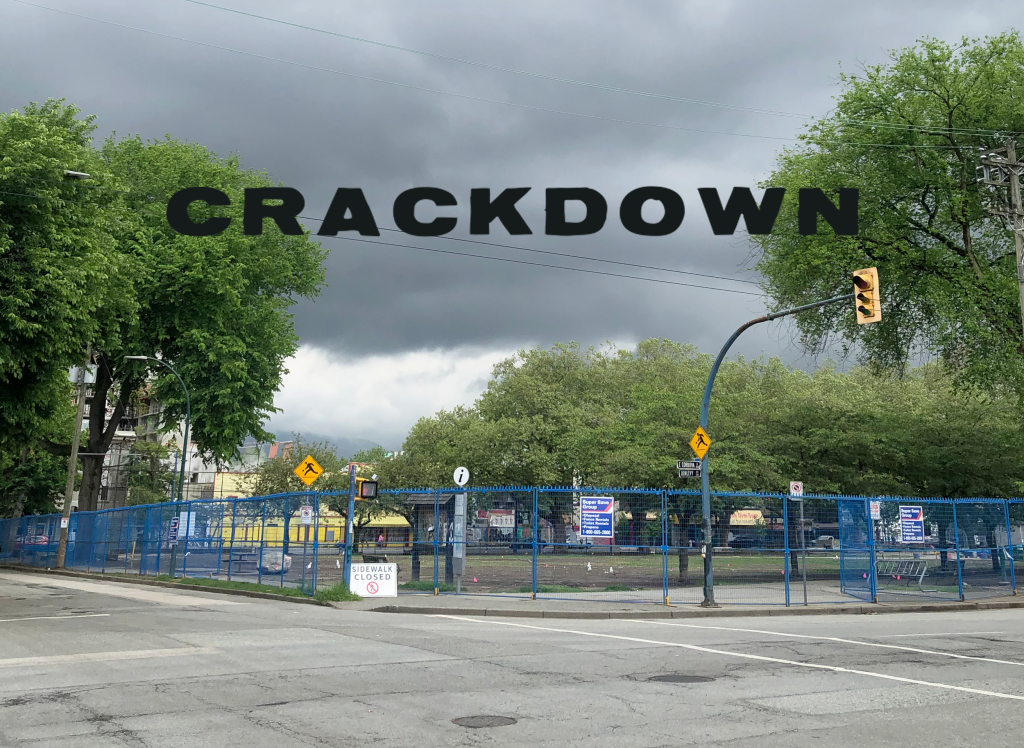
Seriously though, check out the Crackdown podcast linked above about Oppenheimer Park being shut down

It’s not just Vancouver, and that’s my point. An encampment in Prince George was evicted as well, leading the federal housing advocate to call it a “human rights violation” based solely on the fact that it was evicting people from somewhere with nowhere else for them to go. Federally, the Conservatives have been railing against the science of harm reduction, going so far as to blame every last drug overdose death in BC on decriminalization – a pilot project meant to reduce police interactions with drug users (not actually reduce drug deaths) which was a thrilling success, with a 77% decrease in possession charges and a 96% decrease in drug possession seizures! The problem was that people started to see more drug use – the exact opposite of erasure – and that made them uncomfortable. This discomfort unfortunately is the perfect gateway drug to emotionally-driven tripe like that being peddled by Gunn! (Of note, Gunn claims that police don’t actually harass drug users, which is clearly not borne out by the statistic that 96% of police seizures were under the 2.5 grams for personal use before that amount was decriminalized – perhaps this was part of when he mentions that police will “stop and talk to people on the street.” Even if someone isn’t being locked up, that doesn’t eliminate the harassment!)

I’m sure Gunn would comply without complaint to enduring this repeatedly and without reason

What if we could reduce the harms of hard drugs to such an extent that they were no more harmful than alcohol (which in social costs is technically higher than heroin, but haha who cares, right!?). Anyway, let’s say that the drug supply was sufficiently harmonized that it was no longer causing overdoses, that the tools to use it safely were widely available to eliminate the threat of diseases, that the crimes associated with its sale were eliminated, and so on. It is possible – remember we literally used to give legal opiates to children! This is what Gunn fears – he’s actually quite explicit in this when he cites the dangers of “normalization.” What if opiates became so banal that their use was equivalent to enjoying a beer at a hockey game? Or equivalent to cigarettes, where they were discouraged but still mostly tolerated? Perish the God damned thought!

To bring things back to Anita Bryant, it’s important to remember that talking about doing anything about the AIDS epidemic was fearfully seen to be “normalizing” homosexuality. If the homosexuals are dying, well, that’s only because they’re sinners. We’re the only ones trying to save them by praying the gay away, and anyone trying to increase their life expectancy is actually endorsing homosexuality – they’re basically sinners themselves. The parallels to Vancouver Is Dying are endless, and the previous allusion to conversion therapy is depressingly apt. If drug use becomes normal, then people might start being accepting toward drug users!!

Eagerly awaiting the parody that sings about how everyone has unmanaged childhood trauma to a catchy tune!

In my professional life as a health care social worker, I came across multiple people who saw this film and were swayed by it – people who ought to have known better – but I get it! Emotions run deep, and playing to them is a likely way to win in politics, particularly on the right. Crime is scary! The stereotypical drug user, an unkempt man covered in filth and drool with a needle sticking out of his arm, is gross! These are valid emotions! But manipulating those emotions to erase a vulnerable population because you think their lifestyle is a sin has been done before with similarly deadly consequences. Between 1981 and 1988 in the United States, there were 46,134 deaths related to AIDS. In Canada, with a fraction of the American population, there have been 42,494 deaths between 2016 and 2023 related to opiates. I know that it’s not a contest, but my point is that the fear, the moralizing, and the disinformation being put out is just as disgusting now as it was then and that this shit matters. These deaths matter. Anyone who seeks to erase a population is contributing to those deaths because the outcome is essentially the same – the drug user exists no longer by one means or another, and the likes of Gunn don’t seem to mind which route they follow. They don’t see a disease, just a people they define as a disease.

To conclude this excruciatingly long series of posts, Aaron Gunn, your film is toxic and manipulative, degrades human beings, and encourages their deaths. Now you are hoping to become a federal Conservative, with looming control over these people’s lives. A pie to your face is the least you deserve.

It seems quite counterintuitive, perhaps even antisemitic in its own right, to describe the Land of the Jews as antisemitic. It is, in its etymological sense, against the Jews. How could the Land of the Jews be categorized as being inherently against themselves? Well, let’s find out.

I’m sure nothing bad will come from this

What does it mean to be antisemitic? I’m not actually a fan of language that describes oppressive attitudes in hateful terms. It has its uses, but more often than not, the traditions of oppression don’t fall under explicit acts of hatred, but as the enforcement of roles that bind groups of people to a particular label. For instance, it is not hatred of women when someone says they belong in the kitchen, as such an attitude allows for the love of women who fit that description. That’s why it’s racist to say that black people are naturally athletic, even though it’s technically a positive category. In Jewish terms for the sake of this article, it’s the, “make sure your accountant is a Jew” trope. It’s the grouping of a people under a particular heading that limits their individuality. No group is a monolith, and to expect them to be, or to react violently when they stray from their socially determined role, is the racism, the sexism, the antisemitism, and so on. One can certainly hate the stereotype and lash out accordingly, as one who believes Jews to be inherently manipulative might do, but the foundation of that hatred is still formed in the binding of a diverse people into simplistic classifications. If Group A is seen as inextricable from X, then that’s a problem.

October 7th was the deadliest day for Jews since the Holocaust. This is technically accurate, and has been the framing of the Hamas attack across much of the mainstream media. Let’s reframe this a little bit. Imagine 70 years from now; Russia has annexed most of Ukraine, and the rest is occupied in such a way that is considered illegal under international law. Ukrainians, fed up with their oppression, organize a massive and brutal attack against Russia and strike a small village, killing hundreds. It is technically accurate to describe this attack as against Russian Orthodox Christians as that is who most of the victims might be, but would we ever even consider discussing that violence in those terms? No, that would be silly. It is clearly in retaliation for the occupation of a people by an invasive state. Religion would have absolutely nothing to do with it. But Israel is different! Israel is the Land of the Jews, so any attack on it is inherently an attack on Judaism, right?

Anti-Russianist propaganda

Not quite. Some Hamas officials are quite explicit in their linking of this violence to Judaism (though notably much of this rhetoric is dedicated to the elimination of “Israel” and not Jews more broadly), but let’s say for the sake of argument that the violence against Israel is inherently imbued with antisemitism – attack Jews to attack Israel and vice versa. Where did this come from? Why do Muslims hate Jews? Or more specifically, why do Palestinians hate Israeli Jews (a linguistic redundancy, surely)?

Well they don’t – remember no group is a monolith, so the diverse Palestinians are going to have diverse views and perspectives on Israel, but generally, the plight of the Palestinians has been well-documented, and it is certainly reasonable to argue that these conditions allowed toxic resentment and unhealthy violent urges to fester. But why is this particular insurgency tinged with antisemitism when the Russia-Ukraine example would be just absurd within that framing? Why do the Palestinians who do use that rhetoric incorporate antisemitism toward an oppressive state that really only coincidentally happens to be the Nation of the Jews?

Here it comes!

Zionism is the Judaic tenet that the Jewish people are entitled to the ground underneath both Israel and Palestine. According to the original party platform of the ruling Likud party, “The right of the Jewish people to the land of Israel is eternal and indisputable … between the Sea and the Jordan there will only be Israeli sovereignty.” Sound familiar? The idea is that Jews have a right to self-determination, and this must happen on only this particular land… even if other people happen to be living there already. To suggest otherwise is anti-Zionism – which is antisemitic, dontcha know. You can allegedly criticize the government of that dirt and grass, but you can’t extricate the Jewishness from it. Yet, however distinct the government may be from the purity of Zionist soil, the two remain intertwined: Israel has a law describing itself as a land wherein only Jews are allowed self-determination, and Prime Minister Benjamin Netanyahu has opined that Israel is the nation-state of the Jewish people alone. The state has become so woven together with Judaism that it has been described as being an apartheid against those who are not Jewish. If the Land of Israel is Jewish, then the state of Israel must be Jewish to some degree too as the representation of that land. The distinction between the state and the religion is moot because in order for Israel to be Zionist, Jewishness needs to be a part of it. Attacking Israel is attacking Judaism for this very reason: Zionism decrees the self-determining Jewishness of that state.

Back in 2001, some folks who happened to be Muslim flew a couple of planes into the World Trade Center on American soil. While certainly not a universal reaction, many saw this as a clash of civilizations between Islam and Christianity. America is the Christian nation, and thus an attack on that nation is an attack on Christianity. Never mind the division of church and state codified in the Constitution, there are enough ethno-nationalists in the United States that an attack on that nation was seen as an attack on Christianity, sparking the infamous crusade against Muslims in the decades after. I do not intend to suggest that the War on Terror was an absolute symbol of Christianity against Islam, but instead suggest that an attack on a state with far less religious baggage than Israel still managed to become religiously representative in its reactions to violence. Ethno-nationalism will find ways even outside of established ethno-states to link nation with identity; as an ethno-state already, Israel cannot help but imbue the nation with Jewish identity.

The flag is literally the Star of David – who could have guessed the state is literally qua Jewish?

This is why it seems paradoxical to conflate Israel with antisemitism, but this is exactly why Israel is antisemitic. If we accept that Group A being inextricably linked with X is the problem, then having Jews being inextricably linked with Israel must necessarily be antisemitic. A state is by definition a monolith, so any association between the two will always be a problem.

If an attack on Israel is an attack on Jews, then Israel’s response is a Jewish response. Those who wish to frame October 7th one of these way must accept its counterpart – hence the danger of the ubiquitous comparison to the Holocaust. This is why a common diasporic Jewish rallying cry for a ceasefire is “Not in our name;” a demand to distinguish themselves from the Jewish/Israeli monolith. And, while tragic, it also explains why pro-Palestinian groups would protest Jewish neighbourhoods. The Zionist idea of Israel will always be a part of the antisemitism surrounding it.

This is a Jewish Community Centre that was firebombed recently in Montreal. Don’t do this.

Am I advocating for the erasure of Israel as some are surely asking? Ethno-states are inherently corrupt, in that those outside of that identity will always be second-class citizens, and the embedded nature of that identity within the actions of the state will complicate international relations as we’re seeing today. A two-state solution will likely look like the partitioned India and Pakistan, each with their own ethno-state problems, locked in eternal conflict. In my opinion, a single secular state which encompasses the whole area with fair-minded access to holy sites governed by an independent body elected by all parties involved will probably offer the longest lasting peace in the region. No erasure necessary, and the river to the sea is finally unified! You could even keep the name! So I am only advocating for the erasure of Israel insofar as we define Israel as a state inherently intertwined with Jewishness. It does not appear that either of those things are reasonably likely in the short term anyway, so I’m not truly advocating for anything except a more fulsome understanding of the discourse on the matter.

Am I singling out Israel? This is another common rebuttal against criticism of Israel, and yes. I am. Of note, all ethno-states are bad. An American ethno-state would be bad, and I quiver with fear for the next and potentially final presidential election. The Islamic ethno-states in the Middle East are corrupt for many of the same reasons I’ve listed above. India is going down a dark road fueled by its own rising Hindu-nationalism. But those ethno-states, whether real or imagined, aren’t currently committing a genocide, so. This is not blaming Jews for antisemitism; it’s saying that a state that commits war crimes and simultaneously claims an inherent Judaic quality is an affront to Jews. A Christian ethno-state that forced brutal conversion therapy on trans kids in the name of their doctrine would be equally slanderous to individual Christians.

Pictured: a bad thing that does not yet have a systematic death toll of over 10,000 children, but perhaps a blog for another day

To criticize Israel ought to be seen as a sign of solidarity with the Jewish people as the state demands they are enmeshed together. Jews are not Israel! They are individuals with unique needs, perspectives, and values. Israel is not a representation of Judaism, and the Zionist claim that it must be is the true antisemitism. If Israel is Jewish, then it is antisemitic; if Israel is not Jewish, then it is not Zionist. What is the real threat? Jews can support Israel. Jews can support Palestine. They are not a monolith. Israel is perpetrating a genocide, and the claim that they are doing it for the sanctity and security of Judaism is a horrific expression of antisemitism unheard of to this day.