Archives for category: Religion

Previously I wrote about how, through Zionism, Israel as a state and institution became fully representative of Judaism. Israel = Judaism in this framing, and the actions, good or bad, of the state are performed qua Jewish, and any attack on Israel becomes an attack on Jewishness. In this claim, it can’t help but be antisemitic since it forces a generalization across the Jewish population. This got me thinking.

This situation of an institution claiming to act on behalf of a group is not unique to Israel. For example, the Catholic church is codified in the actions and words of the Vatican. Does that make the Vatican anti-Christian? And the short answer is: yes!

Martin Luther was indignant with the corruption of the Vatican when he posted his 95 theses on door of the Wittenberg’s Castle church. He was resisting its claim over his identity. He did not believe that the Pope spoke for his faith, and he started a religious revolution in rebuke. The actions and claims of the Catholic Church were an insult – they felt they were entitled to imbue their authority onto the identity of every single Catholic around the world, and the oppression of that authority was resisted and overthrown.
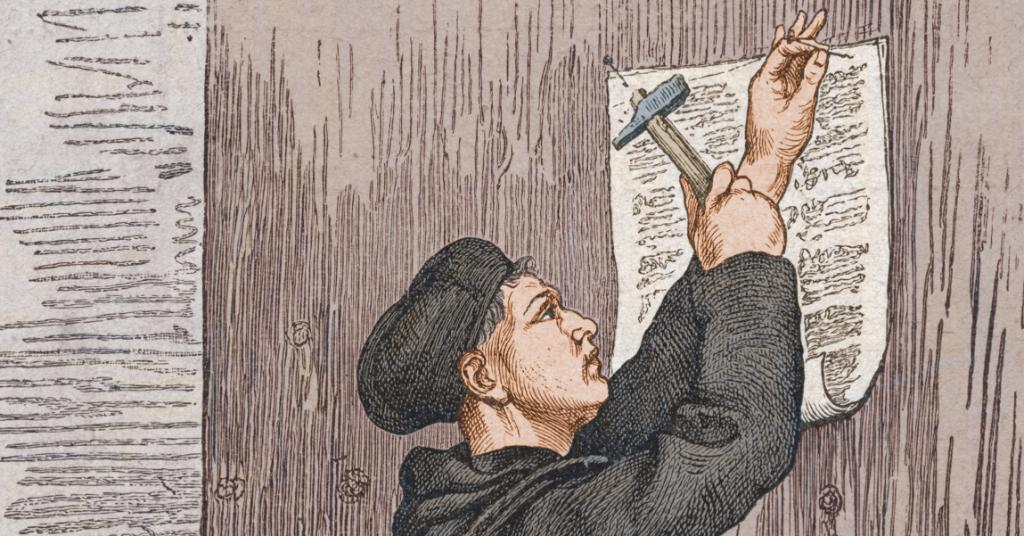
Indulgences!? Not In Our Name!!

Well, it was reformed into the guise of Protestantism. The Catholic Church is obviously still around, and obviously the Vatican is still representative of the identity of Catholics everywhere. However, the power of the Pope is much more symbolic than it used to be. Granted I speak as someone who is not Catholic, but whenever the Pope decrees something, it gives off the vibes of a Hollywood celebrity giving their opinion about politics: it’s going to be get attention, but it won’t actually mean anything tangible. The power of the Pope over the identity of Catholics has waned; the reformation was happening inside the house all along!

The decline in papal power over identity mirrors the decline in power of the Western monarchies. The secular state has similar power over identity: the British Monarch would speak and act on behalf of all Britons. Yet still, the Monarchs of today hold no more power than all the other glitterati we fawn over. Democracy has replaced monarchism, for the better.

Imagine a utopia where we don’t have to care about this…

The modern Western states still have governments that claim to act and speak on behalf of their people. The difference is that if the people disagree with that representation, the people are able (in theory) to remove them when the representation is no longer accurate. The people of that shared identity have greater control over how that identity manifests itself on the world stage.

This is ultimately why Israel maintains its antisemitism despite being a democracy (ignoring the apartheid). Israeli governments are not elected through the votes of every single Jewish person worldwide. The Zionist claim of Jewish representation is much more akin to the Catholic Church of the Middle Ages than the secular states of today. And I am quite comfortable with that comparison.

Any institution that claims to speak for an entire identity, but is not developed and held accountable by the voices of those who fit that identity, will always be an insult.


Immanuel Kant is a famous philosopher dude who said famously that ‘ought implies can.’ What this means is that in order for something to be a moral imperative, one must be able to perform that action in the first place. For example, a person in Canada is not responsible for the actions of a foreign government, whereas we are responsible for our own government due to the ability we possess to elect, petition, and remove that government. Another example could be that if a person is being crushed by a large boulder, we are not morally responsible if we can’t lift that boulder, and it crushes them to death. To misquote Uncle Ben, “Little power prevents relevant responsibility.”

This can also be measured in degrees. If, for example, a train ticket costs $1, and one person has $10 000 to their name and another has $2, both in theory are able to afford that train ticket. However, if they both hop the turnstile, we would condemn more harshly the individual with $10 000. This person is significantly more able to follow the moral imperative, and therefore they become more responsible to adhere to it. I guess Uncle Ben would have been more appropriate here, but I’ve already used that reference, and I like it better as a misquotation.

God, being infinitely powerful, would have infinite ability to act in every circumstance. The largest inequity imaginable in our temporal framework would still be less than a trifle. This means that every instance of immoral behaviour that does occur is the result of infinite neglect. The moral repugnance of His allowing evil to flourish becomes universal in scale. Now if you’re thinking, “What is evil?” like some kind of nerdy philosopher, remember that both God and Kant are duty-oriented ethicists.

“He works in mysterious ways” is the desperate attempt by apologists to skirt around the magnitude of God’s moral failing. We prefer naive confusion over the stark reality, avoiding with every effort the cognitive dissonance that’s sheer weight would crush any inkling of a just or benevolent deity. Infinite neglect. Not the scale of $10 000 over $2; beyond the pecuniary, beyond every measurement, on an infinite level.

If ought implies can, then the being with infinite ability is infinitely responsible. Or in this case, infinitely irresponsible.

Despite the Dawkinsian rise of the New Atheists, true religious rejection in contemporary society is actually fairly low. Not literally believing that two of every animal could fit on a wooden ship, or that a man could survive inside of a whale is not new, and theologians have been discussing the purpose of religious allegory since religion has been around. It is a discussion that takes place within religion, not outside of it. Beyond this theological non-argument “against” God, there are asinine claims like religion could never contribute anything like the iPhone, as if that is the purpose of religion, or even something worth striving for at all. These are not rejections of religion; these are a waste of time.

I want to talk about true rejection. Friedrich Nietzsche deconstructed the entire Christian faith and found it abhorrent. Nietzsche wasn’t rejecting God qua God, he was rejecting an entire social order that a belief in God entailed. “God is dead” was the death of Christian morals, beliefs, social norms, and institutions, and that void where God-as-institution used to be is what Nietzsche set out to fill. Nietzsche sought to take the power that resided in God and install it into man (yes, man, Nietzsche is quite famous for his misogyny). Not just any man, as Nietzsche believed that the pussification of Europe had created the 19th century equivalent of the cuck (soyboy? I think I’m falling behind in my alt-right slang…), but a future man who would rise above the beta herd: the Übermensch.

5d6

The Alphamensch

A slightly earlier contemporary of Nietzsche, who rejected religion with just as much enthusiasm, was Mikhail Bakunin. However, rather than a Promethean heist of power from God, Bakunin saw the religious subservience to God mirrored in subservience to the state, and, recognizing the oppression in both, rejected the notion of power entirely. Not necessarily authority, as he says that when it comes to matters of the railway, for instance, he defers to the engineer, but he would never allow the engineer power over himself. Bakunin saw the same problems as Luther, but rather than try to rectify the problem with more God, he wanted to pull it out by the root.

If someone follows the rules without question because they perceive some degree of moral infallibility in their authors, whether they are the secular laws of the state, traditional social mores, or the divine scriptures of revelation, then they possess religious fervor essentially indistinguishable from any other fundamentalists. Atheism means questioning the face of religion regardless of the mask it wears. Given how religion was founded in power (power over morals, the family model, social hierarchy, sexuality, and so on), if we reject religion, that power has to go somewhere, and allowing it to disperse throughout other institutions is just infusing religion into other aspects of our lives; rejecting it becomes absurd hypocrisy.

stock-photo-model

I’m against gay marriage. Not for religious reasons, I just think the institution of marriage is sacred. I am basing this on literally nothing.

Nietzsche’s vision is Hobbesian in nature. He believed enemies were more important than friends, and a friend that wouldn’t stab you in the back wasn’t worth having at all. The continuous warfare between “friends” was supposed to keep the Übermensch in top form, I guess until he slips up and takes a blade between the vertebrae. The lives of others are supposed to only be seen as instrumental to the Übermensch’s goals, since the only thing worth having is power, and we should all live, constantly striving for more. Like with Hobbes, it seems the only way there could be any form of social cohesion is if the most Über of all the mensches can seize power, might making right, and use his totalitarian control to ruthlessly enforce his will until one of his “friends” overthrows him in a vicious coup. This libertarian wet dream (minus the social cohesion) is one possible direction we could follow if we decide to take God’s power and make it our living goal.

Luckily there are alternatives. What would abolishing power look like? Bakunin’s vision had societies organizing their institutions democratically. Industry would be managed by its employees. There would be no state government because Bakunin believed that we could collectively run our own affairs without overarching regulations so long as everyone had an equal say. Bakunin’s methods for achieving this utopia may be even more violent than anything Nietzsche might conceive, but the vision itself for a world without God is certainly much more palatable.

utopia-denied

Communism ≠ Anarchism, but this image is just amazing.

Regardless of your approach, be it Nietzschean or Anarchistic, rejecting God requires recognizing the multifaceted power that historically has belonged to God. Institutions that rely on power require justification for that power; without God, scrutiny becomes a social necessity, lest we fall into hypocritical dogmatism.