Identity politics has come a long way in shaping cultural discourse. Issues have become less relevant, and we now strongly desire only to talk about ourselves. The issues are still there, of course, ravaging as ever, but they have become only tangentially relevant to how we seem to want to world to perceive us: as victims. There are the traditional groups, long sufferers of injustice, who apparently no longer want to alleviate their suffering but would rather whinge about it ineffectually. Intersectionality, a brilliant method of distinguishing compounding injustice, when combined with identity politics seems to build up a personhood solely of deficits. A black trans-woman has more victim points than a black cis-woman, as it were. Prestige rises the more oppressed you are, but this prestige is built on a foundation of negatives. Thus progressive movements become more about the accumulation of oppression rather than addressing the roots of that oppression.
Consider the Black Lives Matter movement. It began after the death of Trayvon Martin, and its mission is to eliminate the disproportional violence that black people face at the hands of a racist system. And it’s true: despite being 13% of the American population, black people make up 25% of fatal police shootings. Now let’s look at another statistic: despite being just under 50% of the American population, men make up about 95% of fatal police shootings. No one claims that the system is misandrist, but the statistics paint a picture that is at least similar in its violent discrimination.
So why isn’t it #BlackMaleLivesMatter, beyond being way too long for a hashtag? The reasoning behind #AllLivesMatter being racist is that it doesn’t acknowledge the fact that Black Lives are the ones that are in danger. The comparison used is that of a burning building. All houses are worth saving, but the attention ought to be paid to the house that is on fire. Like in this comic strip:
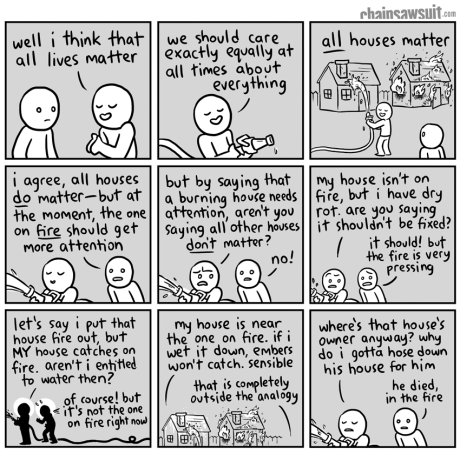
Smug cartoons are so awful, especially strawman ones.
So by this same argument, should black male lives not be at the forefront of this discussion? Apparently not, because if you visit the BLM website, they are quite adamant, with no apparent regard for the irony, that all black lives matter. In fact, the Black Lives Matter movement actively tries to distance itself from black men. Their movement is described as going “beyond the narrow nationalism that … [keeps] straight cis Black men in the front of the movement while our sisters, queer and trans and disabled folk take up roles in the background or not at all.” This is a movement that peddles in outrage each time a black male is killed, but refuses to acknowledge which house is actually burning. Men aren’t traditional victims, so that acknowledgement could only distance them from their goal.
Now, the perfect counter argument to #BlackMaleLivesMatter is what about black women? They suffer greater economic disparity than both black men and white women, and also endure a greater degree of violence than their white female counterparts. Those presumably are fires that need to be addressed as well. And yet, there are more black women succeeding in post-secondary education than any other American demographic. Additionally, low-income rural white women are worse off in both physical and mental health, as well as financially, than low-income rural black women. Focusing solely on any one demographic and assuming that they are the worst off ignores the complexity and true intersectionality that hinders and benefits each group in varying ways. Hell, even in regard to police shootings, Native Americans face the largest disproportion in violence, and the mentally ill are 16x more likely to be shot in a police encounter than any other group. Our hashtag to address the house fire of police shootings really ought to be #MentallyIllNativeMaleLivesMatter, with probably some extra thrown in there too that I haven’t come across or considered. However, this group is far too specific for any kind of broad appeal, and only addresses police shootings. BLM obviously wants to address other issues too, so it ignores its own metaphor (the entire basis for its reproach of #AllLives) in order to do so. Figuring out where the fire truly lies is incredibly difficult and alienating to groups who it doesn’t affect, so they prefer to adhere to victim-mentality in the hopes that nobody notices.
The Cult of Victimhood does not only apply to Black Lives Matter and their insistence on mislabeling their struggle strictly for the sake of appearances. Consider the moniker People of Colour (POC) as a differentiation from white people. This title is meant to demarcate the struggle non-white people have in White America. An example is this video, and I’m going to specifically look at the section where a white woman feels uncomfortable because her Asian coworker is making less money than her for the same job. This is making the false assumption that all non-white people suffer equally under white oppression. This example is perfect, because Asian women actually make more money than white women overall. In fact, according to the Bureau of Labor Statistics, Asian women aged 16 to 24 have earned a weekly median income higher than white men in the same age range consistently in every quarter for the past ten years. Asian women in other brackets typically do a little worse than white men, but when your racial demarcation is supposed to make you worse off based solely on that racial factor, that seems quite significant. As stated, Asian women fare better than white women in all age brackets as do Asian men over white men.
Asian people are disproportionately less likely to be a victim of crime. They have better overall health than other races, as well as a longer life expectancy. If we go back to our police shooting statistics, Asians represent 2% of all fatal police shootings while they make up about 5% of the population. Even in regard to a lack of movie roles, Asians make up about 5% of characters represented on screen. Now, the quality of those roles and the portrayal of Asian characters is certainly something that needs to be addressed, and an argument can even be made that disproportionately higher visibility is beneficial to society overall, but when the loudest voices on Asian oppression are shouting about a lack of film roles despite the representation being proportional, especially against the backdrop of other racial minorities being gunned down in the streets, it seems more like an attempt to jump on the victim bandwagon since in most major categories of regular oppression, Asians are faring better than even whites.
Now hopefully you’ve been paying attention and are realizing that generalizing is stupid when it comes to measuring how privileged or victimized a group of people might be. For example, the wealth gap between the wealthy Asians and the poor Asians is larger than wealthy whites and poor whites, and Asians are less likely to be homeowners. Additionally, even speaking of “Asians” as a homogeneous group ignores that Chinese-Americans are doing significantly better than say, Vietnamese-Americans or Cambodian-Americans. There are certainly fires to be put out within the treatment of Asians in America, but creating a broad pan-racial minority identity in order to create a clear victim/oppressor binary is still problematic and misleading.
I’ve been picking on the Left, but the Right is just as guilty. I mean, consider the groups that claim that straight, white, males are the most oppressed identity in America. There are genuine fears of white genocide, fears of media targeting white men, etc. Men’s Rights Activists even trot out their own data to prove that men have it worse off than women, campaigning to be perceived as the world’s greatest victims. Even if there is obvious evidence to the contrary, the Right still adopts the same language of the oppressed for the same reasons as the Left. Everyone wants to be a victim.
What you should be asking yourself is, why the fuck do people want to be victims?
Firstly, it is an appeal to the emotions beyond anything else. Remember when Newt Gringrich said that he would rather appeal to how his constituents felt over what the statistics said? You should, because this is what he was referring to. If you can get people to be emotionally riled up, you have a better chance for a political victory. Psychologist Paul Bloom argues that being able to point to a victim will induce empathy, but since quite often both sides have access to their own victims who can be paraded in front of cameras, neither side will give up ground because neither side is looking for a reasonable solution. An example he gives is Black Lives Matter pointing to shooting victims compared to Blue Lives Matter pointing to hardworking cops struggling through a dangerous job with little thanks or appreciation. The tactic to win becomes who can pander to the greatest number of people’s emotions, rather than who has the greatest hold on the truth.
Another reason might be pure laziness. We live in a newly sedentary world driven by social media, so people do not feel obligated to do more than just post about how much of a victim they are in the hopes that the squeaky wheel will somehow get the grease. If you imagine a car accident, the victim is the one who is entitled to the settlement. There isn’t any effort required, since the system owes victims compensation simply for being victims. It gives a moral high ground that allows preachiness since the world owes redress. Doing something about oppression requires more than a tweet, but victim mentality believes that merely pointing out the intensity of victimhood will miraculously be enough to change it.
I have my own theory in regard to this mentality. Ernest Becker is famous for analyzing how human beings relate to their own mortality. He posits that in order to compensate for the permanency of death and the terrifying finitude of our lives in the face of it, we seek grandeur in order to deal with this mountain of subconscious anxiety. We can either ascribe this grandeur to cultural trends and possibly follow a leader to use their heroic stature to grant us some degree of immortality, we can ascribe it to ourselves to be our own lonely hero, or we can use the grandeur of religious infinity to give us solace in the face of death. I believe that victim mentality plays a part in Becker’s theory. Consider the cultural heroes of today: they are the scrappy underdog facing off against giant, impossible entities; the rebels against the empire. We seek to be victims because it grants our story a greater flare. It might not even be so much victim mentality as an underdog mentality, since any victory under these conditions becomes that much more memorable and worthwhile. But as a friend of mine pointed out when I spoke to him about this, when you’re the underdog you’re always half expecting to lose.
Victim mentality fails because you can always point to a group that is worse off. Even #BlackDyslexicLesbianLivesMatter doesn’t work because you could just consider that same demographic in India or Saudi Arabia. Since privilege means not being able to have a voice, victim mentality inherently negates any kind of progress being made.

Men aren’t allowed to speak or think about gender. They must submit to the voices of REAL victims and parrot those opinions if this whole “feminist” thing is going to work.
So really, our Black Lesbian Dyslexics ought not to speak about issues they may believe are important, they must take the space they have in North America to speak first and foremost about the plight of those who are worse off than them. The pyramid of intersectional victimhood has no bottom. In a less extreme example, Emma Watson’s speech at the UN on her #HeForShe campaign was criticized for conforming to the gender binary since wanting men to take part in feminist conversations ignores the fraction of the population who do not believe that “men” exist as such. Including them is far more important than including men, after all.
What’s the solution? Well, abandoning identity politics is a good start. The next step would be to identify the causes of whichever fires you’re trying to put out. I’ll use fatal police shootings as my example to keep up the trend. What causes police shootings? Victim mentality says that it’s because black people are oppressed and cops are racist; a distinct victim/oppressor binary that has been entirely unhelpful. Racism probably does play a part, but what about the increased contact that police have with minority communities? Police frequently use mathematical algorithms to determine where to send officers, and they use data based on specific crimes in order to do so. What do they put in their algorithm? It turns out that the crimes that they search for are disproportionately linked to poorer neighbourhoods, and so more police are sent to these neighbourhoods. With more police, more crime is discovered, and so there is a cycle of increasing crime in poorer (notably racialized) ghettos because an algorithm was programmed to send them there. If the algorithm was programmed to search for white collar crimes, which neighbourhoods would have more police officers? Given that white people consume more illegal drugs than blacks, it is likely that an increased police presence would discover a similar increase in crime. Or take the racial disparity in drug crime based on the type of drug: the cheaper crack cocaine that is more prevalent in black communities receives significantly lengthier jail sentences than its powdered counterpart which is more popular among whites. It’s also likely that poverty is simply creating more criminals, making black men more likely to follow that path due to their battered economic condition.
When I worked in a group home, the company policy was that when a child made an allegation against an employee, the company would generally trust the employee over the youth. Employees have all had criminal record checks, various education requirements completed, and a bunch of other hoops that they had to jump through in order to get this position. Youth under the care of the State frequently need to be manipulative to survive, and are often anti-authoritarian to an extreme degree. Given this reality, it makes sense to demand a higher burden of proof on accusers who could simply be trying to get the employee fired because of some perceived slight. Is it the perfect system? No. Does abuse happen? Yes. But my point is, before we start a crusade against the police, blindly calling for their defunding, we have to figure out exactly what is going on, and what the best steps are for addressing that.
What are the goals of the Black Lives Matter movement? Are they to bring police violence down to a proportional level, eliminate violence against only black people, or eliminate unchecked police violence entirely, regardless of who the victim might be? Would the shooting of unarmed black men be okay if it matched the same proportion of unarmed white men?
SMART (specific, measurable, attainable, realistic, and timely) goals are important. Consider the outcome of the protest against Donald Trump’s Muslim Ban compared to the outcome of the Woman’s March. One was demanding something specific, the other wasn’t demanding anything at all. The ban was overturned, and the nothing that the Woman’s March set out to achieve was obtained as well. What if the huge force of Black Lives Matter demanded comprehensive drug law reform? And when they got that, they demanded an increase in integrated social housing? Then a diversification of social programs to reduce poverty? There are plenty of great options out there to reduce police violence, and demanding only to “Matter” isn’t going to achieve any of them.
Setting realistic goals prevents most obnoxious refutations too. If someone says women are victims and men are oppressors, and someone else comes along and says, well then how come women are earning more degrees than men, then the argument has floundered. If someone says 85% of victims of domestic violence are women, here’s why I think this is, and here’s what I think we should do about it, the best someone can do is offer a counterargument to the cause or solution. The issue is set in statistical stone.
There is also Empowerment Theory, which suggests that rather than focus on what’s wrong with a community, we focus on their strengths and their abilities to form their own exodus from oppression. Identities built on deficiencies cannot do for themselves, and must, as the squeaky wheel, simply wait for another, more capable person to apply the grease. This mentality can become internalized, which means that progressive movements that are built on victimizing their population are doing so at the risk of making impotent the same people they are trying to help; the underdog half expecting to lose. Instead, Empowerment focuses on the skills, resources, networks, and stories of communities as the methods with which they better themselves. What would feminism be like if the #YesAllWomen campaign implied that all women were capable of making changes in their own lives rather than implying that all women are helpless victims? There are pockets that exist, such as Good Black News which is devoted to telling only strengths-based stories of black people and Pride campaigns that are telling LGBT children that not only is it okay to be gay, but it is absolutely amazing. However, there needs to be more.
Victim mentality in progressive movements does not ask for anything outside of acknowledgement. A successful white person is one who retweets a BLM hashtag. A successful man is one who identifies as a feminist. No commitment is required beyond this because that is all the cult of victimhood is demanding. There is also a suspicious lack of class consciousness, given that the privileged group is always straight, white men with no mention of wealth at all, and this is likely due to what Zizek would call the unexamined ideology of capitalism infused within western liberalism, but that’s a blog for another day. To sum up, real issues must be identified, real causes must be determined, and real solutions must be applied. Anything else is just a self-righteous waste of time.
Post-script: All of this data is American, but shockwaves of its effects are felt in Canada, given our own Black Lives Matter movement. If you were wondering, in comparison to America’s black 13% of the population representing 40% of its prison population, in Canada, First Nations people make up 4% of the population and 12% of the prison population, Métis represent 1.4% of the population and 5% of the prison population, and blacks, at 2.5% of the population, make up 6% of the prison population. There are also more Aboriginal children in government “care” today than there was during the height of the Residential School era, which would be like if slavery in the United States was still on-going. If the burning house metaphor is applied, then the Canadian fires are burning down the houses of Aboriginals. If we’re choosing not to stand in solidarity, but prefer to fight each other all the way to the bottom to see who gets the honour of being the biggest victim, then BLM Canada really ought to concede defeat.
 Blog for Chumps