Archives for category: Social Criticism

Being an ally is so important to the progressive cause that I literally own two copies of the book Becoming An Ally by Anne Bishop, purchased for my social work courses. I had to move out of town, and I left my first copy at my parents’ place in ignorance of it being required reading for another course. Whoopsies! I know my prof would be absolutely thrilled that I have two copies that I can refer to whether I am at home or visiting my folks, but here I am writing a blog saying not to be an ally, so I guess it evens out. Sorry! I promise I have reasons!

Being an ally is being a member of the dominant group that is supportive of the oppressed groups. A huge part of that requires listening to and then trusting their feelings. However, what about the Christian who claims that “Happy Holidays” is oppressive? It’s not, but why not? The argument that the sheer number of Christians in North America makes oppression impossible is a false one; there are more women than men, but few people would argue that that delegitimizes their claims of discrimination. The reason “Happy Holidays” is not oppressive is because #AllHolidaysMatter is inclusive whereas #ChristianHolidaysMatter is not. It’s like greeting everyone, “Hey, Steve!” It’s really only relevant to people named Steve, and alienates those who are not. Saying the intent lies solely in the greeting ignores the fact that you’re still calling that person Steve. I’ve heard the argument that it is the expression of one’s own holiday, and that somehow makes it better, but that would be like me saying, “Hey, Dan!” to everyone. The problem is still there.

What if a man brings up that 92% of workplace fatalities are men? And then defends the wage gap by suggesting that men earn more money to accommodate their riskier employment? Seems reasonable that someone who risks death as a firefighter or a coal miner should receive appropriate compensation compared to a teacher or librarian who faces comparatively little risk of danger. However, this assertion ignores the disproportionately fewer women in the higher paid management positions and the fact that women make up 62% of minimum wage earners, which are equal if not greater contributors to the wage gap than dangerous employment. I don’t want to get into the social value of employment, but that also comes into play. The feelings of oppression, even when backed up with some degree of evidence, must always be scrutinized with all the available data. To assume that the traditionally oppressed groups are simply more trustworthy than men or Christians would be incoherent. Everyone should be listened to, of course, but for those who claim that feelings hold greater weight than facts, I refer you to this interview with Newt Gingrich.

Being an ally also requires that the ally identifies as, and comes to grips with, intrinsically being an oppressor. This is problematic. The first problem is that this makes change impossible. If white people are oppressors no matter what they do, then no matter what actions they take, they will never not be oppressors, no matter how many generations unfold. It’s entirely defeatist. How is the loop broken if no one can get off? I’m reminded of a meme I saw that said, “Brock Turner isn’t a swimmer who committed a rape, he is a rapist that can swim well.” Brock Turner is a human being who is a rapist and who can also swim well. The instant we define anybody as other than human, we’ve locked them into that role for life. If we apply that to a group of people, we only encourage reverse-discrimination without addressing any of the real problems. An individual may have privilege, but they are not their privilege nor are they the system which enables them to possess that privilege. To make such an assumption is to equally claim that someone who suffers oppression is nothing outside of their oppression.

A white person merrily greeting a non-white person in the street is not oppressive. A white person passing over a non-white person for an employment opportunity is. Making oppression about the group of people rather than the acts themselves is misleading, and distracts from the reality that racism is a systemic problem that anyone can either reinforce or resist at any given moment. Bill Cosby infamously gave a speech that was widely panned as being anti-black. It is not a question of identity or markers, but of acquiescence. It might be easier to acquiesce when one benefits from the privileges of oppression, certainly, but demarcating entire groups of people as villains does not help the cause. Even Martin Luther King said that there must not be a distrust of all white people; it only serves to alienate that group.

There is also the issue of allies keeping silent, unless specifically requested to speak. The theory is that the voices of the dominant group hijack the discourse when it comes to the experiences of the oppressed. One can never speak to the experiences of another, certainly, but I’ve already written an entire blog post about why the voices of the dominant are crucial to progress, so I won’t repeat it here. The gist is that if the dominant group is the one that needs to change, then more voices from the dominant group need to be heard because they are the ones most relatable to others from the dominant group.

Further problems with being an ally arise when one realizes that oppressed groups don’t unanimously agree on issues relating to their group. Bishop acknowledges this which makes the concept of an ally better in theory, but nonsensical in practice. This article raises the issue with prostitution, with the interviewee (a former sex worker) claiming that the voices of sex workers should not necessarily be listened to due to the necessity of outside critical thinking and the collection of relevant data, reasons I’ve already established in this blog. If one asserts themselves as an ally of prostitutes, and is either for or against the practice, they will find plenty of sex workers who support each choice. It no longer becomes a question of being an ally, but of projecting one’s own view into the realm of oppression. Bishop claims that, to be a successful ally, one cannot fall into the trap of thinking they know what’s best for an oppressed group. When discussing such a polarizing topic as prostitution, however, one will invariably choose an outlook that knows best for one group or the other. Either for or against it, one is patronizing those of the dissenting opinion by claiming to be an ally to *all* prostitutes. If one is only an ally to certain prostitutes, that might actually be worse. Better to drop the term altogether and focus on achieving a just outcome.

Think of the Latinos in America. It seems pretty straight forward to claim to be their ally against Donald Trump, the man who declared that illegal immigrants from Mexico are all rapists and murders, and yet there are Latinos who support him. To claim ally-ship to this group in this context would be disingenuous because it homogenizes a vastly multifaceted ethnicity into a singular extension of the preconceived perspective of that so-called ally. One can certainly claim that No One Is Illegal, and I would back them up to the best of my intellectual capabilities, but when projecting a viewpoint onto a people it can only ever be naive self-righteousness that makes that claim. If you want to change the world for the better, and I sincerely hope you do, pick issues, not identities.

The most important part of being an ally is likely to reside in personal relationships, but even there I believe it falls flat. If someone trusts you enough to unburden themselves of an oppression they are facing, listen and respect what they’re saying as a friend. To approach a situation like this as an ally would reduce them to their marker, and the interaction is devolved into a member of the dominant group conversing with a minority, rather than two human beings seeking kinship and refuge in one another.

Bishop does raise good points in her book, and I’m certainly not disparaging her overall message. However, being an “ally” seems more involved with properly identifying oneself as a member of the progressive movement rather than actually making progress as a movement. Don’t bother being an ally. Learn about the issues, listen to the perspectives, make your own conclusions, and affect change as best you can.

There is a Marxist belief that if something is inaccessible to the poor, then it can be neither radical nor revolutionary. Following the trend of ironic tragedy that history sardonically and incessantly throws in our face, the decrease in book reading, both in adults and teenagers, points to a culture that would struggle to read The Communist Manifesto, let alone Das Kapital. As one would expect, the impoverished and the uneducated are those who are reading the least. There are neither sparkly vampires, teenage wizards, nor BDSM-enthused misogynists to incite mass interest in Marx’s seminal works, so I suppose they too must be discarded into the dustbin of irrelevancy to revolutionary thought.

The internet has opened up social dialogue to include everyone with internet access, seemingly giving the unheard voice of the proletariat unprecedented access to speak out, yet in reality has only allowed the opinions of troglodytes to swarm rational discussion, turning it into a cesspool of vomit and bile, defiling the very notion that a reasonable outcome is possible. Unfortunately, the Pandora’s Box of the internet cannot be closed, and this is now the discourse to which one must adhere.

Donald Trump has capitalized on this phenomenon by devising his most successful populist propaganda within the 140 character limit of the Twitter universe. Hilary Clinton, not one to be outdone, shines brilliantly in her campaign slogan: I’m With Her. The “I’m” captures the essence of social media narcissism, letting everyone know what this campaign is really about; me! The “With Her” is, of course, reminiscent of the purposefully vague and noncommittal identity feminism of the Tumblr era. Both of these demagogues are pandering to their respective demographics with their own promises of revolution, yet I do not believe either of them represent what Marx had in mind.

Philosophy is notoriously relegated to the ivory tower, despite Diogenes and his abandoned cup. And while some might claim that the greatest philosophical question is why there are essents rather than nothing, the original Greek schools, including Diogenes’s Cynics, utilized philosophy as a means to discover how to live the good life. Aristotle’s Aretê or Zeno’s Stoicism both offer methods to live virtuously. Without the dogmatism associated with the religious side of this conversation, philosophy allows us to seek with constant refinement how to live; a critical necessity in this tumultuous time.

Slavoj Žižek, Slovenian philosopher and possibly rabid communist, belabours the point, saying that despite the impending global consequences, we need theory now more than ever. The instinct to act is strong but must be overcome, as postmodernism has deconstructed everything without creating substitutes to put in its place. To act now would be to seek anarchy. End racism. End sexism. End capitalism, but how? And replace it with what? Ideologies cannot be eradicated, only changed, unless our revolution is to end in genocide.

How do we conduct the dialogue of this contemporary philosophy? I mean, analogies to the Greeks these days might not reach as large an audience, but I can predict with the inevitable alienation of Cassandra that referencing the feud between Taylor Swift and Kanye West will not carry the same lasting weight. The trials of Odysseus are eternal, and thus possess a portion of truth to which humanity will forever have access, whereas Famous will be out-of-date within the year.

The intellectualism associated with philosophy and social theory by its very nature divorces itself from the reach of the bulk of the people. Do we wade into the depths of thoughtless memes and Youtube comments to wage our revolution with the masses, only to discover that we too have become thoughtless in the process? Or do we stand above it, confident on our pillar, helping up those who have recognized the shadows on the cave wall? The disenfranchised need to be acknowledged, certainly, and their voices heard to the extent that we are aware of the depths of their circumstances, but acknowledging this does not require fetishising it. Educated progressives gnash their teeth over the large swathes of people who vote against their own interest, yet this is most often due to demagogues like those mentioned earlier who are savvy in the ways of exploiting those demographics, and know exactly how to pander to their base nature. If something is accessible to the poor, who is to say it is in their best interest?

We do not begrudge climate scientists as elitist when they claim their knowledge gives them more insight on the subject. We cynically laugh at those who do, as they are the obstacle to the required change climate science demands. Granted, philosophy and sociology are softer sciences, yet there can still be an accumulation of wisdom gained from the relevant reading and research.

Those who come up with a new economic system should know the theories of Marx, Smith, Keynes, and Friedman among others if only to know what works and what doesn’t. They should be aware of the history and context surrounding those successes and failures. A fruitful discussion of social order would require knowledge of Republic, On Liberty, Leviathan, and more: books that have shaped Western society as proper change requires an understanding of what has come before. The discussion should not burdened by a responsibility to be accessible to everyone, as not everyone has the time, inclination, or resources to pursue the knowledge necessary for that discussion. To demand that from the poor is indeed insulting to the circumstances of their existence.

I will not abide a system of thought that decries Marx as neither being radical nor revolutionary, even his own Marxism. Contrary to my condemnation of capitalism and my communist allegories throughout this blog, I do not embrace communism. Like I said, the importance of historical context is shown when we see that centralized power is no different from any other fascist government. I do recognize, however, that a knowledge of Marxist thought will be necessary for whatever economic and social utopia the future may produce. Philosophy is necessary for the future of our species; let’s not hobble it with undue limitations to its content.

I’ve been having a hard time with the recent Dallas shooting of 12 police officers, almost entirely because the progressive people who I have on my Facebook friends list, who make a point of acknowledging that the terrorists attacks in Turkey or Sudan are just as worthy of sympathy as the ones in France or Belgium, are noticeably silent about it. My guess is because they interpret Martin Luther King’s quote, “Injustice anywhere is a threat to justice everywhere” as applicable only to the dominant group. Of course, there are far more victims of police shootings than officers being shot, but when violence is carried out in the name of a progressive movement, and to be clear that is exactly what happened, then a good, hard look is required.

Our first look needs to be this. This is a photo of a Dallas police officer who made it home:

13590497_10153759734922473_2012298315114065061_n

This image is equally necessary to all the images of the black victims of police shootings to create the full context of that discussion.

There are five families who didn’t get to have this moment. Injustice anywhere is a threat to justice everywhere.

Yet I am conflicted. One of the things I did soon after the shooting was reread a previous blog I had written about violence as a response to oppression. I was not unambiguously against it, and was clear in reminding people that violence is often a reflection of the extent of oppression being committed against that populace. Black people face disproportionate violence from police officers, that is incontestable. Is the extent of that oppression creating this violent response? Are we just living in a time of revolution, and learning the humbling tragedy that revolution inflicts on everybody?

Malcolm X is famous for fighting for the rights of black people “by any means necessary.” He believed that without a violent response, “whites would not have to worry about a revengeful response to their brutality.” His unflinching rhetoric made no distinction between enemies and allies in the white race, and he made claims like all whites are responsible for “urban black ghetto[s] where drugs, poverty, crime, unemployment, and bad housing are its defining characteristics.”

Malcolm’s success was in the creation of a proud black identity. He advocated that “black people wherever possible, however possible, patronize their own kind … and start to build up the black race’s ability to do for itself.” He believed that black people had the ability to be exceptional, and he fought for those beliefs. One article that I desperately searched for but could not find suggested that without Martin Luther King, black people would not have the vote, but without Malcolm X, black people would not have their identity.

Now, Malcolm had interesting goals. He believed in creating a nation within the United States where black people could live autonomously outside of the rest of white America. He actually conferred with white supremacists, who were quite happy to kick black folk out of their towns, toward the achievement of this goal. To Malcolm, “segregation is that which is forced upon inferiors by superiors. But separation is that which is done voluntarily by two equals – for the good of both.” Now one could simply look at India and Pakistan to see how effective that would be in practice, but those were his views.

Most importantly, Malcolm’s actions and rhetoric reflected his plans. He could promote violence against white people because they did not have a place in his society. He could make blanket statements about white people because they were irrelevant to his goals. Malcolm has often been criticized for his open hatred of white people, but when his goals are considered, his hatred is reasonable toward their achievement.

What about the Black Lives Matter movement? They practice non-violence, so they must be more akin to Martin than Malcolm, right? I mean sure, there are fringe groups chanting for dead cops, but the vast majority choose non-violent methods. Martin said, “We can’t solve this problem through retaliatory violence… We must meet violence with nonviolence… Love your enemies; bless them that curse you; pray for them that despitefully use you. We must love our white brothers… no matter what they do to us.” Surely a movement that hearkens to Martin’s methodology would mirror his rhetoric, but that does not seem to be the case.

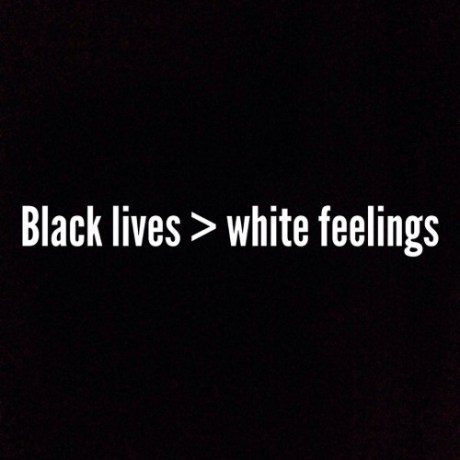
Advocates against racism today frequently use generalized language, directing their messages toward ‘white people’. Examples here, here, here, here, here… I’m not arguing that the information that’s being given is incorrect, but the way that it’s being presented paints the clear villains as ‘white people’. A feature length film was even created called Dear White People that examines this phenomenon. The systemic racism in North America is still being attributed to ‘white people’, and that sounds a lot more like Malcolm than Martin. Memes such as this:

BlackLivesvsWhiteFeelingscr

literally put black people and white people on opposing sides, as if there is a necessary conflict between the two. This article calls the Dallas shooting unsurprising considering the state of American affairs on racial inequality. The author uses a cake metaphor to illustrate this lack of surprise, whereas Malcolm simply said about the national tragedy of his day, “The chickens were coming home to roost.” Even the fight for the exclusion of police officers from the Toronto Pride festival is reminiscent of Malcolm’s aim of separation.

So what did Martin say? Well, he said in his I Have A Dream speech that, “The marvelous new militancy which has engulfed the Negro community must not lead us to a distrust of all white people, for many of our white brothers, as evidenced by their presence here today, have come to realize that their destiny is tied up with our destiny. And they have come to realize that their freedom is inextricably bound to our freedom.” His dream was “that one day on the red hills of Georgia, the sons of former slaves and the sons of former slave owners will be able to sit down together at the table of brotherhood.” He dreamed that one day the “little black boys and black girls will be able to join hands with little white boys and white girls as sisters and brothers.” He acknowledges all the troubles of black people, but his rhetoric is firmly entrenched in an alliance with white people. Memes like this:

13615240_1099525933470665_2594435964447142529_n

People in glass houses…

illustrate the ignorance people have of Martin’s beliefs because his dream, if you listen to the recording, was a lot closer to the message of #AllLivesMatter than anything else. He was very purposeful and clear about his inclusion of whites, and going by the themes of his speech, he would likely have said that “white lives are inextricably bound to black lives.” Martin believed in the supremacy of unity. He wasn’t about anger, but hope. It was this oration of hope and unity that got him the ear of two presidents to fix the systemic problems of his time, whereas Malcolm only raged in the streets.

Even Malcolm rescinded a lot of his rhetoric after his pilgrimage to Mecca, and afterward he said, “I’m a human being first and foremost, and as such, I’m for whoever and whatever benefits humanity as a whole.” He also cites regret at having dismissed a potential white ally on the steps of a college in his fight for the black race:

Well, I’ve lived to regret that incident. In many parts of the African continent I saw white students helping Black people. Something like this kills a lot of argument. I did many things as a [Black] Muslim that I’m sorry for now. I was a zombie then — like all [Black] Muslims — I was hypnotized, pointed in a certain direction and told to march. Well, I guess a man’s entitled to make a fool of himself if he’s ready to pay the cost. It cost me twelve years.

When the grandfather of anger-based identity politics likens that approach to being a mindless zombie, that is a harsh indictment.

Yet I do not believe that Martin could have succeeded without Malcolm. In my blog I refer to a yin yang approach, and Malcolm even addressed this when he said, “If white people realize what the alternative is, perhaps they will be more willing to hear Dr. King.” It’s the good cop/bad cop routine, but with racial politics.

Today though, the only rhetoric allowed is that of Malcolm. Identity politics rules. People are angry, and rightfully so, of course, but we’re missing our Martin. The methodology is meaningless if it does not match the rhetoric or the goals. Are people screaming to love the police, no matter what atrocities they commit? No, they’re banning them from progressive events. The most prominent criticism of the Black Lives Matter movement is the #AllLivesMatter campaign, which is typically dismissed as white ignorance, when really it’s a question about the role the rest of society has within the movement. A Martin today would address that question rather than pass it over with disdain as Malcolm would.

I really don’t know if this is the result of a lack of clear progressive leadership, or the degradation of political movements over time, but Black Lives Matter really needs to analyse its goals to see if they truly match its rhetoric and actions. Is the goal separation or unity? Hatred or love? Identity politics or actual politics? Violence against police officers and racial divisions can only increase given the current discourse because, as it stands right now, the dream is dead.

Post-script: all quotations, unless otherwise cited, have come from here.