Archives for category: Social Criticism

Virtue ethics are one of the oldest established ethical systems in the West. They gave the ancient Greeks traits to try to embody and paragons to try to emulate. Aristotle came up with a list of virtues with the intention of giving people a guide on how to live life successfully. Not a step-by-step instruction, but more of an encouragement toward a better way of living. It is this striving that creates the good life, the eudaimonia, where we live in flourishing happiness. We are at our best in our active virtue in the way that a horse is at its best while running, for just as the purpose of the horse is its speed, so too the purpose of a human is to live virtuously. Virtue is what we aim for, what we strive for, and in that striving, we are living well.

Being virtuous, according to Aristotle, is found within the golden mean. The best life is lived in moderation – neither to be rash nor cowardly, we should live firmly and courageously. Neither miserly nor prodigally, we should live charitably and generously. Aristotle produced a list of virtues within this golden mean as the foundational structure upon which our eudaemonic life can be built. The happy, flourishing life is one of acting honestly, patiently, modestly, and friendly.

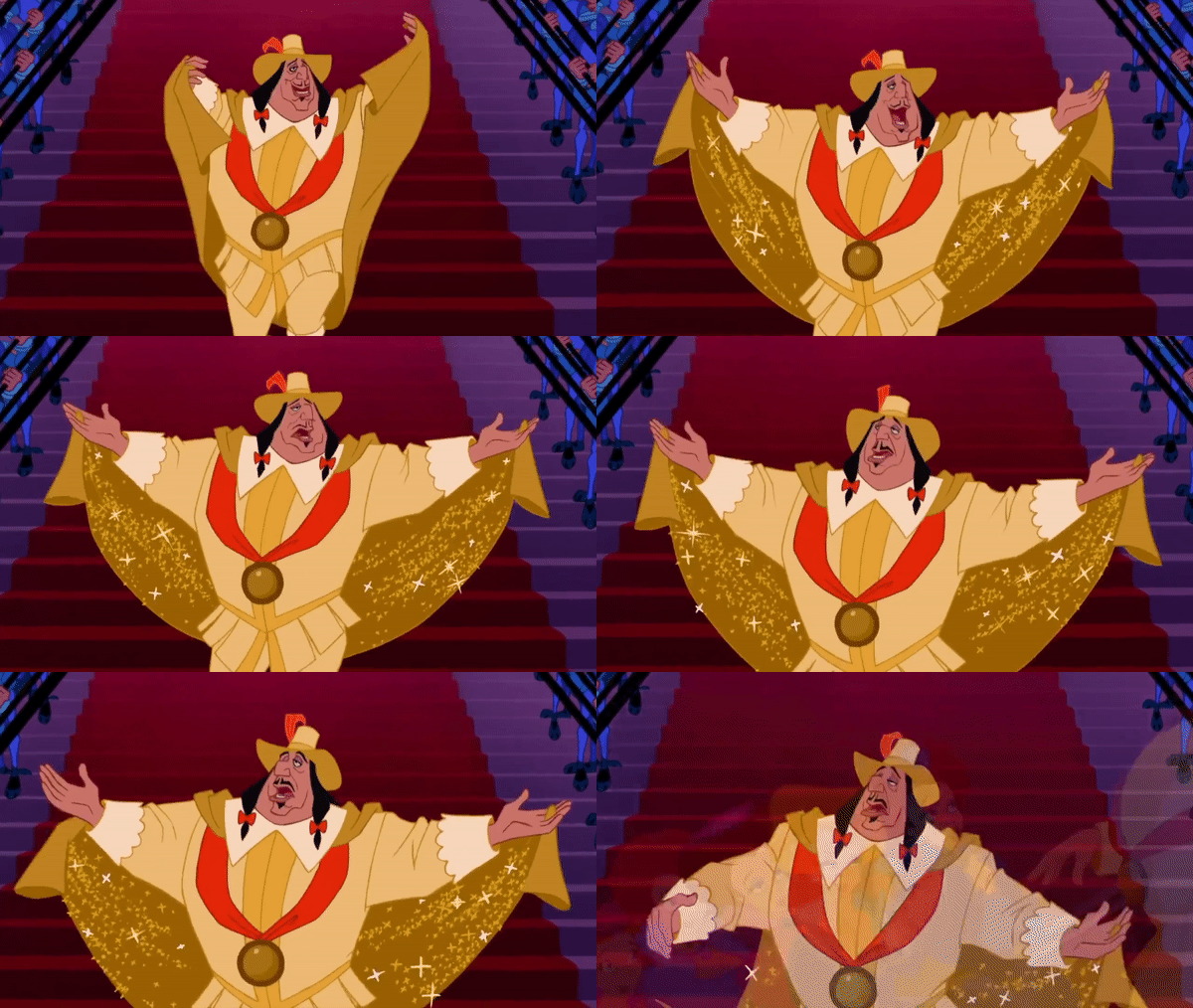
Good to know that righteous indignation is a virtue, or I would be screwed

To become virtuous, one must obviously learn how. Virtue is a skill. One is not born patient, as anyone exposed to a child will discover. Virtues are imbued into the individual by the sage, the one who has achieved their good life. It is up to society to produce its sages so that virtue can be passed on from one generation to the next. The purpose of life is to lead a good one, and so ideally we would want a culture that aims to socialize its young toward virtue.

The problem with virtue ethics is that we always do by default. Children will be socialized and taught how to be virtuous according to the culture that surrounds them; it’s just that those virtues will differ from culture to culture. Christian culture encourages the virtues of forgiveness and mercy whereas a Buddhist culture would focus on the serenity required to relinquish attachments. Who we see as our sage determines the virtues toward which we aspire, whether the Buddha or the Christ.

Jesus was known for shunning the marginalized and praising the wealthy, so probably something along those lines

Despite the persistence of religion, these sages of yore are no longer as influential as they once were. You might have been able to guess this by your having previously scoffed at Christian culture being described as forgiving. This is because we have abandoned those cultures, if not in name then at least in practice. Today, our culture is one of capitalism. Our sage is the billionaire.

Perhaps you are unswayed by my assertion. However, people write books about how to become wealthy, encouraging particular behaviours that will surely lead to financial success. There are schemes, podcasts, cults, and conferences. Television has created an entire genre of entertainment where people go to absurd lengths to become wealthy, and fixates on the traits of the winners as the key to their success. Each of these methods demand a certain “type” of person if that person wants to succeed. If you stay poor, it’s because you just didn’t inhabit the virtues of the wealthy.
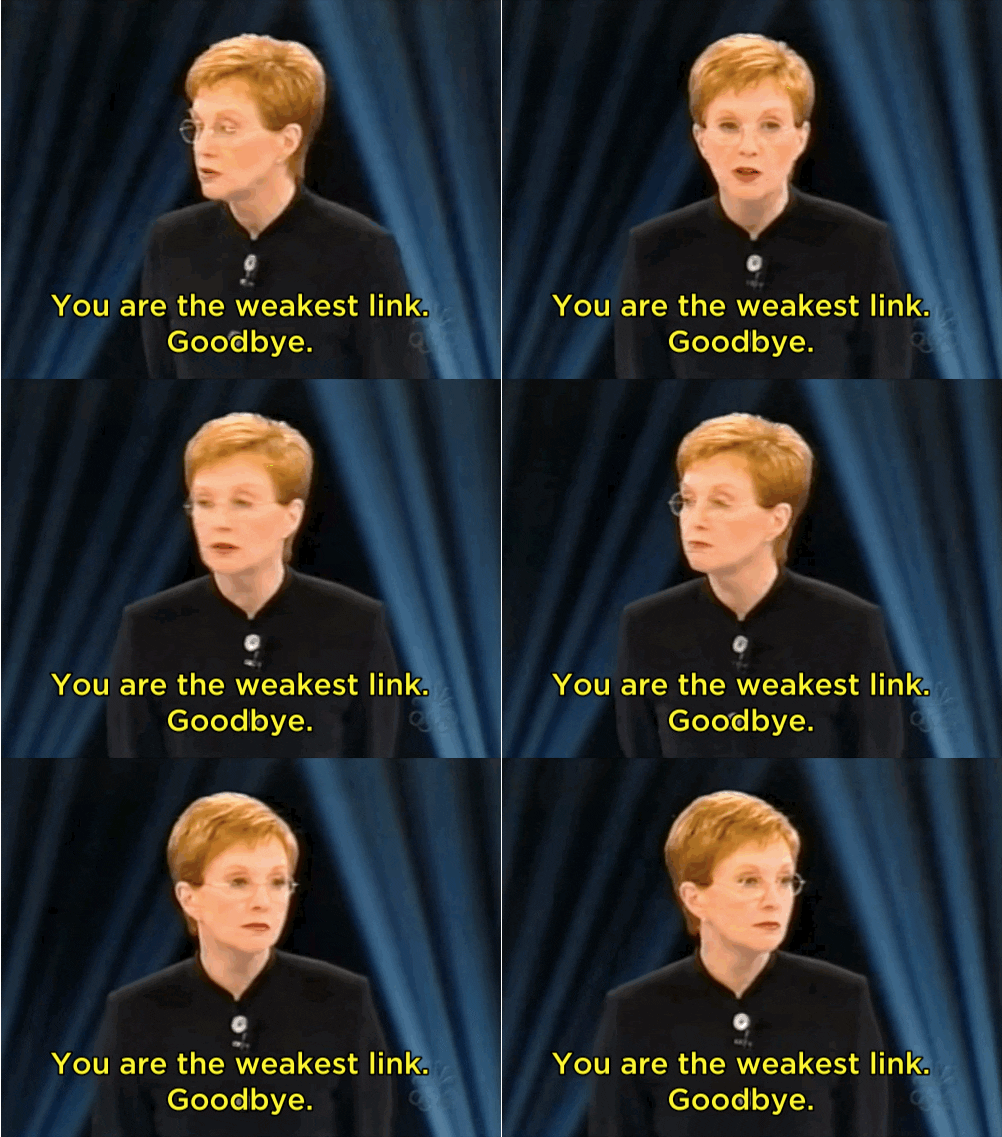
The subtleties of capitalism

A quick Google search turns up a myriad of numbered lists providing the Top Habits of Billionaires. The wealthy set goals and follow them with single-minded determination; they dream big without fear of failure; they spend their time learning and surrounding themselves with people smarter than they are; they take care of themselves by eating and sleeping right; and finally, of course, they are cautious with their money. One could easily turn this into a list of virtues similar to that of Aristotle. The billionaire sage is focused, driven, prudent, curious, social, and bold. Many of these could even exist in alignment with those of Aristotle.

The thing is, the virtue ethics of the Ancient Greeks was self-fulfilling. Living well is its own reward. Hence why moderation is important, even in our virtue. There is no such restraint within capitalism, however, because the goal isn’t virtue in-itself: it’s money. There is no moderation in the virtues of today because capitalism necessitates infinite growth. The concept of the golden mean is antithetical to the voraciousness of the capitalistic system. Today, one is virtuous for the sake of something outside of virtue, which means that the virtues themselves are only of secondary value. The “Hustle Culture” and “Grind Culture” that have sprung up as the pinnacle of these modern day virtues is toxic for exactly this reason. It is physically and mentally exhausting to live this “good life” because the demands put on us aren’t driven by any idea of a eudaemonia but by what was once considered a cardinal vice: avarice.

“I want golf clubs! I want diamonds! I want a pony so I can ride it twice, get bored, and sell it to make glue!”

The other problem with capitalistic virtue ethics is that they’re a lie. Social mobility has little to do with one’s virtue. The ability to actually improve your financial situation is low, and has been getting worse for decades. Wages are going down, so we’re making less money than our parents. The only place where incomes are rising are for those who are already rich. The decline of unions, the change in technologies, barriers on education… these are the things that are keeping most of us broke, not our personal vices. No matter how early you get up or the number of goals you set, your economic situation probably isn’t going to change all that dramatically.

A society will necessarily create its own virtues. Societies are created by humans, and humans need to know how to behave well to fit in with their neighbours. We will always have virtues, and we will always have sages. However, it is important to observe what those virtues demand of their adherents, or if living like the sage actually allows one to become like them. The modern virtue ethics of capitalism are viciously idolatrous in both regards. The Renaissance was in many ways a return to antiquity to absolve Europe from the hollowness of the medieval period. With capitalism, our virtues are equally hollow. While I am not so nostalgic to demand a return to the Ancients, it is at least clear that our current virtues leave much to be desired.
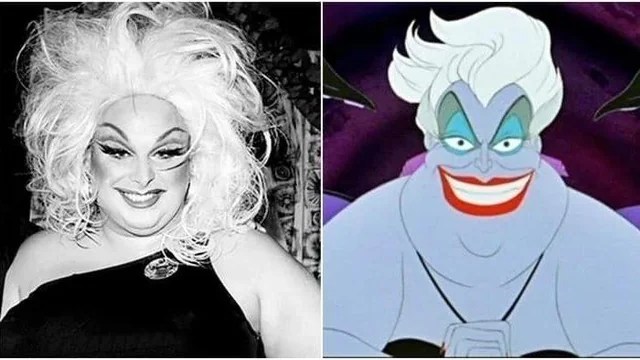
Those in the West live fairly comfortably in democracies. Sure, some of us are technically constitutional monarchies, but our overall vibe is still pretty democratic. Partisan politics always seem to claim to be the voice of the people and not the voice of the king, so there are at least overtures to democracy. And yet, we still tell kid stories that revolve around princesses. Disney has a veritable pantheon of them and isn’t seen as an enemy of democracy (barring the inanity that is the state of Florida). Celebrating someone in the queer community is to call them a “queen.” The monarchy remains embedded in our culture across the spectrum, from the capitalists to the queer dissidents.

The usage of these monarchist tropes certainly don’t aim to be anti-democratic. Disney princesses rarely do any actual governing or promote policy measures; they typically go on adventures, solve mysteries, and sing songs about how many thingamabobs they own. If there is a queen or king involved, they may even have a short temper you certainly wouldn’t want in an autocrat, but it’s never viewed in that context – they’re just a mean ol’ parent who doesn’t let their teenage daughter have any fun! The monarchies in these stories are about as apolitical as you can get.

The queer coding for villainy, on the other hand, is far more obvious.

So why have the story told through the lens of monarchism at all if its function as a form of government is completely irrelevant to the plot? Why is Ariel a princess when she can just be some random girl with an overprotective father? The same story works if they’re poor and Triton is a working single father who is trying to raise his daughter alone, but she isn’t focused on taking care of herself or her future; she’s focused on hoarding useless junk. These stories don’t need monarchism, so why romanticize a form of dictatorship most countries killed a whole bunch of people to overcome? Monarchies are bad, you guys! Remember? Remember how America fought a war and France killed a lot of people to get rid of them? Democracy and monarchy are antithetical toward one another, and we’re supposed to love democracy!

The Beauty and the Beast fairytale takes place only a couple of decades before this happened in France. Let’s just say that those two did not live happily ever after, and you know, maybe they shouldn’t have!

Edmund Burke is the father of modern day conservatism, and he was a staunch opponent of democracy in his time and opposed the French revolution. He recognized the failures of the contemporary monarchies that were being resisted, but believed ultimately that there still ought to be an elite governing the masses, and if the current group were a failure, then they were just the wrong kind of elites. Monarchism, and the aristocracies that are associated with that type of rule, are elites who dictate how the world ought to be run. When viewed in this context, we can see that this ideology can actually be applied quite comfortably to our capitalist system. The elites are the rich, and it is right and good that they influence our democracy, because they are better than the rest of us. They’ve proved it by being richer than us in a competitive market. They won; we lost. They earned their place in the aristocracy, and therefore their voices count more than ours. Forget democracy, we shall be governed by those who can buy out the most of their competitors.

A bad elite whom ought to be resisted, in comparison to all the good elites that we should never resist because their rule is natural and righteous

This is why queer people call each other “queen,” to infer that their peer is an elite. Queer people are often downtrodden and dispossessed, and reclaiming some power by stealing the language of elitism is a way to overcome that. It could even be argued that the usage is satirizing the idea of elites, as drag satirizes gender and patriarchy. I expect each person who calls out, “Yas Queen!” has their own reason for doing so, but at its core, it is a reference to an elite, whether ironic or genuine. I’ve also started seeing people refer to men as “kings,” and this trend does not appear to have any of the irony that it really ought to.

Similarly, with no hint of irony, stories about princesses create an image in a child’s mind that there are groups of people who are simply better than others. If there’s a dragon or a mer-witch, then thank God we have a class of people capable of handling them. We wouldn’t want to trust that kind of responsibility to the peasants! Readers naturally empathize and insert themselves as the hero of the story, and so they believe themselves to be that class of person: it doesn’t matter what station in life you’re born into, when you read a story with monarchical characters, all of a sudden, you’re an elite too. And if you’re not, you could be! Just say your prayers and take your vitamins, and by God, maybe you’ll be rich some day too!

Poverty is real and brutal in Agrabah. You can be extrajudicially killed by the police for stealing a loaf of bread, but that certainly can’t be the fault of the monarch! See, if you want to escape poverty, just find a magical lamp! Aladdin proves his worthiness and becomes royalty through merit, his poverty a miscalculation rather than a systemic injustice.

These stories naturalize power imbalances. That’s why monarchism is still included in these “tales as old as time” despite being irrelevant to the story. Kings historically claimed a divine right to their rule, and while that trope has fallen out of fashion, cultural monarchism still seeks to naturalize the righteousness of the elites of today’s society. Our modern princess stories might have empowered women wearing the tiara, no longer requiring to be saved, but it’s the empowerment of the Girl Boss who still functions within an unequal capitalism. She deserves to be the She-E-O; she’s better than those seamstresses making fast fashion out of Bangladesh, and don’t you question it! If you are born into a situation where succeeding in capitalism is essentially out of the question, well, you’re just destined to peasantry. Accept it. Your betters will make all the important decisions about your life. Here’s a fun song about living under the sea to explain why.

See? The peasants are happy because they get to eat the grasses that the corpses of decadent and opulent kings fertilized. Those kings may live longer and have more of their needs met because of their wealth, but the important thing is it’s natural and therefore cannot be questioned.

Democracy necessarily requires equitable access to the functions of power. If someone isn’t able to have their voice heard, then that’s not a democracy. These stories are not subtle about being anti-democratic: they literally have kings and queens in them. We celebrate and romanticize the monarchy because some groups of people benefit from undemocratic structures cementing their neo-aristocratic roles as pseudo-lords within a plutocracy. To even compliment someone as a king or queen is to normalize that these hierarchies are natural and good, and that we ought to celebrate whatever power, however small, we have within them. Who benefits from people thinking that humanity is divinely segregated into natural categories? Certainly not the vast majority of us.

To call me “queen” is to call me tyrant. To idolize a princess is to deify the robber barons. Perhaps instead, Yas comrade!

Freedom sure sounds great, doesn’t it? It inspires whole convoys, after all. There is an entire American congressional caucus dedicated to it! We’re supposed to let it ring, and for that privilege, we are charged a buck-oh-five. There are statues dedicated to the very notion of liberty, and yet it remains vague and undetermined, generally on purpose by those advocating for it. Typically ‘Freedom’ in the political sphere means rich people not having to pay any taxes, but that’s never explicit, and so people often have this vague, fuzzy feeling about the term that’s generally positive. So what does freedom actually entail? Is it more than just feeling secure against the threat of terrorists and commies through lower corporate tax rates?

Freedom, when pressed, is obviously about the freedom to choose. We can’t choose anything if Sharia Law is enforced and we all have to convert to Islam, or the communists have us all wearing the same grey sweatsuit lining up for the same loaves of bread. Freedom means being able to choose between loaves of bread and the freedom to convert to Christianity!! Right? To an extent. Freedom in its most absolute sense would be all the choices from choosing between two loaves of bread to killing yourself. If we are truly free, there are an infinite number of choices available to us at any given moment.

Memes, you’re definitely growing on me as an educational resource

Does this sound terrifying? It should! The freest person in the world is the recovering drug addict. Their entire lives were previously dedicated to all aspects of doing drugs: grinding to get the drugs, doing the drugs, a short grace period to do some wallowing, and then grinding again. It’s a loop that’s hard to escape, but it does happen. When it does, that person has only known a very constrained lifestyle, and now, without any of it, they are free to do literally whatever they want. Maybe they might go back to school, or start working again, or reconnect with their sober friends. Or maybe they might travel, or go to a treatment centre, or move to a new home away from their drug den, or go for a walk or a movie or the library or the mall or a drop-in centre or a counseling session or a swim in the ocean or a music festival or back home to their parents or a cry in the shower or, as has been established, just end it all. These are choices that must be made every second of every day without any idea of when this flood of choice will end. People off themselves all the time in recovery, and part of the reason is the amount of freedom that they have. The experience of absolute freedom is a void of unknown and infinite possibility, an expanse of overwhelming nothingness ahead of you, and you are the only person responsible and capable for taking that desolate void, both outside and inside of yourself, and turning it into a worthwhile life. Alcoholics Anonymous tells recovering addicts to take things one day at a time simply to limit the number of choices people in this precarious and vulnerable position have to make. The existential anxiety of making a choice is so great that many people relapse simply because the miserable cycle of drug use is at least a known quantity and has a degree of comfort in taking those choices away. Anyone calling them a coward for this has never undergone the experience.

Limiting freedom is actually quite healthy for normies too! You ever hear of structure and routine? They’re great ways to stay healthy. People have a hard time making it to the gym when they have to choose to go to the gym, but when it becomes habit, and they are no longer actually choosing to go, they now have a routine. This is actually incredibly beneficial! If someone is feeling low and unable to do much, their bodies will automatically follow the routine they’ve habituated, and voila! They’ve still made it to the gym despite their blues, and you know what? They’re probably feeling a bit better because of it. Obviously the reverse is true with bad habits, but creating a good life is about creating good and healthy habits. Even something like making a list is helpful because it forces our decisions into a box that restricts our choices to the items listed – they get done because we don’t allow ourselves to choose outside of that box. The irony of freedom’s celebrity is that the goal of life is reduce the number of choices we actually have to make on a day-to-day basis; we just automatically make lunch for work the next day, or go to bed at a reasonable hour, or use the healthy groceries that we buy rather than leave them to rot in our refrigerators. Success comes when our lives are mostly automated, and an automated lifestyle is not a free one.

Pictured: successful humans

This seems somewhat intuitive. Has anyone faced a major life choice and thought: wow, this is a pleasurable experience! Or was there a lot of anxiety and catastrophizing about what the future might look like whether you choose this or that? Especially once you realize that not making a choice is also a choice, and allowing the status quo to perpetuate itself is one of those infinite choices you have to deal with. If a choice seems easy, it’s likely because you’ve been culturally primed to accept that choice as typical and normal – and how free is that of a choice, really? Jean-Paul Sartre, notorious philosopher of freedom, tells us we are “condemned to freedom.’ Choosing negates all other possible choices, and is a terrifying, inescapable, and necessary experience.

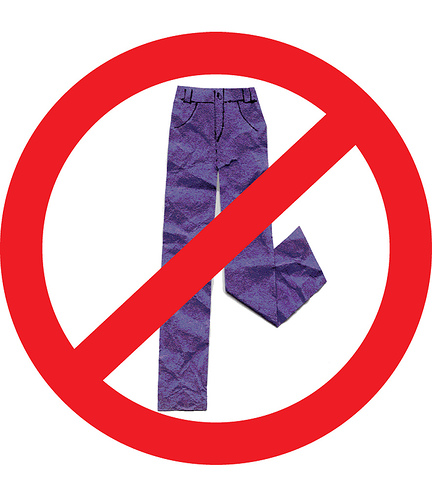
And I do think it’s necessary! Don’t get me wrong: I’m not against freedom! We must choose. Having someone else making these major choices for us is an unforgiveable oppression. Just, as with everything, in healthy moderation. Even those Freedom Truckers wore their seatbelts on their drive to Ottawa, and had nothing to say about seatbelt mandates, or traffic light mandates, or pants mandates. No one was out there protesting their freedom to not wear pants, only masks, even though the arguments against pants are way more grounded in science than the arguments against masks!

Don’t you just hate them?

So why is freedom, something that actually kinda sucks, celebrated like it’s the fundamental aspect of Western civilization? I mean, I think it’s reasonable to yadda, yadda, yadda over the escape from the tyranny of the British monarchy since the freedom I’m describing goes well beyond the fight for democracy, but I think the Freedom of today has far evolved beyond that democratic rebellion oh so many centuries ago. Given the link between the fascistic elements of Western society and claims of Freedom, I think that much is clear! So what is it? My personal thoughts are that Freedom has come to represent the dream of a meritocracy. We obviously aren’t living in a meritocracy, but if we are Free, then we must be! I earned my life through the choices I’ve made, and if there are outside social factors subtly influencing my position in life, then the value of my merit is lessened. If I am Free, I am not determined. Whether my life is good or bad, it is my own. I have carved out my place in this world, and the only way that that’s going to change is if the commies and terrorists are allowed to come take our Freedoms away. When people talk about Freedom, they aren’t actually talking about freedom at all since, as discussed, freedom is an incredible burden foisted upon us by an uncaring universe. They’re talking about dignity. I matter because I am Free. Their vitriolic shouts of Freedom and spittle aren’t a call for action, but a plea to have the meaning of their actions recognized.

Freedom is a good thing in the same way that democracy and socialism are good things; we ought to have a choice in our governments and our workplaces. We ought to have choices in our own lives even as we aspire to limit them. Those choices can be painful, and an overwhelming amount of freedom is such a sublime threat that I pray none of you ever have to face that kind of dread. Freedom is… fine, I guess. We’ve become kinda weird about it, but that’s because society has become kinda weird. We’ve become so disconnected from the world around us that we actually insist on it now; if the world is connected to me in any way, then what I do doesn’t matter! How broken of a culture is that? Freedom with a capital F has seemingly become the last bastion of being okay with ourselves while all other forms of meaning are being erased by those who profit off our existential despair. This is why Freedom and fascism can exist in tandem. The thing is though, we can create our own meaning without having to believe that we are alone in creating it. Being alone sucks, but being free around other people means respecting their freedom which often means limiting our own. Given we’ve established that limiting our freedom can be a good thing generally, this shouldn’t be seen as a threat, but as a way to lead a happier, healthier, and more cohesive lifestyle.

I am choosing to add this image to this blog, not because it is relevant in any way, but because I want to. Or am I only doing it to adhere to the goal I set for myself in my previous blog? How free of a choice was this really?

Freedom is like eating our vegetables. We don’t want to do it, but we have to, and if we can find a way to make them more appealing by dousing them in the ranch dressing of moderation, that’s probably for the best. What we don’t want is for Freedom to distract us from the reality of freedom. Freedom more often than not needs to be limited, whether that’s to avoid existential dread, to have a healthy routine, or simply to get along well with others. This doesn’t eliminate meaning, but enhances it. Freedom with a capital F is a lie. Freedom with a lower case f is all we have, all we are condemned to endure. Best to make the most of it!