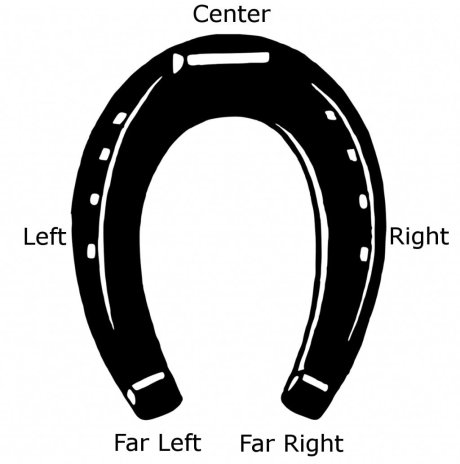
There is this belief that the centre possesses the highest moral value. The Golden Mean of Aristotle suggests that the ethical character exists between two extremes. Between cowardice and rashness is bravery; between stinginess and prodigality is liberality. When applied to politics, the spectrum appears as a horseshoe with the Right and Left extremes meeting near the bottom, allegedly indistinguishable from one another, and the glorious yet humble centrists take their position at the pinnacle of enlightened political thought.
13493486_f1024

It kind of looks like seating arrangements with the head of the table being really conspicuously obvious. Whoever came up with Horseshoe Theory must have been a centrist.

Of course this is incredibly patronizing to those without liberal viewpoints, but it’s also patently absurd. It’s the “both sides” rhetoric which equivocates fighting Nazis with being Nazis. The truth does not lie between two extremes of an argument. It’s like going to a court case, and assuming that justice exists somewhere in the middle between the positions of the defense and the prosecution, without listening to either side.

Not listening is key to political centrism. It’s telling victims that, while I recognize that there is bad shit going on, I understand your situation better than you, and I will judge you harshly for your response to violence that I do not have to endure. It’s telling those who victimize others that, while I recognize that what you’re doing is socially destructive, I respect your right to do so within the written law. Centrism is the perpetuation of the status quo even if the status quo is harmful to certain groups and privileges others, which means, by its very nature, centrism benefits the socially destructive simply by its passive allowance of their flourishing.

Centrists assume that any dialogue is productive. It suggests that groups who want to secure basic freedoms can solve their differences amiably over tea with others who believe those groups to be subhuman. I’m not saying that dialogue can’t solve the issue, but the type of conversation matters more than simply having a conversation. To be politically centrist is to avoid productive debate, despite conventional wisdom, because they insist that the louder and illegitimate voices have an equal seat at the table, despite the silencing effect that this has on others. Marginalized voices must be given a microphone in order to be heard above the din, and certain arguments are unjustifiable in productive dialogue, like the supremacy of one group over another, and those arguments must be quashed or ignored if we’re going to actually make any progress. White supremacy, for example, cannot be debated because it is not grounded on a debatable foundation.

Despite the language we use to understand politics as a spectrum, it’s far more complex and nuanced than a horseshoe or even a linear framework. It seems asinine to perceive climate science as a position on the political spectrum, but it is. Believing that black people should be murdered less too finds its place on the political spectrum. If someone believes that gay people shouldn’t be able to marry, we consider them right wing, but if they murder someone because they’re gay, are they are more right wing? Is murder on the political spectrum? That’s like saying a Muslim who commits a terrorist act is more Muslim than one who doesn’t. If someone believes that workers should own the means of production, we call that left wing. What about the difference between those who want to achieve it through revolution compared to those who wish to achieve it through incremental reform? Is one more left than the other? The belief is the same, the methodology is different. We consider revolution more extreme, and therefore somehow “more left”, but the basic political beliefs are identical. Political methodology should not impact political position. If we were in Eastern Germany during its Communist phase, and someone set off a car bomb because they wanted liberal democracy, would they be considered more centrist than someone who only handed out pamphlets? Jean-Jacques Rousseau would never be considered a centrist during his time, even if what he was fighting for are the values of centrists today. We have the term Overton Window to describe acceptable social discourse (ie. centrist values) which can shift depending on the surrounding culture, which means that centrism is essentially arbitrary. Politics is issue specific, and that’s why we have racist Gay Rights activists and fiscal conservatives who think pot should be legal. There isn’t really a defined spectrum, just a mainstream with the “extreme” political views falling on the outside of that. Centrism is only pop-politics.

To self-describe as centrist is nothing more than virtue signalling. It’s buying into the myth of the spectrum simply because it puts you in a flattering light. Centrists get to claim the moral high ground because of the perceived golden hue of the mean, even if what they advocate is otherwise morally bankrupt. Claiming a label that identifies you as socially responsible unlike those types is choosing to remain ignorant because the destruction going on around you does not affect you personally. Listen to the arguments, research the data, and see if “both sides” truly have equal merit.

You know who perpetually sucks? Those jerks in the out-group. They’ll never be as cool as us in our in-group. They’ll always be the Other, and as such, we will literally never care about them. At worst, we’ll go out of our way to kill every God damned one of them. Remember, it’s not because we’re jerks; it’s because they’re jerks.

Us and them have always been at odds, and that conflict has resulted in quite a lot of really tragic things, in hindsight. However, it’s a mentality that’s difficult to escape. Jonathan Haidt posits that there are five moral frameworks with which every human is imbued: harm, fairness, in-group, authority, and purity. The last three are often rejected by liberal-minded individuals, or at least not given as much weight, while all five are embraced by the conservative-minded, though the first two are generally less weighted than for liberals. Haidt suggests that while a focus on the in-group, authority, and purity can lead to terrible outcomes, they are needed for social cooperation in the long term. Cohesion requires solidarity, and solidarity requires some degree of enforceable rigidity.

We need union. We need to be a part of a group. We are social creatures. The nature of that group is important, however. Conformity within the in-group is problematic. Conformity means that abnormal behaviour, even benign abnormal behaviour, becomes stigmatized. Michael Warner describes a modern reality where gays are becoming part of a sterile “normal”, where they will be accepted so long as they blend in to the sexual status quo. Marriage is encouraged because it offers a legitimacy to a gay relationship, even if by doing so it still delegitimizes other, non-state recognized relationships such as polyamory, casual encounters, or cohabitation. Deviance is still deviant, and gays are only accepted so long as they conform to the generally puritanical sexual standards of the West. This is obviously despite the fact that homosexuality itself was once considered inherently deviant, and seeking conformity to a shaming culture belittles the underlying goals of the movement.

The shame of deviance is problematic for more than just sexual minorities. New ideas are quashed because they do not fit with the current paradigm. Information that is in conflict with the accepted group ideology is swept under the rug which means that any output generated can only be considered propaganda. Consider a political party; are they going to champion new research that disagrees with their values? Is the backbencher going to have a say if they aren’t going to toe the party line? Of course not. Social conformity on the macro level is just the expansion of partisanship to a larger ideology.

Can we have union without the perils of conformity? In truth, we cannot. There will always need to be a thread that interweaves throughout society that binds everyone together. However, the perils can be mitigated. Celebrating deviance from the norm is in fact a form of conformity. If everyone is called upon to support diversity, that is in itself a structure of conformity. Consider this quotation from Karl Popper:

Less well known is the paradox of tolerance: Unlimited tolerance must lead to the disappearance of tolerance. If we extend unlimited tolerance even to those who are intolerant, if we are not prepared to defend a tolerant society against the onslaught of the intolerant, then the tolerant will be destroyed, and tolerance with them. — In this formulation, I do not imply, for instance, that we should always suppress the utterance of intolerant philosophies; as long as we can counter them by rational argument and keep them in check by public opinion, suppression would certainly be unwise. But we should claim the right to suppress them if necessary even by force; for it may easily turn out that they are not prepared to meet us on the level of rational argument, but begin by denouncing all argument; they may forbid their followers to listen to rational argument, because it is deceptive, and teach them to answer arguments by the use of their fists or pistols. We should therefore claim, in the name of tolerance, the right not to tolerate the intolerant.

Relativism fails because it simply becomes an argument for nihilism, but absolute relativism, where relativism is itself something that is demanded, creates an ideology that can be successfully promulgated. There are of course other factors to be taken into account (universal tolerance could potentially lead to the acceptance of child molestation, for example), and to go through a full list isn’t something that I’d like to get into just now, but the basic foundation that Warner suggests is focused on personal autonomy. We decide how we behave, and society as a whole fights for our right to do so.

However, as with the paradox of tolerance, freedom is something that cannot be universal. There are two types of freedom: freedom from oppression, and freedom to oppress. I’m sure you can come up with contemporary examples of each on your own as people aren’t very subtle when they are describing the type of freedom that they are after.  The two are mutually exclusive, and society can only fight for one. Given the nature of Popper’s tolerant society, the choice ought to be fairly straight forward.

Do people know what is meant when it’s said that ‘race’ is a social construct? I mean, I hope they do, since it’s something important to know. Given the increasing frequency of certain news items I keep seeing, the answer is probably not. Race being a social construct means that what people see as ‘race’ is ascribed by society, and does not reflect anything real. To be black in America is to possess ‘blackness’ which is defined by the history and contemporary reality of race relations in America. Blackness is laziness tinged with amoral greed, as defined by Reagan’s “Welfare Queen” rhetoric. Blackness is criminality, as personified by the ‘black culture‘ of the commercialized violence of hip hop, gangsters on TV, and then overtly legislated in the criminal justice system that pegs them as super-predators. In Canada, much of this carries over to our Native population, who must also endure the caricature of the Dead Indian, the feather-wearing Brave that no longer exists outside of its representation of our forlorn past. Most importantly, it is irrelevant to modern society. The more we perceive our Indians to be a thing of the past, the less likely we are to take them seriously today. Whiteness in turn has its own social construction: white people are more civilized (Modernization Theory posits that societies outside of Europe and its descendants are struggling toward a European model of civilization, since it allegedly has already reached the societal peak), and with that gift of civilization, whiteness is generous as it loves to impart that gift onto others (commonly called the white saviour complex). Despite those who seek scientific research delineating innate racial differences, the answer is that we’re all basically the same, and it is only public perception that defines what we call ‘race.’

Which leads to ethnicity. Ethnicity is seen to be the ‘real’ race, since it is linked to a shared culture and nationality. People have an essence of Polish to them, for example, if their grandparents were born in Poland, and they eat lots of pierogi. However, ethnicity runs into its own problems. What happens if someone who is of third generation Polish descent lives in North America and is fully assimilated into North American culture? Do they maintain their Polish ethnicity? Would the same be said of a fully assimilated person of Korean descent? Alternatively, what if that Korean American really loved pierogi and ate just as much as our original Polish family? What if that Korean lived in Poland and participated exclusively in Polish culture? Can there be a Canadian or American ethnicity?

There are two factors that are at play in answering these questions. First of all, outward appearance: someone of Korean descent will never be considered as ethnically Polish simply because they look different. The second is blood: those who declared the assimilated Pole as still ethnically Polish will likely look to ancestry as the chief determinate. In Métis culture, there are those who demand that a bloodline to the original Red River Settlement is necessary in order to be a ‘true’ Métis. So ethnicity boils down to innate qualities derived from genetics, and what a person looks like, irrespective of how much or how little of their assumed culture they participate in. It’s gussied-up race, is what I’m getting at here. It’s the difference between saying black people smoke pot, which is an offensive generalization, and Jamaicans smoke pot, which alludes to Rastafarian culture, but in reality is simply refining a stereotype. Claiming an American or Canadian ethnicity is absurd because of the diversity within those nations, but that diversity apparently does not apply anywhere else.

People have different reactions to ethnicity. It’s almost a trope to ask Asians where they are really from, as if their ethnicity will determine every future interaction with them (Vietnamese people drive like this whereas Chinese people drive like this). Others are proud to be a part of a tradition passed on through the generations. However, participating in rituals, venerating symbols, and basking in the comfort of a common community are the markers of religion, not race. Believing in an insoluble bloodline that creates a human essence is a matter of faith, with all the spiritual significance and potential for destruction that that implies. And just as with religion, someone’s heritage can mean as much or as little to them as they choose. That is always up to them. If you find yourself assuming the importance of someone’s heritage, or making blanket statements about someone’s “culture”, then remember how ethnicity and race are interchangeable, and how this then would make you a racist.

Don’t be a racist.