Competition is supposed to be the whetstone with which society continually betters itself. Society will flourishes when companies go head to head, as the free market will determine, based on what each of them offers against the other, which will succeed and which will flounder. We revel in the competitive, with combative (both figuratively and literally) sporting events being subscribed to with almost religious dogmatism. Competition appears to be the foundation of Western civilization, supporting the capitalist doctrine of invisible-hand economics.

In Ancient Greek philosophy, the competitive ideologues were called Sophists. The Sophists sought not to reach any kind of philosophical epiphany, but rather only to use language and rhetoric to convince their audience of their deliberative victory, regardless of the weakness of their arguments. The Sophists were derided by the classical philosophers whose names everyone knows, and now sophistry is used in common language to mean “the use of fallacious arguments, especially with the intention of deceiving.” History has already shown its preference.

Certainly the classical philosophers sparred over ideas. Aristotle is quoted as saying, “Piety requires us to honour truth above our friends” in regards to his philosophical criticisms of his tutor and friend, Plato. The difference however is this: the goal of Plato and Aristotle was never to be “right,” their goal was the truth. The Sophists had no goal other than to win, competition being their only motivation.

Competitivism as an ideology prefers to focus on winners, but by its very nature necessarily requires losers. The selfish could theoretically hoard to their heart’s content without impacting anyone else; the competitive need someone else to lose. Consider the outcome of the Sears corporation attempting to promote company profits by splitting everyone up into units and pitting them against each other. Unsurprisingly, they collapsed into chaos. The groups spent more time sabotaging each other than actually contributing anything toward the company’s well-being. Though in theory there could be Pyrrhic winners within the Sears organization, the main takeaway is that regardless of how the individual units did on their own, Sears as a whole failed catastrophically. The only thing stopping the Sears model and its consequences being a symbolic microcosm of society as a whole are the government regulations stopping competing corporations from burning the whole country to the ground. Competition is not a whetstone, but rather the motivation to slice the Achilles tendon of your opponent.

Unfortunately, those likely to win in a libertarian battle-royale, based on their already accumulated wealth and status, seek to drive us toward its unforgiving hellscape: the celebration of competition and the illusion of meritocracy allows them to exude the moral nobility of a cultural hero, no matter how many dead they’ve left in their wake. Who doesn’t love being a hero? From here, competitivism becomes a means of control. The winners have already won a game rigged in their favour, so they have nothing to fear, while the losers fight for scraps. Those who have noticed the problem can do nothing; to stop competing means to starve. We cannot stand with our neighbours because our neighbours are after the same scraps we need to feed our family.

In my own personal experience, I had a practicum at a Senior’s Resource Centre that provided information and other resources to those over the age of 65. All of the Senior’s Activity Centres in town got their funding from the same government grant, which means helping senior citizens is a zero-sum game. Some Activity Centres would come to the Resource Centre for a letter of commendation, little realizing that the Resource Centre too was seeking the same funds. If the goal was the improvement of the lives of seniors, then there would be an emphasis on dialogue and collaboration. Even if there were disagreements over the best methods, the goal would drive the collective forward. But because competitivism forced them against each other, they each now only have the goal to keep their own heads above the water, senior citizens be damned. The heads of the Activity Centres could not be in the same room together. It is my very own Sears Corporation anecdote. However, this is slightly different. Whereas the failure of one company might not have a huge impact on society overall, the collapse of the care for seniors in this city would devastate the local population. And due to the incumbent cutthroat competitivism, there is no possibility of political solidarity to stand against it.

The same applies to the private sector. I’m sure anyone with half a brain and half a heart has asked themselves why corporate executives seem to disregard the future of the human species for the sake of a short-term profit. Surely they must have grandchildren? The same systemic ideology that applies to Senior Activity Centres applies to corporations. A CEO that cannot provide immediate gains will simply be replaced by one who can; the corporation must remain competitive or it will sink. Though I’m sure greed certainly plays a part, it is the rules of competitivism that create the destructive myopia. “Winning” triumphs over common sense.
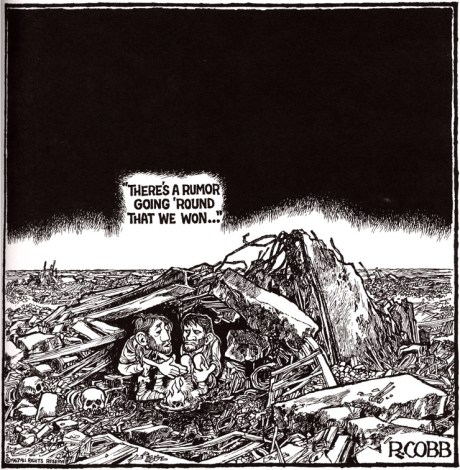
Competitivism: Where the means justify the end

What’s the point of being better than someone else? An evolutionary psychologist might make an argument for a biological mating drive, comparing us to male birds who advertise their virility with flamboyant plumage in competition with the other males. Hobbes’ state of nature paints humanity as brutal and selfish at our core, and he argues that for civilization to work we must be stringently regulated by a governing body. Though perhaps, just as libertarian goddess Ayn Rand suggests we condition altruism out of our social psyche, we could condition out competitiveness instead, which would reduce the need for oversight.

Alternatively, an anthropologist might argue that our natural state is far more collaborative, and that competitivism is what is conditioned into us rather than its opposite. Things like sporting events would be less like cultural memes indicative of our biological impulses, and more like propaganda for a systemic imbalance alien to our intrinsic nature. The only reason our society functions the way it does would be because the winners have told us this is the way it must be. In either case, be it our natural state or not, competitivism needs to be wrested from our civilization, lest it turn it into ash.

Post-script: I am directly related to athletes, so I’m going to answer the question about whether the elimination of competition would eliminate sport altogether. It is a question of goals. Is testing the human capacity for speed and endurance a reasonable goal? Sure. Why not test our limits. Is putting a ball in a net a reasonable goal? No. That’s entirely arbitrary and pointless. Sports entertainment is sophistry in its original sense. If it is something worthwhile, then it ought to be worked towards collectively and collaboratively. Can you imagine what a collaborative hockey match would look like? It would be a bunch of players standing in front of an empty net trying to see how many pucks they could put in during the span of three 20 minute periods.

What does it mean for something to be true? You might be inclined to suggest that it is a factual representation of the world, so sure. Let’s go with that. How do we know that something is a factual representation of the world? Well, we’d have to figure out what it means to know something. The general consensus is that to know something is to hold a justified, true, belief. Let’s examine some controversy.

The Gettier Problem is a criticism of the justified, true belief model of knowledge. It is best explained using an example. A shepherd is tending his flock, and he checks in to see if all are present. He counts all but one, and then sees his last sheep on a hill in the distance, and thus knows that all his sheep have been accounted for. However, what he thought he saw was actually a dog, though his sheep was just on the other side of the hill, out of sight. The shepherd was justified in his belief since he did see something, and his belief was true since the sheep was indeed on the hill, but we would never claim that he knew his sheep was on the hill since he was mistaken in his observation.

Sheep dog

No one suspects the slightest!


I want to examine the ‘truth’ statement of the Gettier Problem, rather than its epistemological connotations. The sheep is only ‘truly’ on the hill because I placed it there as the author of this thought experiment, but in any real life situation completely removed from the abstract, how would we know that it is true? In order for it to be true, we would have to know it to have that property, and in order for us to know about that property, it would have to be true. Truth and knowledge become a chicken and egg infinite regress when we take the lessons of the Gettier Problem and infuse them into real life situations.

There are further problems with truth. Consider counterfactuals. Counterfactuals represent statements that are true, but do not offer a factual representation of the world. For example, if I say, “The cup is red,” and we can all see that the cup is red, it is a true statement because the cup in the world is red, and my statement is a factual representation of that. However, if I say, “If America focused on the popular vote rather than the electoral college, Hilary Clinton would be president,” it is still a true statement, but it is not a representation of anything in this world. Philosopher David Lewis postulated that if we wish to maintain truth as a factual representation of the world, counterfactuals must rely on alternate universes to which these statements must refer. So we either accept that infinite alternate universes exist, or we accept that truth as a representation of the world is an unfounded premise.

Lastly, let’s look at the Liar’s Paradox. “This sentence is false.” If the sentence is true, then it is false, and if it is false, then it becomes true. If something must be true or false (and how could it be both? Or worse yet, neither?), then the Liar’s Paradox frustrates the notion of truth further. However, let’s look at “This sentence is false” in the context of language rather than of truth, and compare it to, “Colorless green ideas sleep furiously.” Both sentences are grammatically accurate, and seem to point to things in the world, but both are equally nonsense. Something green cannot be colourless, nor can an idea possess either of those characteristics, nor can an idea sleep, nor can the process of sleep or ideas be angry.

Statements of any kind do not point to things in the world, but to mental imagery. For example, the Nile river is still the Nile river if it floods, if it becomes diverted or dammed, or becomes polluted to the point where there are more arsenic molecules than H20. “The Nile river” refers to our idea of “The Nile river,” regardless of its properties in the real world. “The cup is red” refers to our ideas of cups, redness, what it means to be, and the specificity of “the”. It’s not pointing to the cup in the world at all. This makes the problem of counterfactuals much less relevant, since language, no matter its use, can only ever point to mental imagery. It also negates the Liar’s Paradox, since mental imagery does not have to be coherent to the same degree as real world objects. We are not observing any objective falseness, nor analyzing a sentence in the world; both exist only in our minds.

The truth, then, is not a factual representation of things in the world, since that premise is riddled with problems and ultimately unknowable. Thus the truth is our mental understanding of what a thing means to be true.

What does it mean to be a patriot? Obviously loving your country is the baseline from which we must work, but what form ought that love need embody? Frequently this love is merely blind obedience. For instance, while disastrous foreign intervention is often portrayed as bumbling or ridden with mistakes, and the methods may be challenged, the actual right to intervene is never questioned. The patriotic state is morally infallible, even if its arbiters are only human in their expression of that impossibly righteous doctrine. Those who claim the highest degree of patriotism often have the strongest distaste for the elites of their country, despite them representing the very mechanisms for how that country operates. This contradiction illuminates that patriotism can represent a disturbing level of authoritarianism, as even if the masters of society are held in contempt, their deeds and motivations at their core are ultimately indisputable. Patriotism as a guise for authoritarianism is not built on a foundation of love but one of control, so clearly that option must be discarded.

If not obedience, why not disobedience? John Stuart Mill said, “Laws never would be improved, if there were not numerous persons whose moral sentiments are better than the existing laws.” Moral infallibility is certainly not the property of any state, which means that the people are the ones responsible to hold it to account. Participating in the system is quite often nothing more than a concession to the very nature of that system, which means that disobedience is possibly one of the few ways to hold those in power to account, as is our responsibility. Consider these quotations from anti-suffragettes. Emma Goldman, the radical feminist and anarchist, said:

The history of the political activities of man proves that they have given him absolutely nothing that he could not have achieved in a more direct, less costly, and more lasting manner. As a matter of fact, every inch of ground he has gained has been through a constant fight, a ceaseless struggle for self-assertion, and not through suffrage. There is no reason whatever to assume that woman, in her climb to emancipation, has been, or will be, helped by the ballot.

Helen Keller, yes, that Helen Keller, was a socialist dissident who also believed that enfranchisement was the wrong direction to take:

Our democracy is but a name. We vote? What does that mean? It means that we choose between two bodies of real, though not avowed, autocrats. We choose between Tweedledum and Tweedledee . . . You ask for votes for women. What good can votes do when ten-elevenths of the land of Great Britain belongs to 200,000 and only one-eleventh to the rest of the 40,000,000? Have your men with their millions of votes freed themselves from this injustice?

These women were not creating objections based on misogynistic ideas of a woman’s place in society, but were objecting based on the principle that the country belongs to its citizens rather than the ruling class. The idea of political disobedience is never disobedience for disobedience sake, but rather to improve the state of the world so that the lives of the people are improved along with it. It is an ideology of communal unity, where the bond of the people is driving forward the mechanisms of change. This is a patriotism of love. This is a patriotism that believes the state can be improved because the people within it deserve the best of all possible worlds. Dissent is not a rejection of the nation; it is its embrace, believing it can do better because it deserves to be the best. We are our nation. We deserve the best.