In Germany, the crippling Treaty of Versailles contributed to the democratic election of their notorious, inhumane despot. It imposed harsh financial debts on the people of Germany, forbid their voices from being heard in its construction, and punished them for over a decade as a consequence for the actions of their leaders. When the Great Depression rolled in, the finances that the US was loaning Germany for its recovery disappeared, destroying the final remnants of the already ravaged German economy. The people sought to lash out after their global bruising, and were offered a scapegoat by right-wing populism in the form of the Jews (and gays, and the disabled, and gypsies, and Christians…).
So America, what’s your excuse? It may sound contrived and a little petty, but it’s a question that needs to be asked, and it’s a question that needs to be answered.
America did not have an outside coalition enforcing punitive economic policies onto their country, but rather, it slyly enacted them itself. The increasing personal debt, the outsourcing of jobs, the apathy of the elites for the working class; all of this is reminiscent of Weimar Germany but without the diktat of outside countries. The Great Recession moniker that was ascribed to the recent economic crisis should have been the ultimate foreshadowing of who was to come. The cause of that Great Recession is multifaceted and complex, but many attribute it to the repealing of the Glass-Steagall act back in 1999; notably, an event perpetrated by a Democrat. Repealing the Glass-Steagall legislation removed the banking regulations created in response to the Great Depression, another harbinger of history repeating itself.
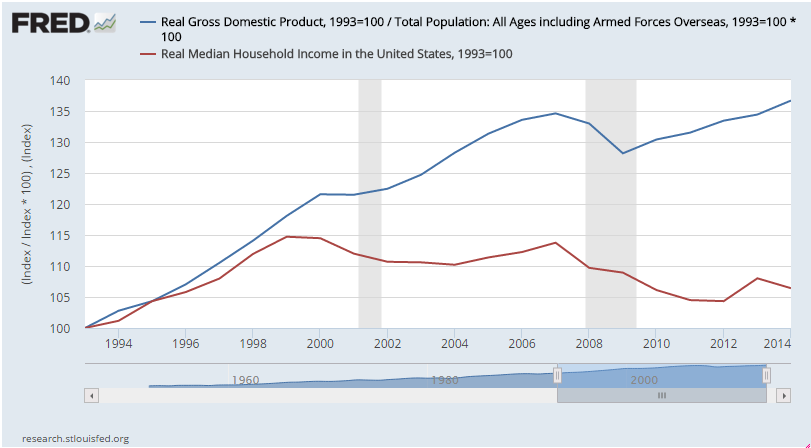
You can also just look at this. It illustrates pretty nicely that the institution of America left its people behind a long time ago.
When the inevitable market crash violently ripped across the country, the proposed solution was to bail out the banks. No punishments for the culpable, no legislation was changed, the banks were simply given back the money they had swindled from the hapless people. Again, this disgrace of justice was meted out by yet another Democrat.
America’s descent into totalitarianism was almost preordained. It is undeniable that there were elements of misogyny hindering Clinton’s campaign, but even if she won, what kind of monstrous candidate would have arisen after four years of more of the same? Clinton denigrated unions, she ridiculed environmentalists, and is just as entrenched into corporate welfare as any of the less insane Republican candidates. Progressing along the status quo that spawned a Trump campaign would not have improved with age.
Those who fear the journalistic sanctions under a Trump presidency should be aware that the mainstream media has been complicit in perpetuating the discourse of the status quo for ages. Even recently, Democracy Now! journalist Amy Goodman was charged with criminal trespassing for covering the Dakota Access Pipeline protest. Though the charges were dropped, it appears we do not need to wait for Trump to be sworn in before dissenting voices are criminalized. In addition, you might consider the unprecedented crackdown on whistleblowing under the Obama administration as further disregard for accountable governance. America has been tailspinning for a long time now, and it is of no use to pretend like it would never crash. Looking at historical precedents, someone like Trump is not entirely unsurprising.
I know I’ve been picking on Democrats, and maybe there are some of you demanding I account for the Republican congresses that blocked progressive legislation or Republican presidents that put forward their own destructive policies, and yes, those exist. This isn’t a problem created solely by the Democrats, but by the American political institution itself. When government becomes structurally plutocratic, even overt partisanship becomes more of a charade than an allegiance to any particular group.
Some have already begun blaming third party candidates for the failures of Clinton and the Democratic party (as if Gary Johnson, who wanted to eliminate taxes and abolish all government programs, would siphon votes away from the Democrats), when the reality is that a vote for a third party is a rejection of that broken political system in the vain hope that, this time, maybe people might pay attention to the shards of their democracy lying on the floor and decide to do something about it. Voting for a third party is not a vote for the greater of two evils, it is a refusal to participate in the system that enables constant concessions from the left as the Democrats can essentially behave however they want, knowing full-well that they will always have a Republican bogeyman to point at each election. Constantly voting for the lesser of two evils under this pretense will only allow its evil to grow.
Many people wish to attribute this grave election loss to racist individuals who have succumbed to the xenophobic rhetoric spewed by Trump, and judging by the endorsements given to him by white supremacist groups, it is a likely contributor. But the alt in alt-right intrinsically defines it as outside of the mainstream, so the pockets of racist support backing Donald Trump is difficult to attribute to the majority. In fact, blaming the election on the fear of the Other could very well be blaming the racial scapegoating rather than the cause of the necessity for scapegoating in the first place. Was Hitler’s rise attributable entirely to Germany’s antisemitism, or were there other factor’s at play? Hint: think the Treaty of Versailles…
It might also be convenient to claim that this is a racist backlash against having a black president. Except Obama had two terms, meaning that a majority did not seek to punish him for his race the first time around. If we consider when the Civil Rights act was implemented in 1964 by Lyndon B. Johnson, which might have garnered comparable racialized political backlash, we could expect a similar white supremacist to emerge in the next election. Except LBJ won 44 states to 6 in the subsequent election, and when the Democrats lost the following election to a Republican, this ended up being Richard Nixon, who worked on desegregating schools in the South, enforced the controversial busing of black children outside their neighbourhood to accommodate equal representation in schools in the North, and implemented the first federal affirmative action plan. However much backlash there may have been in interpreting the Civil Rights act in certain states, the federally elected official (Nixon) maintained a greater degree of racial sensibility than either political candidate in this last election.
Today, the voices standing up for racial equality tend to make broad, denigrating statements about white people in order to get their messages across, while during the civil rights movement, Martin Luther King was very purposeful in his inclusion of them. If we want to attribute Trump’s victory to a racist backlash, we must consider that the large number of white people who voted for Trump may have ignored those voices simply because they were tired of being attacked. If we, as progressives, wish to create allies or a dialogue, we have to be aware that maligning entire demographics of people is not an appropriate way to gain their sympathies. If, however, progressives insist on attacking whites, they may become so disillusioned with progressivism that they might elect Donald Trump! Oh wait. I suppose we can’t get that one back, can we…
Part of Trump’s success is also due in part to the media’s insatiable desire to tell Trump shock stories, knowing full-well how many papers his antics will sell, and in the process distract from the real drivers pushing forward his campaign. Arlie Russell Hochschild is a sociologist who went deep into Trump country to find out what attracted voters to Trump, and found that it was generally people who felt as though they had been left behind by the establishment and believed in Trump’s sales pitch that he could do something about it. What differences might there have been had the focus of the Democrats been on acknowledging the failures of the system and promising to adjust them, instead of attacking the character of the “deplorables”?
The Tea Party movement began in the wake of the bank bailouts, driven by anger at having been betrayed by the banks and the government. Yes, there was racism involved, but that was only ever an auxiliary motivator for the disdain of the government. Unlike the Occupy movement which preferred to abstain from actively creating change, the Tea Party successfully rallied behind their leaders and managed to vote in several political candidates. Regardless of how you feel about the Tea Party and the recent political movements of the Right, they were quite successful in establishing themselves in practical ways within the system to effect change, and now, one of their leaders is the president.
I’m aware racism is a thing, and I’m aware it played a role in Donald Trump’s success. I literally compared this election to Nazi Germany, and saying that I’m ignoring the impacts of race is telling me I’m ignorant of the hatred of Jews during the Holocaust. My point is that we can’t ignore the factors that have exacerbated American xenophobia, we must find alternative ways of discussing racial progress so as to not alienate the majority of the population, and the broken democratic system of America needs to be reformed. Cowardly hiding behind the Democratic party should no longer be considered morally acceptable.
If we believe this to truly be a cycle of history, then I expect that, after the upcoming World War III, the equivalent of the Nuremberg trials for America will not be as forgiving as the Obama administration was on the war crimes committed during the Bush era. That is, of course, if anyone is left to hold America accountable for its failure to stop a Trump presidency.


 Blog for Chumps