About a week ago, I was waiting at a bus stop on my way home, and I was approached by a pair of Mormons going about their rounds. They stopped to chat, as is their wont, and the one, taller Mormon acknowledged my E Pluribus Anus shirt that I was sporting at the time.

This is the only picture of me where the logo is reasonably visible, and I'm not taking a fucking selfie for my dumb blog.

This is the only picture of me where the logo is reasonably visible, and I’m not taking a fucking selfie for my dumb blog.

This is a reference to the television show Community for those godless heathens among you who don’t know your anus references, as seen in the school’s logo.

It translates to, "From Many Buttholes." Very poetic.

It translates to, “From Many Buttholes.” Very poetic.

Now, to me, this was great because it meant I got to talk about buttholes with Mormons, which has been my dream since childhood. I mean, we talked about other things like where they were from and boring social stuff, but whatever. The point is we shared a pleasant conversation. Meanwhile the bus pulls up, and they ask me if I would want to meet up with them later for a gathering, and I said, “No, I’m not interested, thank you, but it was nice chatting with you!” and got on the bus. As we parted ways, the one Mormon shouted after me, “Pop POP!” It was a magical moment.

As I got on the bus and displayed my pass, the bus driver said to me, “I saved you, huh?” as if I had just barely survived a shark attack, and he had pulled me from the water. Thing is, he hadn’t. The Mormons were kind and polite, and I was perfectly content having an idle conversation with them, and the bus driver did not commit any extra effort to rescue me from the uncomfortable situation he believed me to be in, he was just doing his job. If anyone was legitimately trying to save me, it was the Mormons.

A lot of people loathe door-to-door evangelists, and I get it. That used to be me. I would relish the occasion where one day I would finally get to ask a silly religious person why God would have created a universe wherein He would have to wait billions of years for His creation to come about if He allegedly loves us so much, or if the Earth is only 6000 years old, how does that explain the entirety of science? I mean, I love popcorn but I gotta admit, two minutes is about the extent I’m willing to wait. Compared to billions of years? Nobody loves popcorn that much. Alternatively, if I just came across a bowl of popcorn in the street and assumed that’s where popcorn came from, then I’d be stupid. I call it: The Popcorn Argument.

Eventually I learned that purpose, hope, and community are super important and hey! Turns out religion offers all those things. Now I’m the atheist who writes blogs defending organized religion. Go figure. These days when I’m given the opportunity to demand an explanation for the problem of evil, I prefer just being pleasant with another human being. Honestly, I’m probably better off.

Now, I didn’t write this blog just to tell you about my dabblings with theology. What I wanted to do was help out a reader or two come to grips with evangelist behaviour because it gets a lot of flack, and I don’t really think it deserves it. So come with me on a thought-experiment journey to a magical land where money dictates the turning of the world… which is actually this world. I guess you didn’t have to journey that far.

Imagine you won the lottery. Not like a free scratch or ten bucks, but the real jackpot. Huzzah, right?! And I’m not even talking about double-digit millions of dollars here, I’m talking infinite dollars. Literally an unending supply of dollars. Pay off your bills, take a trip to Hawaii, buy that happiness everyone keeps talking about… you will never have to have a financial worry again in your life! Now we’ll have to stretch our imaginations here a little bit and pretend you’re not a selfish piece of shit. You realize that with infinite dollars, you could pay off the bills of everyone! Pay off their mortgages; fund their kids’ tuition; pay for their health insurance! With an infinite amount of dollars, you could pass on infinite dollars to everyone! It’s one of the perks of infinite! So you go door to door, and you’re like, “Hey friend! I was that person who won that crazy jackpot that defies the laws of economic inflation! Want to have all your financial troubles taken care of forever?” Sane people would say yes. Suddenly, you realize that you’ve stumbled into a weird hippy commune! They reject your currency because they’re content with their bartering system of beads and hemp! They say things like, “Don’t you know that your money is fake? What real value has a piece of paper outside of what society collectively attributes to it? NOTHING! You believe in a lie!” The crazy fools, don’t they see the glory that is monetary-based capitalism? Monetary-based capitalism within which, as infinite-aires, they can live out the rest of their hippy lives in abundance and luxury? Lunacy!

So as a person with access to the infinite who is seeking to share its benefits for the good of everyone, do you feel like you’re worthy of scorn from smelly hippies? No, of course not. You’re only trying to help! The difference lies in each group’s perspective as to what generates worth, be it the agreed upon social value of a piece of paper (or more so nowadays the value of a few pixels on a screen), or, to bring back our titular Mormons, the value of an invisible deity. Each person is going to have a different view, but if we realize that unless we are selfish pieces of shit, we would perform the exact evangelistic deeds if we had access to an infinite portion of something we find so valuable.

I’ve been having a hard time with the recent Dallas shooting of 12 police officers, almost entirely because the progressive people who I have on my Facebook friends list, who make a point of acknowledging that the terrorists attacks in Turkey or Sudan are just as worthy of sympathy as the ones in France or Belgium, are noticeably silent about it. My guess is because they interpret Martin Luther King’s quote, “Injustice anywhere is a threat to justice everywhere” as applicable only to the dominant group. Of course, there are far more victims of police shootings than officers being shot, but when violence is carried out in the name of a progressive movement, and to be clear that is exactly what happened, then a good, hard look is required.

Our first look needs to be this. This is a photo of a Dallas police officer who made it home:

13590497_10153759734922473_2012298315114065061_n

This image is equally necessary to all the images of the black victims of police shootings to create the full context of that discussion.

There are five families who didn’t get to have this moment. Injustice anywhere is a threat to justice everywhere.

Yet I am conflicted. One of the things I did soon after the shooting was reread a previous blog I had written about violence as a response to oppression. I was not unambiguously against it, and was clear in reminding people that violence is often a reflection of the extent of oppression being committed against that populace. Black people face disproportionate violence from police officers, that is incontestable. Is the extent of that oppression creating this violent response? Are we just living in a time of revolution, and learning the humbling tragedy that revolution inflicts on everybody?

Malcolm X is famous for fighting for the rights of black people “by any means necessary.” He believed that without a violent response, “whites would not have to worry about a revengeful response to their brutality.” His unflinching rhetoric made no distinction between enemies and allies in the white race, and he made claims like all whites are responsible for “urban black ghetto[s] where drugs, poverty, crime, unemployment, and bad housing are its defining characteristics.”

Malcolm’s success was in the creation of a proud black identity. He advocated that “black people wherever possible, however possible, patronize their own kind … and start to build up the black race’s ability to do for itself.” He believed that black people had the ability to be exceptional, and he fought for those beliefs. One article that I desperately searched for but could not find suggested that without Martin Luther King, black people would not have the vote, but without Malcolm X, black people would not have their identity.

Now, Malcolm had interesting goals. He believed in creating a nation within the United States where black people could live autonomously outside of the rest of white America. He actually conferred with white supremacists, who were quite happy to kick black folk out of their towns, toward the achievement of this goal. To Malcolm, “segregation is that which is forced upon inferiors by superiors. But separation is that which is done voluntarily by two equals – for the good of both.” Now one could simply look at India and Pakistan to see how effective that would be in practice, but those were his views.

Most importantly, Malcolm’s actions and rhetoric reflected his plans. He could promote violence against white people because they did not have a place in his society. He could make blanket statements about white people because they were irrelevant to his goals. Malcolm has often been criticized for his open hatred of white people, but when his goals are considered, his hatred is reasonable toward their achievement.

What about the Black Lives Matter movement? They practice non-violence, so they must be more akin to Martin than Malcolm, right? I mean sure, there are fringe groups chanting for dead cops, but the vast majority choose non-violent methods. Martin said, “We can’t solve this problem through retaliatory violence… We must meet violence with nonviolence… Love your enemies; bless them that curse you; pray for them that despitefully use you. We must love our white brothers… no matter what they do to us.” Surely a movement that hearkens to Martin’s methodology would mirror his rhetoric, but that does not seem to be the case.

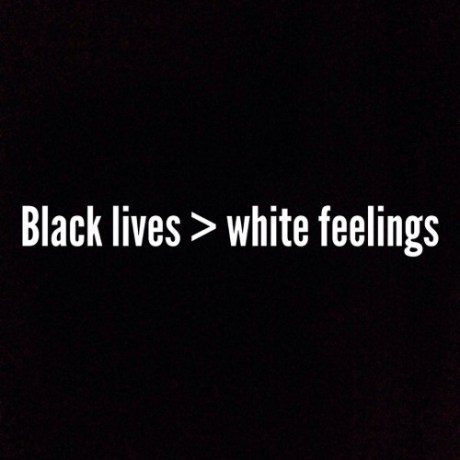
Advocates against racism today frequently use generalized language, directing their messages toward ‘white people’. Examples here, here, here, here, here… I’m not arguing that the information that’s being given is incorrect, but the way that it’s being presented paints the clear villains as ‘white people’. A feature length film was even created called Dear White People that examines this phenomenon. The systemic racism in North America is still being attributed to ‘white people’, and that sounds a lot more like Malcolm than Martin. Memes such as this:

BlackLivesvsWhiteFeelingscr

literally put black people and white people on opposing sides, as if there is a necessary conflict between the two. This article calls the Dallas shooting unsurprising considering the state of American affairs on racial inequality. The author uses a cake metaphor to illustrate this lack of surprise, whereas Malcolm simply said about the national tragedy of his day, “The chickens were coming home to roost.” Even the fight for the exclusion of police officers from the Toronto Pride festival is reminiscent of Malcolm’s aim of separation.

So what did Martin say? Well, he said in his I Have A Dream speech that, “The marvelous new militancy which has engulfed the Negro community must not lead us to a distrust of all white people, for many of our white brothers, as evidenced by their presence here today, have come to realize that their destiny is tied up with our destiny. And they have come to realize that their freedom is inextricably bound to our freedom.” His dream was “that one day on the red hills of Georgia, the sons of former slaves and the sons of former slave owners will be able to sit down together at the table of brotherhood.” He dreamed that one day the “little black boys and black girls will be able to join hands with little white boys and white girls as sisters and brothers.” He acknowledges all the troubles of black people, but his rhetoric is firmly entrenched in an alliance with white people. Memes like this:

13615240_1099525933470665_2594435964447142529_n

People in glass houses…

illustrate the ignorance people have of Martin’s beliefs because his dream, if you listen to the recording, was a lot closer to the message of #AllLivesMatter than anything else. He was very purposeful and clear about his inclusion of whites, and going by the themes of his speech, he would likely have said that “white lives are inextricably bound to black lives.” Martin believed in the supremacy of unity. He wasn’t about anger, but hope. It was this oration of hope and unity that got him the ear of two presidents to fix the systemic problems of his time, whereas Malcolm only raged in the streets.

Even Malcolm rescinded a lot of his rhetoric after his pilgrimage to Mecca, and afterward he said, “I’m a human being first and foremost, and as such, I’m for whoever and whatever benefits humanity as a whole.” He also cites regret at having dismissed a potential white ally on the steps of a college in his fight for the black race:

Well, I’ve lived to regret that incident. In many parts of the African continent I saw white students helping Black people. Something like this kills a lot of argument. I did many things as a [Black] Muslim that I’m sorry for now. I was a zombie then — like all [Black] Muslims — I was hypnotized, pointed in a certain direction and told to march. Well, I guess a man’s entitled to make a fool of himself if he’s ready to pay the cost. It cost me twelve years.

When the grandfather of anger-based identity politics likens that approach to being a mindless zombie, that is a harsh indictment.

Yet I do not believe that Martin could have succeeded without Malcolm. In my blog I refer to a yin yang approach, and Malcolm even addressed this when he said, “If white people realize what the alternative is, perhaps they will be more willing to hear Dr. King.” It’s the good cop/bad cop routine, but with racial politics.

Today though, the only rhetoric allowed is that of Malcolm. Identity politics rules. People are angry, and rightfully so, of course, but we’re missing our Martin. The methodology is meaningless if it does not match the rhetoric or the goals. Are people screaming to love the police, no matter what atrocities they commit? No, they’re banning them from progressive events. The most prominent criticism of the Black Lives Matter movement is the #AllLivesMatter campaign, which is typically dismissed as white ignorance, when really it’s a question about the role the rest of society has within the movement. A Martin today would address that question rather than pass it over with disdain as Malcolm would.

I really don’t know if this is the result of a lack of clear progressive leadership, or the degradation of political movements over time, but Black Lives Matter really needs to analyse its goals to see if they truly match its rhetoric and actions. Is the goal separation or unity? Hatred or love? Identity politics or actual politics? Violence against police officers and racial divisions can only increase given the current discourse because, as it stands right now, the dream is dead.

Post-script: all quotations, unless otherwise cited, have come from here.

Pride is a canonically sinful act, yet this must be understood in the context of a time when passivity and conformity were considered virtues. Pride is no sin. Arrogance is the destructive assumption that, “I am better!” whereas pride is a pure, “I am!” Pride is the act of looking at ourselves and celebrating who that person is, who that person can be. It is acknowledging the beauty of our differences, as history has proven that pride cannot exist in conformity.

With difference, however, comes fear. With fear comes hate, and violence. But rather than cower or be shamed, pride rises against it. Pride exists in defiance, as a challenge to those who, out of their fear, seek to belittle or degrade those beautiful differences in which pride thrives. To be proud is to stand up no matter the number of times we are knocked down.

Pride demands the courage to be different. Pride demands the integrity to be the best possible version of ourselves we can muster. Pride demands the honesty to bare our genuine souls to the world. All these attributes are the most admirable qualities a human being can embody, and it these aspects of ourselves that we honour.

To tell others to be proud is to empower authenticity in a world overrun by self-doubt and humiliation. It asks that you celebrate yourself, that you celebrate your community. Celebrate what separates you from your neighbour, and celebrate what separates your neighbour from you. So be brave. Be true. Be proud.