Archives for posts with tag: addiction

It seems almost unconscionable to ascribe a moral quality to ill health. It’s absurd to think that someone who has caught the common cold is some kind of sinister deviant, but as far back as the lepers being shunned and shuttered out of society, humanity has pointed at the unwell and called them devils.

Europe blamed the Black Death on the wrath of God, who was furious over the alleged impiety of His people. The mentally ill used to be incarcerated alongside criminals, their characters indistinguishable. Even lately, the AIDS epidemic of the 1980s seemed only to punish those considered perverse. Consider how we inquire after cancer: did they smoke? Did they eat processed foods? Did they stay too long in the sun? What was their lifestyle like that earned them a terminal illness?

Disease is an unquestionable evil, but why are we so quick to point to its host as having responsibility for it? When disease becomes a moral choice, the pure among us become immortal. The myth that bad things only happen to bad people convinces us that if only we maintain our righteousness, we will be spared. Righteousness only as a veneer, of course, as compassion for the ill could only ever be a supererogatory act. Far simpler to pillory the sick and use the blind luck of our good health as evidence of our sanctity.
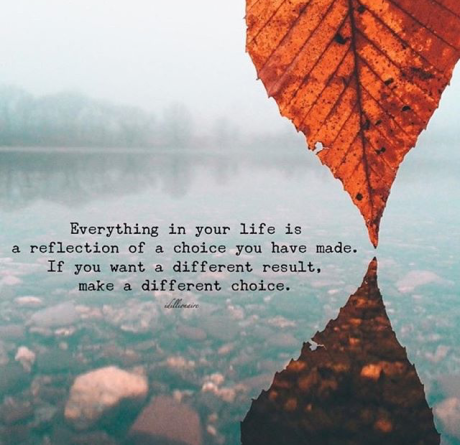
everything-in-your-life-is-a-reflection-of-a-choice-you-have-made-if-you-want-a-different-

A meritocracy of health. God, I hate memes.

Where this demonization of illness is most prevalent is the disease that seems to be built on a long series of choices: addiction. It’s so immoral that it is literally a crime. Mitch Hedberg satirizes this mentality with his quip:

Alcoholism is a disease, but it’s the only one you can get yelled at for having. “Goddamn it, Otto, you’re an alcoholic!” “Goddamn it, Otto, you have lupus!”

One of those two doesn’t sound right.

Addiction is a reaction to trauma, neglect, and mental illness. Addiction is what happens when reality is so brutal that the body seeks any kind of escape from it. Addiction isn’t so much of an illness as it is the medication for when life is a sickness, and then through the obsession of escape it becomes a part of that sickness. Any sense of “choice” in the matter is illusory, any kind of “morality” illegitimate.

But people continue to yell at those whose lives have become diseased. Consider the top rated comment on a CBC article saying that in the first 8 months of 2017, the number of overdose deaths in BC had reached 1,013, compared to the entirety of 2016 which was 922:

I have a real hard time feeling sympathy for these people who have died. They knew fentanyl was out there. They knew that over doses were on the rise and out of control. There’s absolutely no way they didn’t know the risk that they were taking! Yet, they chose to anyways. So no. Finding sympathy is very hard for me.

1,013 human lives extinguished. That’s 1,013 families that have to deal with the grief and guilt of a loved one they will always wonder if they could have done more to save. Of course addicts know that there is Fentanyl in the streets. Some of them ask for it directly. The “risk” isn’t the point. The cure may be worse than the disease, but for many of them it’s the only option available, and some might see the risk of overdose as a potential escape from their sickness altogether. Can we truly judge those adrift at sea who drink saltwater rather than endure the agony of thirst?

But it’s fine. Sympathy is for the bleeding hearts. That could never happen to me because I am morally righteous. I am pure. I am better than them because I wasn’t raped, or abandoned, or abused, nor do I have voices in my head that only shut up when I shoot heroin into my veins. I get to tell myself that it’s my choices that make me noble. My fear of death, a bold reminder in the face of an addict, is well hidden behind the vitriol I espouse. But death cannot come for me. I am pristine. I am immortal.

At the recovery house where I volunteer, one of the most disturbingly poignant comments that one of the clients made was that everyone wants to help you when you’re sober. People go to bat for you, they help you make ends meet, they are supportive and loving. When you’re on drugs, however, you are a pariah. Doors close, relationships are destroyed, and nobody helps you because they don’t trust that you’ll receive it in good faith.

Of course, it makes sense. When people are addicted to drugs they tend to prioritize those drugs over anything else, and to assume otherwise is a dangerous gamble. Often the mentality is that the person must hit rock bottom, and make the choice for themselves to recover, and when they are on the road to sobriety, that is when the support rolls in. To offer support beforehand prevents the necessary rock bottom that is the prerequisite for redemption.

But why withhold love for a person at their very weakest? Addicts, on top of the physical properties of addiction, continue their habit because their sober life is more miserable than their intoxicated one. Rock bottom is subjective, and is entirely irrelevant to the myriad of roadblocks that occur on the path to recovery. Allowing a person to get to the worst possible position in their life will not necessarily grant them the insight towards a healthier lifestyle, but it will increase their chances of killing themselves. Sobriety must be shown to be the better alternative to addiction, and social exclusion, cultural alienation, and insufficient resources to maintain a decent sober life preclude that imagery.

One might argue that love does remain, but I would disagree and say that the love is there for the person who once was: whoever existed before “the addict” came into the picture, not the addict themselves. The addict is no longer worthy of love, and is seen only as a symbol of what used to be. The continuance of love becomes conditional on the addict returning to a state as close to the original as possible. Only an addict can truly bond with another addict, hence the Anonymous program. The broken understand the broken, and there develops a community of outsiders out of necessity.

This leads to shame. No one likes being damaged. The addict tends to hide it. They pretend it’s not as big of a deal as it is, or that they’re doing better when they’re not, or that they’re not actually an addict. I’ve heard a fair number of stories of addicts who have maintained steady sobriety who then crumble to pieces when invited to a party, and are too embarrassed to reveal their deficiency and relapse simply because they don’t want people to know how defective they are. Of course, if no one cares for the broken, why would they ever admit to it?

Maybe I’m being too cynical, but let’s look at the damaged across the board. Say your best friend got dumped, and all they did was whine and complain about how heartbroken they were. How long would you tolerate it before the two of you started drifting apart? A week? A month? A year? Say your sibling became an addict and started stealing from you. How much of your material wealth would you have to lose before you gave up on them? Or someone who got in with the wrong crowd and started committing crimes. At what point does it become unforgivable?

Compassion is a finite resource. We can only ever hold out so long. Social workers, whose entire job is to care about the broken, have one of the highest burnout rates of any profession. We’d rather take Tough On Crime measures than care for our criminals. We’d rather avoid eye contact with homeless people panhandling for change. We change seats to escape sitting next to the man muttering to himself on the bus.

I’m pretty sure everyone unconsciously knows this, so we all try to hide our problems as best we can. Our social media profiles border on the hedonistic in order to disguise any faults we have. Our gratuitous greetings of, “Hi, how are you?” to strangers is inevitably met with a standard “fine” or a “same ol’ same ol'” because mediocrity is still better than having an issue that you’re struggling to deal with. Our healthy veneer only cracks in front of the close friends and family members whom we trust not to abandon us the instant we show any sign of weakness, but even then we still try to portray ourselves as the protagonist when we reveal our gripes, despite all the unseen doubt, guilt, and insecurities that cripple us.

I’m sure there are biotruths out there that suggest that only the strong survive, and it’s our Darwinian nature to desire strength and dominance and shun weakness. You can only care for the fawn with a broken leg for so long before you have to leave it for the wolves out of necessity. However, making up “biotruths” to justify abhorrent and selfish qualities as a means to dismiss them as simple human nature is defeatist and counterproductive.

However, we’re all fucked up. We all have insecurities, faults and flaws and any “biotruth” that dictates a desire for strength doesn’t take that into account because it would mean that we’d desire those who are best at hiding their faults, not those who are the most faultless.

We may be fucked up, but what constitutes “broken” is entirely subjective. Are sex workers “broken”? Are the diseased and the disabled “broken”? Are functional addicts “broken”? Can we really dehumanize anyone to the point where defining them as “broken” is ever even appropriate? Can people get to a point where they are truly beyond repair? Those we may perceive as “broken” might see themselves otherwise, and who is to say which of us is correct?

We avoid the broken because we fear that they will take us down with them. The addict will steal from us; the emotionally damaged will depress us; the criminal will become a liability. And maybe they will. But we are healthy. We are stable. We are fixed. We can be resolute because we are not broken, and we can help bring them up rather than abandon them out of the fear that they will take us down.

But we don’t. Maybe we’re not as stable as we let on, and we worry that our own little deficiencies will be exacerbated by any contact with the broken. So we all keep hiding, never truly being authentic. Showing any weakness or vulnerability could have devastating consequences, after all.