Archives for posts with tag: America

Kyle Rittenhouse was 17 years old when he decided to travel to Kenosha, Wisconsin with the intention of using a weapon to “protect businesses” against Black Lives Matter protesters in the most cursed year of our Lord, 2020. Whether or not any businesses were protected by his actions, Rittenhouse did end up using his weapon and killed three people on his quixotic quest to protect the capital of the ownership class. While he was infamously found Not Guilty due to self-defense, those three human beings would still be alive today if Rittenhouse prioritized lives over property and decided to stay home – or even just to travel unarmed. He made the choice to create the opportunity for death to happen, and it did.

For his ethical crimes, if not his legal ones, Rittenhouse was feted by the Republican party with house representatives stumbling over each other to offer him internships, including Matt Gaetz who did so even before the verdict had been established. He received a standing ovation at a Turning Point USA conference. He met with President Trump. He was embraced by the Right for a single act of extreme violence – not in spite of it, because of it.
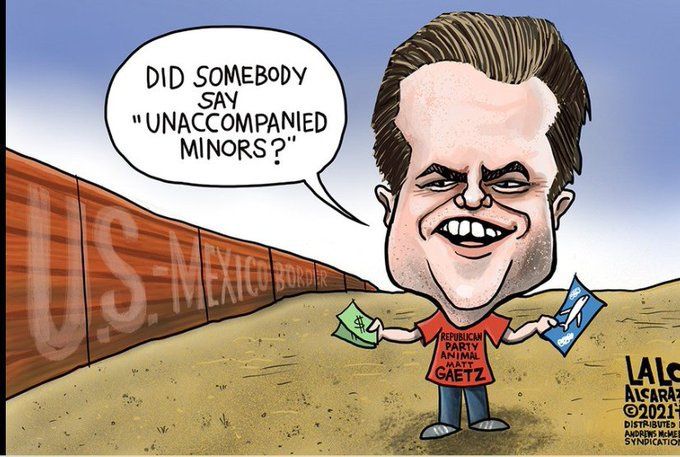
Escaping legal ramifications for being a terrible person? No wonder they got along!

Daniel Penny was 24 years old when he decided to use a chokehold on a homeless man in distress on a New York City subway train in the still pretty cursed year of our Lord, 2023. Jordan Neely was unarmed, and is quoted as saying, “I don’t have food, I don’t have a drink, I’m fed up. I don’t mind going to jail and getting life in prison. I’m ready to die.” He threw garbage at people, but did not touch anyone. He had a diagnosis of schizophrenia. While intervention was literally being begged for, the kind provided was that of a marine who only had one kind of training. Daniel Penny killed Jordan Neely.

Similar to Rittenhouse, Penny’s acquittal by the courts was widely celebrated by the Republican party. Penny had protected a train full of citizens, after all! He was invited to a football game by Donald Trump and J.D. Vance for his troubles, his accomplishment identical to that of Rittenhouse – he had killed someone.

Quick! Someone give him the Crippler Crossface!

Luigi Mangione was 26 years old when he allegedly decided to murder UnitedHealth CEO Brian Thompson in the now-tired-repetition-of-this-bit, 2024. He wrote “delay, deny, depose” on the bullet casings used in the killing in likely reference to how insurance companies obfuscate claims to avoid paying them. More than 26,000 Americans die from not having health insurance each year, and Mangione acted in direct response to this as, per his manifesto, “the first to face it with such brutal honesty.”

Mangione is loved by the internet in ways that appear to transcend partisanship. Yet, in terms of established politicians, Donald Trump has called for the death penalty. Murder is back to being bad again. Bernie Sanders, the leftest of the left in terms of establishment politicians, condemned the killing and said that the way to make change is through mass movements, not murder. Alexandria Ocasio-Cortez as the Robin to Sanders’s Batman, said the killing wasn’t justified, but that she understands people’s unsympathetic response to it given how health insurance works in America. There has been a broad attempt to connect the Democratic party to this kind of retributive violence, but the connection simply does not exist. No one is going to invite Luigi Mangione to anything.

Can you even imagine Luigi getting a beer with like, Barack Obama or George Soros or something? Fuck off!

What’s the difference? It’s not like if Mangione is found Not Guilty that it’s going to change anything. Remember that Matt Gaetz asked Rittenhouse to be an intern before the trial was even over, and that the President is a convicted felon. Trump pardoned all of the January 6th insurrectionists and calls them heroes and patriots. Legal responsibility has nothing to do with it. The difference is ideology.

I think it’s important to acknowledge here that all killings are political. If a gangster kills another gangster over a drug deal gone wrong, that’s political. Society has made the choice to criminalize drugs, therefore drug dealers have no civil recourse to resolve their business disputes. Politics also withheld other opportunities from these young gangsters, and incentivized alternative methods of income due to the meagre offerings of the state. We’ve collectively decided that we prefer to have dead gangsters and their collateral damage in order to make a statement on the morality of drugs: they’re bad (except alcohol, sugar, gambling, etc.). Of course, dead gangsters are political killings in the way that American health insurance kills tens of thousands of people a year; the politics is hidden behind the veil of the status quo. People don’t think about the politics because these deaths have been normalized and neutralized. What’s fascinating is that Republicans brought politics into the limelight in these instances. The difference between Rittenhouse, Penny, and Mangione is that Republicans have openly welcomed murder into their fold, and Democrats have not.
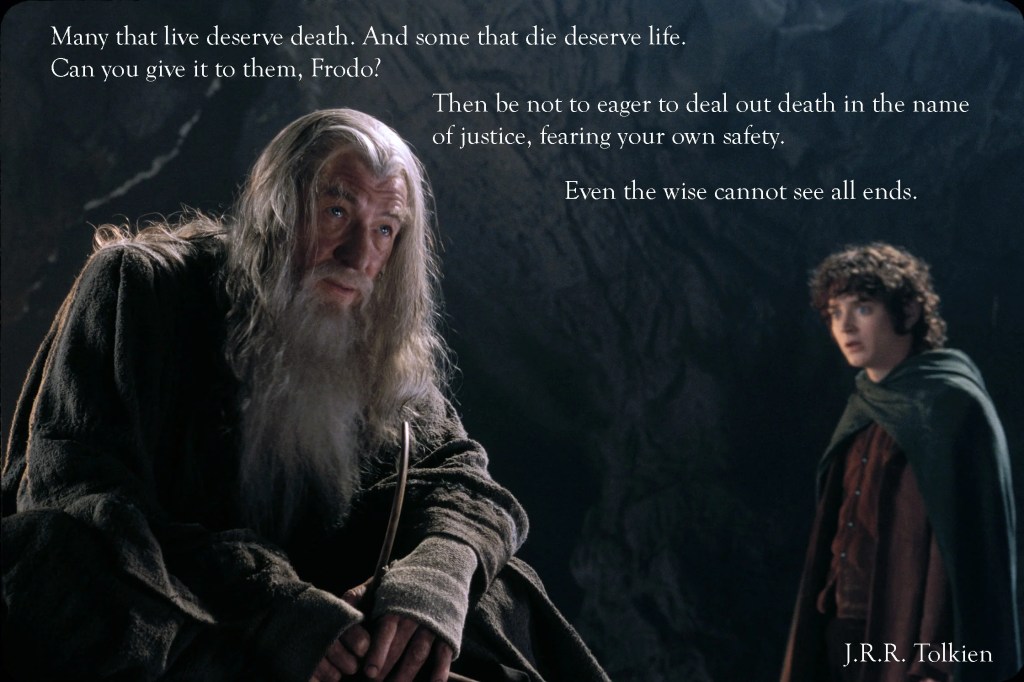
Gandalf the White!? Gandalf the Woke!

Republicans could have looked at Rittenhouse and Penny and said that, while it’s important to recognize the value of property and the comfort of (*cough* white) citizens, it’s a tragedy what happened, and we deeply regret how these encounters unfolded. Much in the same way that progressive Democrats talked about Mangione, Republicans could have talked about Rittenhouse and Penny. They chose not to. These killings could have remained relatively neutral and normalized, but by dint of actually embracing these killers, Republicans brought overt capital-p Politics into the discussion. Through the way they’ve responded, Republicans have shown that this is their preference. They are building a politics wherein murder is not just acceptable, but actively encouraged. These killers were rewarded for their deeds.

To be completely upfront, this was the extent of what I wanted to write about this topic. As the length of time between my posts suggests, I tend to procrastinate quite heavily when it comes to putting my blog ideas online. In and of themselves, these killers represent rather well the radical extremity of the Republican party in comparison to the milquetoast Democrats when it comes to how far they’re willing to go in implementing their respective social ideologies. However, as I’m sure you’re aware, there has been a bit of a development in this topic since I began mulling it over.

What could it be??

Charlie Kirk was killed in the back-to-being-funny-again year of our Lord, 2025. Who did it and their motives is irrelevant. Everyone unanimously agreed immediately that this was done because of Kirk’s political views; the killer has been mapped on to what society already wanted to talk about by default. For the Right, the killer is “them.” They’re explicit about this, “They killed Charlie Kirk.” I’ve seen it personally on social media, and you can just trawl through any given Republican’s Twitter feed or speech that they’ve given and see the blame being placed on “the Left” or even Democrats. Representative Nancy Mace said that Democrats “own” what happened to Kirk. Representative Bob Onder said that the “Left” is “pure evil” and that there is no longer any middle ground. Conservative influencer with the ear of Donald Trump Laura Loomer said that the government needs to start prosecuting “leftist” organizations. Trump of course never strays from blaming the “Left” for everything, and refuses to even attempt to unify the country after this polarizing killing.

Compare this to the liberal responses, symbolized in the Ezra Klein article in the New York Times that talks about the tragedy of the killing, as politics should be about debate, free speech, and not killing people you disagree with. Don’t celebrate this, you nerds! It’s the exact same response as with Luigi Mangione; this isn’t the way to move politics forward; if you disagree with someone, build a movement – like Charlie Kirk did! He did politics the right way! Like I said, people are just mapping this event on to the beliefs that they already have. The Right blames the “Left” and continues on their merry way cracking down on groups of people they don’t like. Liberals talk about how the progressive wing just doesn’t understand how politics *really* works. This isn’t marking a turning point (pun intended) in American politics, but a continuation of how each party was going to act anyway. Republicans will keep being fascists, and Democrats will keep not understanding how fascism works, preferring instead to be Voltaire, defending to the death the rights of Charlie Kirk to say whatever he wants! Of course, Voltaire never actually said that, and his most famous work is actually about how everything is terrible.

“You’re a bitter man,” said Candide.
That’s because I’ve lived,” said Martin.”

The perseveration on the celebration of Kirk’s death is frustrating. Op-eds keep emphasizing the importance of dialogue and deliberation in response to disagreement, and that celebrating Kirk’s death defiles that sacred tenet of Free Speech. The problem is that this is awfully convenient for the politics of murder that is already in charge and dominating in the United States. Suggesting that sitting around talking while people are having their rights taken away, while a genocide is being enabled, while marginalized groups are being violently persecuted simply for existing, is the height of naive privilege. It’s nice to talk about an ideal society where problems are resolved diplomatically and to philosophize about a marketplace of ideas creating rousing debates that bring us closer to an ultimate truth. This utopia is not our reality. While you certainly can try to talk your way out of someone holding a gun to your head, it’s not that uncontroversial to try to defend yourself through other means. What Charlie Kirk stood for isn’t something that you ‘disagree’ with, it’s something that you fight. Words can be used in that fight, certainly, but the very institutions of deliberation, the American judicial system for one, are being sorely tested in whether or not words will be of any use combating the roaring fascism in control of the country right now. We shall see how effective they are.

Charlie Kirk founded Turning Point USA which, as noted above, hosted Kyle Rittenhouse after he killed those three people. Kirk was against civil rights and thought Martin Luther King, Jr. was awful and bad for America. He thought that immigrants of colour are “replacing” white Americans and should be treated accordingly. He built a movement on these principles, and helped Donald Trump win the 2024 election. The ethnic cleansing of mass deportations that is on-going is a part of Charlie Kirk’s legacy. Charlie Kirk is a significant contributor to the politics of murder that has become part and parcel of the American Right. His death is being used as an excuse to amplify that kind of politics; the tragedy of Kirk’s death isn’t that he died, it’s whatever comes next.

Was Charlie Kirk being killed a good thing? I don’t care. It happened, and it’ll probably spark a vicious, oppressive backlash that defines the success of any terrorist attack. I’ll finish by quoting Malcolm X on the assassination of John F. Kennedy:

“The chickens have come home to roost.”
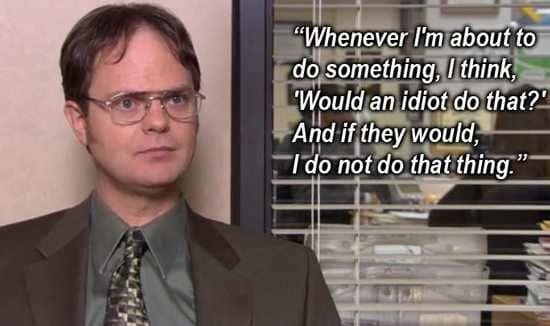
There’s a common conservative trope in America that responds to any demand for gun reform after a mass shooting with a disappointment in “the left” for making the tragedy “political.” In the most considerate light, this is the assertion that one ought to focus instead on processing grief rather than… what? What are politics? I mean… what am politics? I did a whole bit with my title; I should probably refer back to it for some degree of continuity. So what am politics?

Politics am the process by which a system functions and is successfully navigated. Think of office politics: if I want this report submitted, I know I have to get it in before noon because Pam in accounting has liquid lunches every day and is too sauced later in the afternoon to get any meaningful work done. If I want that promotion, I need to laugh at Scott’s jokes because he is the boss and has a fragile ego and holds a grudge. You have to recognize the power dynamics at play, understand everyone’s role and the eccentricities that inform their behaviour within that role, and perform your own role accordingly in order to meet your own needs within that system.

Politics!

Government isn’t politics; it’s an institution of politics for the functionality of the society that it governs. If I want any hope of a clean energy deal, I have to give Joe Manchin a rusty trombone in order to get it. This is no different than getting Pam to process your TPS reports quicker by buying her a nice vodka cran, if tasting slightly worse. It doesn’t even necessarily matter what the goals are; politics can just as easily gum up a system as it can loosen it. An obstructionist can use all sorts of political tools and rhetoric to achieve the self-interested goals of whatever lobby group is paying for their motivation: that’s also politics. It’s just that the system that it’s sustaining is plutocratic rather than serving the needs of the demos. Systems are legion and intersect in all sorts of ways.

My first example was an office because I specifically wanted to distance politics from government to make it clear that politics exists anywhere. Politics exists across the whole spectrum of governments, and if you think about the vast differences between a democracy and an autocracy, and the different maneuvers that would be required to function within each of them (e.g. how one goes about satisfying the needs of the many compared to satisfying the needs of the one), it’s obvious that politics can be everywhere, even when it’s defined by only its most overt form. Remember, it’s the process by which we function within a specific system. It doesn’t matter what the system is, whether a workplace, a nation, or a relationship, politics is there. When you successfully answer whether those pants make her ass look fat, you’ll likely be congratulated by being told that you provided a satisfactorily diplomatic response: a distinctly political term.

In short, dismissing gun reform by saying, “it’s easy to go to politics” is by definition, politics. If you are carefully considering your words in order to maintain the functionality that serves you within the system you’re navigating, you’re doing a politics. The far more interesting question is, I think, what is political?

What am political?

When something is political, it means that it is attached to a particular system’s functionality. Laughing at Scott’s jokes is a political act. It is conforming to a persona of flirtatiousness in order to succeed within a business dominated by men informed by a lecherous patriarchal worldview. This is why they say that the personal is political: our individual actions either conform to or rebel against the systems within which we function as our means of navigating them (see code-switching as another example). In Scott’s instance, we have to navigate the system of interpersonal relationships wherein we behave in a particular way to avoid ostracization, the system of a workplace wherein we need to perform in a certain way in order to pay for food and rent, and the system of patriarchy wherein I actually don’t have to worry about this part because I’ve been a dude this whole time.

It would actually be a much shorter list if we try to think of things that are not political. Come to think of it, even an act of God like Hurricane Katrina is still political because it showcased the failures and successes of a variety of systems. Similarly with Covid-19, it too stress-tested the functionality of our various systems. These supra-human events are just as political as, say, the Civil Rights movement because if we are paying attention, we can use politics to adjust our systems accordingly to prevent future failures. Or, alternatively, condemn the system as a whole if we see its successes as abhorrent when the veil is ripped away. Anything can be political if it highlights the (dis)functionality of a systemic response, so our short list is a list of zero. Who knew.

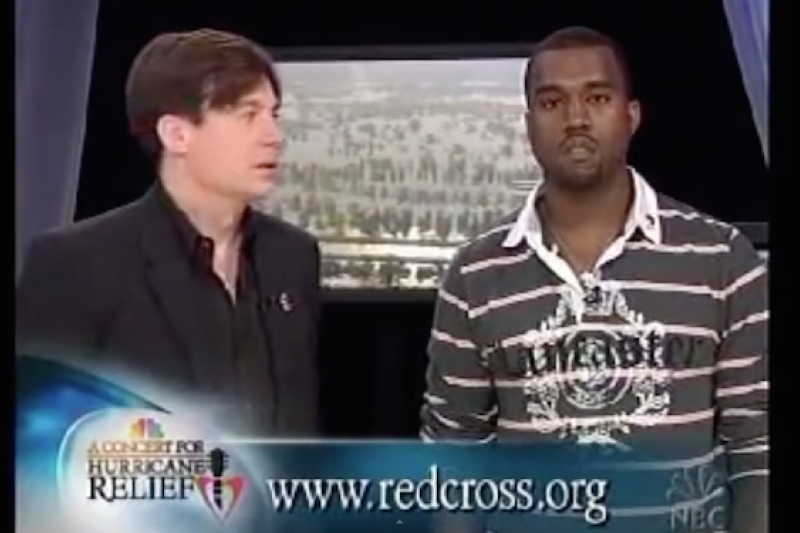
Remember when Kanye cared about black people?

All this boils down to a belief that guns, and all the deaths that inevitably accompany them, transcend literal acts of God in that they cannot be politicized. Right? Something that is embedded in the United States constitution, itself another institution of politics, would defy all reason if we approached it politically. It’s seemingly okay to politicize mental health, and I would genuinely love to see massive increases in expenditures to bolster social supports for those with mental illness, but somehow I don’t think that that governmental response is in the cards either. It would be fun to call the Republican bluff and table legislation that did exactly this to see how Republicans find a way to weasel their way out of it, but Democrats have their own systems they’re trying to protect.

A belief that guns are inevitable does not want the system to change; mass shootings are indeed emblematic of its success. Guns mean freedom! All those dead children are the broken eggs intrinsically linked to this omelet of ambiguous “freedom.” Unadulterated “freedom to” with no regard to “freedom from,” this is what the success of that system looks like. Those who use politics in order to hide the abhorrence of that success using the denunciation of “politics” to do so are the vilest of hypocrite.

The war in Afghanistan began with the oppressive, theocratic Taliban in power, and ended with the oppressive, theocratic Taliban in power. Sisyphus rolled his Katamari Damacy boulder up the mountain, and it rolled right back down again. The absurdity of the war is obvious on its face, but there is a desperation to find meaning within it that would make Camus blush. Though it’s somewhat old news by now, during the American withdrawal, there was all sorts of noise about how Western forces were abandoning their Afghan comrades to the brutality of the Taliban.

I am not trying to diminish the severity of what the Taliban has done and will continue to do with those dissenting under its rule. My glibness comes as a result of the crocodile tears shed over the bodies of those slain during the withdrawal from the war that ignore the over a hundred thousand bodies that accumulated preceding it. Losing a war is bloody; that’s the reality of war. If you don’t like it, maybe question the war itself rather than the means of its end.

The realities of war

The tears come from the bipartisan desire to create meaning in a pointless war: if there are good Afghans to save, it means that the war produced good Afghans worth saving. Nobody would have given a shit about them otherwise; the West would be much more inclined toward taking refugees if there was a heartfelt belief that we need to create a safe haven for those fleeing violence and persecution. The sad irony is that those whose freedom from the Taliban was being demanded were those who had aligned themselves with the invaders, cementing the linking of a “good” Afghan with their complicity in the war.

Another central tenet that the war in Afghanistan was meaningful is the women’s liberation that the war provided. Some women were able to go to school, and therefore 20 years of death, torture, and war crimes are vindicated. Those women are worse off now than they were before; again, no argument, but finding miniscule acts of success to justify what is otherwise 20 years of pointless war is incredibly ignorant. In actuality, using war to generate feminism is more likely to produce a nation of incels who see feminism as cancer than an Islamic Feminine Mystique.

Thanks, Betty Friedan!

Using feminism as justification for the war in Afghanistan, and gesturing loosely toward the mostly urban women who benefited, pointedly ignores the majority of women who live in rural settings where most of the war took place. Afghan women were certainly not benefitting from the war when they and their families were dying from it. The quick rise of the Taliban points to a nation hungry for incel-logic; Afghanistan may actually be worse off than it was 20 years ago from the perspective of democratic and liberal reformation due to the brutality used allegedly in its name. Sisyphus’s boulder fell back down the mountain and into a ravine. The West tried to viciously impose liberal secularism in Iran with the Shah, and he too was violently overthrown by a virulently religious fundamentalist group. Any positive regard held for Western ideals is just as dead as all the rest of them.

The war made Afghanistan worse, and for what? The bipartisan narrative adopted in much of the media paints the picture of a blundering but ultimately benevolent force trying so hard to do good but occasionally failing in simple but horrific ways. Like if Rocky Balboa knocked out Apollo Creed in the first round, but because his eyes were all bruised up and he couldn’t see, he wandered into the crowd and begun striking civilians at random. At home we’re watching and thinking, no! Rocky! If only Mickey had cut you so you could see! We are helpless as Rocky bludgeons old women and children in his missteps. Then, after the crowd boos too loudly for too long, we lament Rocky leaving, shaking our heads at the blows he receives on his way out the door. Meanwhile, Apollo Creed has gotten up and dusted himself off, and being the only one left standing in the ring, claims victory.

YO AMERICAAAAAAAA!

We could still love Rocky after such a blunder. It’s forgivable. But that’s not how war works. The better analogy would be if Rocky was at a bus stop where Apollo Creed was reading a newspaper, and Rocky was like, “I heard you hate women!” and then pulled out a gun and shot him. Then he wandered away from the bus stop to a nearby wedding reception and shot up the guests. And he did so with eyes wide open.

The West knew what was going on in Afghanistan. They’re actively preventing themselves from being held accountable to international law. We’ve had whistleblowers point out the war’s criminality to us repeatedly and they’re all being punished for it by both American political parties. And for what? For what? For literally no reason. Terrorism didn’t go away; Al-Qaeda evolved into ISIS-K. Afghanistan is fully red pilled. America wanted war instead of justice, the rest of the West went along with it, and this is what we’re left with.

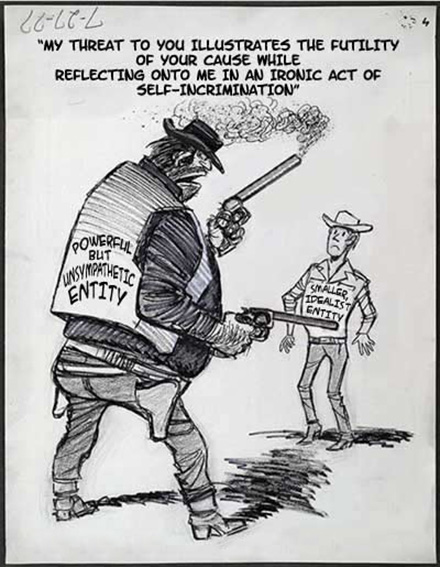
Cartoons make the villains easy to spot!

I’ve purposefully avoided talking about the military-industrial complex and how the reason for the war is obviously all the money that was made by the defense contractors and weapons manufacturers. It’s not that I disagree, it’s that we don’t have a smoking gun pointing to that level of Machiavellianism, and I want to be as convincing as possible. The war is provably pointless in a way that ought to make us reflect on why it ever happened in the first place. When there is no justification for a war, it’s a lot easier to compare it to straight-up murder. The war in Afghanistan was criminal. Those who participated in it are criminals. Anyone saying otherwise is covering up a crime.