Archives for posts with tag: Conservative

Christmas, as it is popularly understood, is a deeply conservative holiday. It is literally about the birth of the Christian saviour, and there is a declared war against it by woke liberals who wish nothing more than to acknowledge a world outside of baby Jesus and His manger. It is a holiday deeply embedded with tradition, symbolism, and in-group community – big conservative values! For those who know me or have read this blog for any length of time, you’ll know me as an anarchistic atheist who disdains power and hierarchy, whether religious or secular. You would assume that someone with such radical beliefs would be antagonistic toward Christmas and all its consumerist, nativist ideology.

You would be wrong.

It was a revelatory moment when I realized that I was a Christmas conservative. Obviously not in the mainstream sense with either of those two phenomena, given the birth of Christ holds no meaning in my life nor do I believe churches ought to be exempt from taxation. I just like to celebrate the way that I’ve always celebrated. Big family affair, some gifts, a real tree, Christmas Eve on Sesame Street, and an immutable canon of movies and songs.

Elf on a Shelf became a thing much later in my life, so I think it’s tacky and creates additional lies that must be maintained on top of an already dubious holiday tradition of Santa Claus and the north pole. They keep making Christmas movies, some of them even fairly well-done, but as much as they might involve the saving of Christmas from a variety of yuletide threats, they will never be truly Christmas to me. People literally mark the beginning of the holiday season with the emergence of Mariah Carey’s All I Want for Christmas is You, rising from the rotting leaves of fall to usher in the season of unending retail insanity. I do not consider it a Christmas classic since it did not come out early enough in my life for me to have had it embedded in the core of my Christmas spirit. I’m not so much a Grinch about Christmas as I am a stodgy, old curmudgeon, set in my ways, whinging about the kids these days who know nothing about what Christmas is truly about – how I personally have celebrated it since I was a kid!

The greatest consequence of global warming is she keeps escaping every single time!

I see value in the way that I celebrate Christmas. It’s important to me, and I wouldn’t want to have to change my ways because I see this holiday as sacred, in my own secular way. My community is small and familial, but meaningful. I have my traditions, my important symbols, and my cherished values deeply entwined with this holiday. I’m hopeful to be able to pass down my traditions to my currently hypothetical children. As much as anyone can be a conservative, I am with Christmas.

When I realized that I was a Christmas conservative, it formed within me a hitherto unknown empathy for the right-wing. It’s nice to have nice things. Change isn’t an inherent good. Progress is nuanced, and blasphemy can truly sting in the yearly attacks of a 90s pop-diva. Maybe the values of typical conservatives don’t come from what they abhor; maybe the values of typical conservatives, perhaps, mean a little bit more…

Some say his bipartisanship grew three sizes that day!

I think the biggest difference in a Christmas conservative like myself and a traditional conservative is that modern Christmas is very clearly diluted in its practice and has been embraced by secularism rather broadly. People get upset when stores have “Happy Holidays” in the window, but they’re not putting it up during Ramadan, are they? Much in the same way that everyone acknowledges that this is the year 2025, we celebrate a Christian holiday without too much fretting over the minute details of its religiosity. It is patently obvious to me that my puritanical Christmas beliefs come from my individual upbringing, but less so to regular conservatives that their own values come from the same place. There are as many Christianities as there are Christians; it’s just that no one acknowledges that, so it’s easier to want to impose a false doctrinal unity on everyone else.

I don’t care if you listen to Mariah Carey, during Christmastime or otherwise. You can sneakily move your elf from shelf to shelf, and I’ll keep my opinions about it to myself. We can still be friends if you don’t like Home Alone, though I won’t necessarily trust the movie recommendations you might make in the future. The need to impose is where I break from the broader conservative movement. Other people don’t need to adhere to my lifestyle; that would be silly. Much in the same way a man kissing another man doesn’t infringe on my ability to kiss a woman, nor does someone born a man identifying as a woman impinge on my own lifelong masculinity, I don’t carry the fear and insecurity inherent in typical political conservatism that needs a mono-culture in order to feel safe in their practices. I can only empathize to a point.

How badly does one need to pee in order to be embrace inclusivity?

So this holiday season, celebrate however you like – or don’t at all! I am neither your real nor your hypothetical father!

Merry Christmas, ya filthy animals!
There’s a common conservative trope in America that responds to any demand for gun reform after a mass shooting with a disappointment in “the left” for making the tragedy “political.” In the most considerate light, this is the assertion that one ought to focus instead on processing grief rather than… what? What are politics? I mean… what am politics? I did a whole bit with my title; I should probably refer back to it for some degree of continuity. So what am politics?

Politics am the process by which a system functions and is successfully navigated. Think of office politics: if I want this report submitted, I know I have to get it in before noon because Pam in accounting has liquid lunches every day and is too sauced later in the afternoon to get any meaningful work done. If I want that promotion, I need to laugh at Scott’s jokes because he is the boss and has a fragile ego and holds a grudge. You have to recognize the power dynamics at play, understand everyone’s role and the eccentricities that inform their behaviour within that role, and perform your own role accordingly in order to meet your own needs within that system.

Politics!

Government isn’t politics; it’s an institution of politics for the functionality of the society that it governs. If I want any hope of a clean energy deal, I have to give Joe Manchin a rusty trombone in order to get it. This is no different than getting Pam to process your TPS reports quicker by buying her a nice vodka cran, if tasting slightly worse. It doesn’t even necessarily matter what the goals are; politics can just as easily gum up a system as it can loosen it. An obstructionist can use all sorts of political tools and rhetoric to achieve the self-interested goals of whatever lobby group is paying for their motivation: that’s also politics. It’s just that the system that it’s sustaining is plutocratic rather than serving the needs of the demos. Systems are legion and intersect in all sorts of ways.

My first example was an office because I specifically wanted to distance politics from government to make it clear that politics exists anywhere. Politics exists across the whole spectrum of governments, and if you think about the vast differences between a democracy and an autocracy, and the different maneuvers that would be required to function within each of them (e.g. how one goes about satisfying the needs of the many compared to satisfying the needs of the one), it’s obvious that politics can be everywhere, even when it’s defined by only its most overt form. Remember, it’s the process by which we function within a specific system. It doesn’t matter what the system is, whether a workplace, a nation, or a relationship, politics is there. When you successfully answer whether those pants make her ass look fat, you’ll likely be congratulated by being told that you provided a satisfactorily diplomatic response: a distinctly political term.

In short, dismissing gun reform by saying, “it’s easy to go to politics” is by definition, politics. If you are carefully considering your words in order to maintain the functionality that serves you within the system you’re navigating, you’re doing a politics. The far more interesting question is, I think, what is political?

What am political?

When something is political, it means that it is attached to a particular system’s functionality. Laughing at Scott’s jokes is a political act. It is conforming to a persona of flirtatiousness in order to succeed within a business dominated by men informed by a lecherous patriarchal worldview. This is why they say that the personal is political: our individual actions either conform to or rebel against the systems within which we function as our means of navigating them (see code-switching as another example). In Scott’s instance, we have to navigate the system of interpersonal relationships wherein we behave in a particular way to avoid ostracization, the system of a workplace wherein we need to perform in a certain way in order to pay for food and rent, and the system of patriarchy wherein I actually don’t have to worry about this part because I’ve been a dude this whole time.

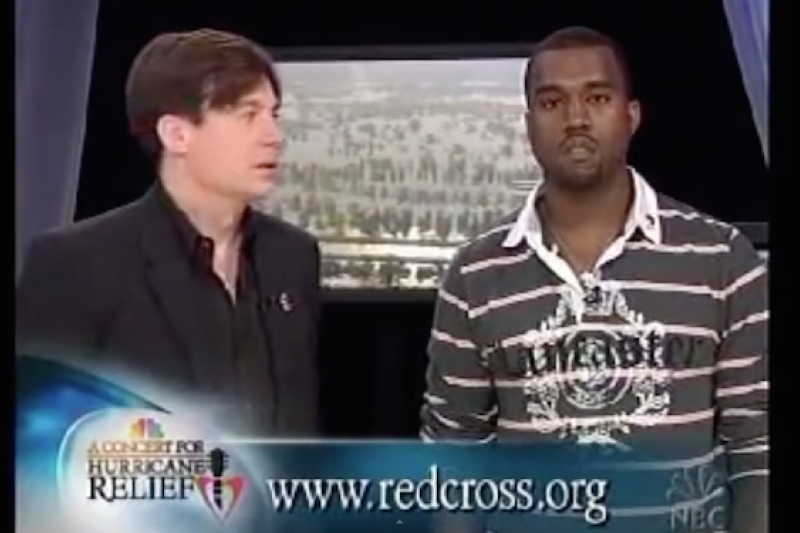
It would actually be a much shorter list if we try to think of things that are not political. Come to think of it, even an act of God like Hurricane Katrina is still political because it showcased the failures and successes of a variety of systems. Similarly with Covid-19, it too stress-tested the functionality of our various systems. These supra-human events are just as political as, say, the Civil Rights movement because if we are paying attention, we can use politics to adjust our systems accordingly to prevent future failures. Or, alternatively, condemn the system as a whole if we see its successes as abhorrent when the veil is ripped away. Anything can be political if it highlights the (dis)functionality of a systemic response, so our short list is a list of zero. Who knew.

Remember when Kanye cared about black people?

All this boils down to a belief that guns, and all the deaths that inevitably accompany them, transcend literal acts of God in that they cannot be politicized. Right? Something that is embedded in the United States constitution, itself another institution of politics, would defy all reason if we approached it politically. It’s seemingly okay to politicize mental health, and I would genuinely love to see massive increases in expenditures to bolster social supports for those with mental illness, but somehow I don’t think that that governmental response is in the cards either. It would be fun to call the Republican bluff and table legislation that did exactly this to see how Republicans find a way to weasel their way out of it, but Democrats have their own systems they’re trying to protect.

A belief that guns are inevitable does not want the system to change; mass shootings are indeed emblematic of its success. Guns mean freedom! All those dead children are the broken eggs intrinsically linked to this omelet of ambiguous “freedom.” Unadulterated “freedom to” with no regard to “freedom from,” this is what the success of that system looks like. Those who use politics in order to hide the abhorrence of that success using the denunciation of “politics” to do so are the vilest of hypocrite.

The maxim that “the personal is political” has been around since its origin in the 1960s feminist movement. It postulates that what happens in one’s personal and private life is actually quite relevant to and influenced by the larger, structural factors at play on a macro scale. But really, everything is political. Mezzo level institutions and organizations are political. Media is political. Neutrality is political. Everything is interconnected, and what happens anywhere is going to be shaped by, and will shape in its own discrete way, the world and its ideology.

When it comes to film and television, the same holds true. In general terms, action and horror films are inherently conservative. I appreciate a wide diversity exists across all genres, and some great films are great because they subvert common tropes, but by and large, action and horror films are inherently conservative. There is some threat to the in-group from an outside force, and the only difference between the two is whether the protagonist goes on the offensive or the defensive. Action films are usually a bit more broad in that the threat is typically to upset the status quo (think of the Joker who wants to change the world, and Batman who wants it to stay the same – Batman’s ‘solution’ to the world’s problems is ultimately to remove all the deviants). Or you can think of Captain America: Civil War which is one long advertisement for libertarianism (don’t let oversight committees hold me accountable; I, as an individual, know best). Horror films are more personal in that the threat is much more intimate. The threat is more overwhelming and overpowering. The viscera is embellished. But the overarching theme between the two is clear: the Other is dangerous, and you better fight or the bogeyman will get you. Think about it this way, conservative politicians and pundits use horror movie rhetoric to justify action movie policies.

They may seem like us, but there is just enough of a difference that their inhumanity is truly revealed

In contrast, adventure films are inherently progressive. The protagonist leaves their comfort zone, goes on their hero’s journey, and learns something from having experienced the different. Consider the original trilogy of Star Wars which would be incredibly problematic by today’s standards of identity politics: every human is white except for the one black guy who is pretty shady. Yet by the end of the story, Luke has found friends, teachers, and allies across a wide range of species with different languages, cultures, and lifestyles. The final confrontation is an overcoming of hatred, and the humanity of the antagonist is very literally revealed when Darth Vader connects with his son in his dying moments. It isn’t an outsider that is the villain of Star Wars, it’s hatred. It’s an ideology that can be overcome through non-violent resistance – Luke wins by refusing to fight.

The politics of a thing doesn’t have to be overt. It can be baked into the structure of the way a story is told. A character can have an exploratory relationship with the different, or it can be a threat. Protagonists in stories are paragons of how to interact with the world, and the way that the storytellers frame that interaction will inherently be political one way or another. Even the really obvious political messages like in Civil War don’t seem obvious because it is the framework of the story shaping the message rather than a character yelling at you that libertarianism is amazing. Though the beard Steve Rogers grows afterward may be telling…

Sharks, the Thanoses (Thanii?) of the sea, being shown here in a radical propaganda film that tells us that even those maligned as unthinkingly violent can be our friends… if we leave our comfort zone

Superficial politics is what is commonly associated with politics in movies today. Movies that base their entire marketing campaign on how much of a woman their protagonist is, or ensure that a minor character is Asian, or show a brief allusion to the existence of homosexuality in the corner of their film: these are what instigate the great political debates of our time.

When a film goes to great lengths to include every identity, it feels hollow. Films are finite, which means they have only so much time for character development, and peppering the screen with diverse, one-line characters is far more tokenistic than it is a genuine political statement. Even a television series doesn’t have enough time to invest in all the colours of the rainbow. Representation is important in films, but tokenism is not representation. Better to have less representation than just a rich tapestry of background characters, and then produce greater depth.

There is just… boy! There is just one of every kind of you, isn’t there?

I’ve written previously about feminist ethics in ‘feminist’ films. In this case I want to look at the politics. Replacing the male lead of an action film with a female doesn’t change the inherently conservative nature of the format. This likely contributes to the intense backlash that these types of films receive from white men: they are no longer presented as the in-group, which means they must be part of the out-group, which means they are closer to the one-dimensionally monstrous villains than to the heroine saving her own status quo. When Captain Marvel destroys the patriarchy with her laser fists, she isn’t creating a new, brighter future because the world she is saving belongs only to the in-group of the comfortable female watching the film from home. The world isn’t actually changed in any meaningful way, it just doesn’t have Jude Law in it anymore. The dynamic of the out-group threat remains the same; it is simply the content that is shifting. Here the narrative is exulting my elimination, and it doesn’t feel all that great. Hence, backlash.

Jonathan Haidt paints purity as an inherently conservative virtue, and I agree that it is, but it exists within progressive circles as well. When the left cancels itself on Twitter because someone isn’t being the perfect incarnation of allyship, that is the same manifestation of out-group exclusion found in any conservative diatribe. Framing old, white men as the dastardly fiends to be destroyed by a quick-witted teenage white girl and her motley crew of minority friends and LGBT acronyms is a shallow political message of identity and a deeper presentation of group categorization. The categories may be new and turn traditional categorization on its head, but the process remains the same.

A girl!? Inventing things!? Harumph and such!

Superficial politics in media will never change anyone’s mind because it isn’t intending to. It’s probably encouraging further divisiveness because conservative ideology is inherently divisive. Its intentions are to make money. Is it such a shock that billion dollar corporations aren’t actually as progressive as they pretend to be? Controversy breeds money, and enough people buy into shallow political pandering to turn a profit because they’re thrilled to be a part of an in-group for once, and their political education has come from triple-digit character count polemics on social media. Plus it pisses off the alt-right, and therefore it must be good! This kind of film will continue to be made so long as this continues to be the state of our world. If Fox News really wanted to end this manufactured culture war, they’d just stop ranting about it, and it would probably go away. I guess they have their own ratings to consider.

The thing is, though, more people probably learned how to open up to the outside world and fight against fascism from Star Wars than they did from the Ghostbusters remake. Ideology has a place in film, but it needs good storytelling to be effective. The right complains about Hollywood’s conversion to ‘woke’ culture, but progressive ideals have always found their home in fiction. The issue is panderous, bad writing and tired conservative tropes dressed up in progressive clothing that are alienating to the new out-group.

My political activism involves liking movies with really rabid comment sections on their YouTube trailers

I like action movies. Batman is my favourite superhero, and I thought Civil War was better than Infinity War. I dislike horror movies for the most part, but not for the reasons listed here. You can enjoy things and ignore the politics within them, but that doesn’t mean that the politics aren’t there. Those who don’t recognize them are going to be much more susceptible, and that sounds ominous, but it goes both ways. Maybe people will learn to be kind to strangers if they saw it in a movie once? There is a difference between good politics and bad politics, despite what those evil, relativistic postmodernists think!! Good politics represented as preachy and tokenistic only reinforces bad politics. Good politics embedded in a good story will go infinitely further.