Previously I wrote about how, through Zionism, Israel as a state and institution became fully representative of Judaism. Israel = Judaism in this framing, and the actions, good or bad, of the state are performed qua Jewish, and any attack on Israel becomes an attack on Jewishness. In this claim, it can’t help but be antisemitic since it forces a generalization across the Jewish population. This got me thinking.
This situation of an institution claiming to act on behalf of a group is not unique to Israel. For example, the Catholic church is codified in the actions and words of the Vatican. Does that make the Vatican anti-Christian? And the short answer is: yes!
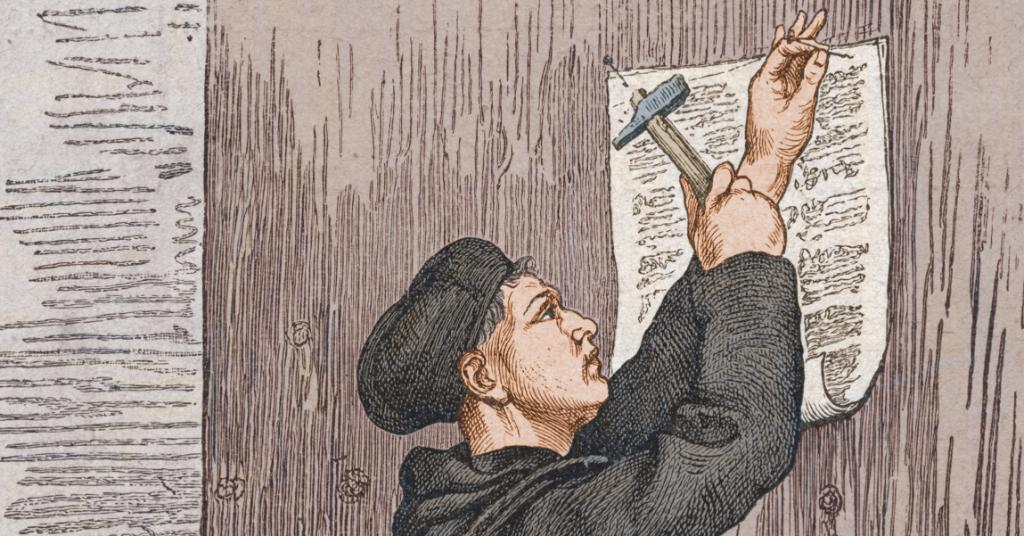
Martin Luther was indignant with the corruption of the Vatican when he posted his 95 theses on door of the Wittenberg’s Castle church. He was resisting its claim over his identity. He did not believe that the Pope spoke for his faith, and he started a religious revolution in rebuke. The actions and claims of the Catholic Church were an insult – they felt they were entitled to imbue their authority onto the identity of every single Catholic around the world, and the oppression of that authority was resisted and overthrown.
Indulgences!? Not In Our Name!!
Well, it was reformed into the guise of Protestantism. The Catholic Church is obviously still around, and obviously the Vatican is still representative of the identity of Catholics everywhere. However, the power of the Pope is much more symbolic than it used to be. Granted I speak as someone who is not Catholic, but whenever the Pope decrees something, it gives off the vibes of a Hollywood celebrity giving their opinion about politics: it’s going to be get attention, but it won’t actually mean anything tangible. The power of the Pope over the identity of Catholics has waned; the reformation was happening inside the house all along!
The decline in papal power over identity mirrors the decline in power of the Western monarchies. The secular state has similar power over identity: the British Monarch would speak and act on behalf of all Britons. Yet still, the Monarchs of today hold no more power than all the other glitterati we fawn over. Democracy has replaced monarchism, for the better.
Imagine a utopia where we don’t have to care about this…
The modern Western states still have governments that claim to act and speak on behalf of their people. The difference is that if the people disagree with that representation, the people are able (in theory) to remove them when the representation is no longer accurate. The people of that shared identity have greater control over how that identity manifests itself on the world stage.
This is ultimately why Israel maintains its antisemitism despite being a democracy (ignoring the apartheid). Israeli governments are not elected through the votes of every single Jewish person worldwide. The Zionist claim of Jewish representation is much more akin to the Catholic Church of the Middle Ages than the secular states of today. And I am quite comfortable with that comparison.
Any institution that claims to speak for an entire identity, but is not developed and held accountable by the voices of those who fit that identity, will always be an insult.
You ever go through a midlife crisis? Or endure the awkward evolution of adolescence? Surely at least one of those things – blogs aren’t really for the Tik Tok crowd. Coming to grips with who we are, who we want to be, and who we definitely are not is often a painful experience. When we search for an identity, it can be difficult because we don’t even know exactly what it is we’re looking for. What is an identity? How would I even go about getting one?
Be the Pokémon you want to see in the world
A good place to start is to list some identities, and one of the easy ways to do that is to make “I am” statements. I am a brother. I am a friend. I am a work colleague. There are other “I am” statements that I’m just going to ignore for now because I want to focus on the relational identities that my list has obviously focused on. I am who I am to the people around me. There’s something important to note here, though. If I have a kid, but leave early in that kid’s life to get some cigarettes and never come back, can I really say that I am a father? Biologically, sure, but biology does not an identity make. In a relationship, the way I relate determines the extent to which I can identify myself within it. Identifying as being a part of a relationship that you haven’t actually committed to in any meaningful way is what is commonly called a “red flag.”
Another example: if I identify as my race, or as my sexuality, that is likely because I am using that as a means of connecting to a larger community of that race or sexuality; perhaps both for the intersectional in the crowd. That’s why those in the dominant group are better off avoiding using their dominant traits as an identity; it creates relationships based solely on that trait. Those in minority groups need the solidarity that a healthy relational identity provides. Because of the redundancy of solidarity in a dominant group, identity within it becomes inherently oppressive. To be clear, identifying as an ethnicity in a relational way is usually done through connecting to a historical people, to a local community or neighbourhood, or to the people in a particular homeland. Also, it usually expands beyond the purely relational too. It typically involves the things that you do.
In searching for Waldo, do we ultimately discover ourselves?
An “I am” statement you might have been thinking of previously was your employment. I am a butcher. I am a baker. I am a candlestick maker struggling for business ever since electricity became a thing and now only serve a niche market. However, the same identity issue applies as before: if my job is to push papers, and the measure of my work is the amount of TPS reports I complete in a day, I’m not going to identify as my employment. As much as it might put food on my table, it won’t be who I am as a person. We have to connect to the things that we do in order for them to define us. We need to be able to have autonomy over what we do, see the results of our labour, and be challenged in ways that build our skill. Of course, what we do and who we know aren’t everything.
Tell me child, in what way would you like to make a profit for your employer?
Exuding certain characteristics or principles is also an identity. I am honest. I am brave. I am compassionate. This is the identity that navigates the way we engage with our relationships and our work. I am honest with my friends. I am brave in my dangerous career. I am compassionate with strangers. These qualities don’t even necessarily have to be abundantly positive: I am a tough guy when it comes to connecting to others emotionally – which means that expressing myself would not only go against social expectation, it would go against who I am. We very often cling to our harmful attitudes quite dearly because giving them up means giving up a part of who we are. These identities can even come into conflict. For instance, I am “reliable” and a “hard worker” who doesn’t spend any time with my children.
For those who have read Viktor Frankl, you may be noticing a pattern. Frankl posits that the ways in which humans find meaning in their lives are through our relationships, our work, and our attitude. Now I’ve just gone and described identity as those same three categories. Identity, who we are, is simply the ways we find meaning in the world.
“Hey Boo Boo, let’s go get us a pic-a-nic basket”
Unfortunately, the modern world has lain a trap for us. For example, we can connect to the characters in the Star Wars universe. We can go on all the Star Wars rides at Disneyland, lovingly bedeck our laptop with Star Wars paraphernalia, and we can be loyal to our franchise in a way that no loser Trekkie would ever understand. Every fundamental attribute of identity exists, and yet, for those fans whose identity rests solely in some form of consumption, be it television, film, sports, novels, etc., life seems awfully hollow. These are typically called parasocial interactions – when the way we connect to something only goes one way. We’ll never be able to ask Luke Skywalker to help us move (and that would be amazing because force powers would make it so much easier), and that’s because he’s a fictional character and force powers aren’t real.
Modernity has twisted identity in a way that is particularly sinister because consumption identity is often determined by sociopathic corporate interests that don’t care how broken and lonely we feel, they’re just happy to milk whatever pseudo-identity we have to their product for everything it’s worth – literally. Parasocial interactions are often exploited to sell figurines, novelty items, and an infinite supply of Marvel films.
We need reciprocity in our identity. We need to experience growth in our work. We need to experience recognition in our relationships. If we don’t, we will only ever be half of a person. There’s no problem with liking Star Wars or the Green Bay Packers or whatever else, but when it becomes an identity, then it means that something is fundamentally missing from who you are.
If your childhood is genuinely ruined by a capitalistic cash grab in the form of a shitty remake, then you probably didn’t have a particularly fulfilling childhood. It’s time to start over, friend.
Building a new identity is hard. The drug addict who quits their drug of choice is not just giving up drugs; they are abandoning the relationships they made in their addiction, the routine of their daily grind, their entire lives. Those who cannot build something to fill that void will relapse because the emptiness that remains is far more painful and scary than an unending fight against withdrawal symptoms. The early stages of recovery are a desperate search for meaning that, if unaddressed, will cause more relapse than any insatiable urge or temptation. “Boredom” is one of the biggest killers of recovery.
Identity is a huge part of our lives. It’s the entirety of who we are, in fact. If we don’t like our identity, or if we’ve lost large chunks of it through recovery, retirement, disability, or other identity-altering experiences, then we have to find a new way to find ourselves. Relapse is not the worst thing that can result from a loss of identity; the stakes are pretty high. But if we know the foundations of who we can become, then we can build on something solid. We can strive to love well in our relationships, find purpose in the work that we do, and exude qualities and principles that we can be proud of. Who we are is how we find meaning. What’s meaningful to you?
The ship of Theseus is an ancient philosophical thought experiment about the nature of identity. Theseus is an ancient Greek dude, and like all the ancient Greeks that we hear about, he had a ship. Unfortunately, Theseus’s ship ran into some hard times, and needed to have some parts replaced. A plank here, a plank there. All the sails at some point, I guess. The point is, after a while, every single part of his ship had been replaced with a newer one. The questions is: how is it still Theseus’s ship if literally nothing of the original remains?
Little known fact: Theseus was a dog this whole time
Aging is, in scientific terms, a son of a bitch. Our muscles atrophy; our hearing starts to go; and, in some cases, we lose our memories and our grip on the reality around us. We too become slowly replaced over time, just not with newer parts as with Theseus’s ship, but with older, crappier parts that give out and have a mustier smell. When our older family members develop dementia, we struggle with the same kind of identity crisis as Theseus. We are looking at someone that we used to know in one way, and now none of the original parts seem to remain.
Dementia in a loved one is actually incredibly difficult to witness, and I am insensitively making light of the situation. I’m not going to stop, but it’s important to acknowledge.
I do believe that the ship of Theseus maintains its identity over the duration of its incremental replacement because there remains a single constant: Theseus. It’s Theseus’s ship because Theseus sees it that way, with a degree of social corroboration as well (people will, for the most part, agree that it is still Theseus’s ship – otherwise they would see it as stolen). The identity of the ship exists in its relationships just as much as it does in its material make-up.
The same holds true with dementia. Before my grandmother passed away, she developed dementia and no longer saw me as her grandson. However, I still saw her as my grandma because my inevitable deterioration has yet to begin. We maintain our relationships with our loved ones, and that maintains their identity. She was my grandmother. That relationship never changed even if her own perception of her active relationships had shifted wildly. Even if she no longer sees me as her grandson, this is irrelevant. Keep in mind how the ship might relate back to Theseus, given how it is an inanimate object. It wouldn’t, is my point. We define how we relate to others, for better or for worse.
This is not my grandmother, but wouldn’t it be great for this blog if it were?
Part of who we are is certainly the sum of our parts. Our physical and psychological body cannot be fully cleaved from the concept of our identity, but these, our physical body especially, are only superficial facets of who we are. I am a son, a brother, a partner, a friend, a coworker, and a bitter, hated enemy. I had a grandmother, and that defined who she was to me. Theseus had a ship, and it was how he related to that ship that defined its identity regardless of how many planks ended up being replaced. If you continue to love them, they will continue to be your loved ones.






 Blog for Chumps