Archives for posts with tag: Israel

I often find myself thinking about the Haitian Revolution. Not because I’m a historian, nor do I feel any particular personal connection to slavery. I am quite Caucasian, thank you, and my natural empathic connections lay in far more privileged in-groups. Frankly, I have more in common with the French slavers than I do the Haitians, and that is precisely my point.

Hello comfort zone!

The Haitian Revolution was vicious. When the slaves rebelled, they did so with ferocious gusto. The Haitians tortured and slaughtered every single French family on the island, ostensibly to prevent further enslavement, but arguably as revenge for the crimes of their colonial nation. The only White folks who were spared were the Germans and Poles. In retaliation, the French set up a blockade around the island with their navy of warships and forced reparations from the new republic, demanding the former slaves pay their slavers approximately $3.5 billion USD in today’s currency, with Haiti only paying it off finally in 1947. Haiti’s modern day impoverishment was imposed by a jilted nation bitter about losing the people they owned as property.

The Haitians brutalized French civilians, killing entire families including children. Did France have the right to defend itself? In a just world, should they have invaded the poor nation to reestablish the status quo? Let’s say for the sake of argument that the French would have been delicately proportionate in their response, and avoided killing civilians, targeting only the militants who overthrew the slaver regime. They were one of the few republics globally at that point, deposing their own tyrannical rulers in their own notably dovish way; surely their cause must have been just – they were an oasis of democracy in the world! Would their resolute nobility justify returning the Haitian people to enslavement? Should we condemn the Haitians for their revolution? Surely a peaceful solution was possible, and while we may mourn the tragedy of French retaliation, devastating in its reality, we cannot abide the violence of a slave revolt. Surely.

I don’t think the Haitians had truly exhausted their kumbaya resources

Slavery is now considered one of the greatest evils humanity has ever perpetuated. To respond to it with violence isn’t actually at all controversial. When America eventually caught on that slavery is bad, it had a whole war against itself in order to reject it. To talk about the Haitian Revolution without the context of slavery is just about the most absurd thing anyone could ever do; even the worst student in a high school history class would still include the word “slavery” somewhere in their failing final paper, perhaps even in the title. When we look at the slave revolt, the keyword is already present in the phrasing. To pretend it erupts in an ahistorical vacuum would require significant leaps of racism to ignore.

My parallel is not subtle, and the criticisms are predictable. What the French did, slavery, is objectively wrong, and the Israeli treatment of Palestinians is a false equivalence. Perhaps, but we must look at the context to determine whether or not that is actually true. In the occupied territories of the West Bank (deemed illegal under international law), Israeli settlers are forcibly evicting Palestinians from their homes in order to claim the land for their own, often using violence to do so. In Gaza, one has to wonder how Israel had the power to eliminate access to drinkable water from entering the region after Hamas’s attack, along with other trifles like fuel, food, and medicine. This blockade has been in place since 2007. What do you call it when one group controls the necessities of life of another, removing access to it when they disapprove? It is driving a people into submission, reminding them who has the power over their lives. While there is no forced labour, the comparison to slavery does not feel too outrageous. There is a word that is commonly bandied about though, apartheid, as described by Human Rights Watch, Amnesty International, and even the Israeli human rights group B’tselem. What does it mean to use violence against such a state of oppression?

This surrounds Gaza. This is why it’s often compared to an open-air prison with unlivable conditions even at the best of times. What kind of moral equivalence should we attribute to the imprisonment without charge of an entire people?

Which leads me to the second predictable criticism. We’ve grown as a species since the days of colonialism and slavery! We don’t need violence anymore! Even the apartheid in South Africa was resolved through the peaceful actions of the great Nelson Mandela! Violence, in any context, is inherently evil and should never be used as a political tool.

There is an old philosophical adage that states that ought implies can. This is a simple maxim that stipulates that only someone capable of acting ethically is responsible for doing so. If I can’t lift a boulder that’s crushing you to death, I am not responsible for saving you. If I’m Superman and just don’t bother to lift the boulder, then I am acting unethically. It’s fairly straightforward – we can’t perform moral duties that we are unable to perform, therefore we are not obligated to follow them.

Holding people to literally impossible standards?! Something something joke about relationships

Can Palestinians use non-violent means to end the apartheid imposed upon them? I mean they’ve tried. The United States has vetoed every single United Nations Security Council resolution that would hamper Israel’s ability to oppress them. The International Criminal Court has been rendered essentially impotent in their investigations into the matter due to America’s opposition, sanctioning prosecutors. Israel also flatly rejects the jurisdiction of the court, denying any international legitimacy to the complaints of the Palestinians. The Boycott, Divest, and Sanction (BDS) movement that attempts to use similar tactics that ended apartheid in South African is often legally impermissible, or at the very least culturally frowned upon rendering it inconsequential as peaceful protest. When Palestinians protest peacefully locally, they are often shot for their troubles. Journalists covering the situation are also killed with impunity. The list goes on.

What exactly ought the Palestinians to do? When we condemn Hamas, we’re saying they ought not to have done what they did, but the follow-up question becomes: what ought they to do instead? There does not appear to be any effective measure Palestinians can take that will alter their situation in any meaningful way. Are they simply to sit passively by? Allow history to unfold as it will, without their input? Should the Haitians simply have waited for the French to determine on their own that slavery is morally bankrupt? France ended slavery in 1848, 44 years after the Haitian revolution. Would we ask them to endure another couple generations of slavery to avoid any wearisome violence? How long do you think it will be for the Palestinians to wait, or will the historical narrative have them driven out of their homes forever? The idea of forcibly relocating a people out of their homes under threat of death has terrifying precedent.

Don’t you know that patience is a virtue?

The third and final predictable criticism is that I am justifying the terrorism of Hamas; what Hamas did was good actually, and innocent Israeli families deserve to die. Hopefully by now you’ve been able to ascertain the entire point of this article. We cannot justify the acts of Hamas in the same way we cannot condemn them. We cannot say they ought to have committed such atrocities just as much as we can’t offer an alternative. If ought implies can, and Palestine is forbidden any action whatsoever, then there can be no ethical component to their deeds. The October 7th attack can neither be condemned nor justified because it does not exist in the ethical realm. The violence of Palestinians transcend any ethical deliberation because ethics have long been unattainable for them. Hamas acted in what amounts to a state of nature, and people died. We are allowed an emotional reaction to be sure, but not an ethical one. If we want an ethical option for Palestinians to embrace, perhaps we should give them one. We can act.

If I was alive in Haiti in the early 19th century, me and my family likely would have been tortured and killed by dint of nothing more than our racial identity. I certainly wouldn’t have enjoyed it, and I would appreciate people mourning the deaths of me and my loved ones. I’ve long questioned, however, even before October 7th, 2023, the justifications for my survival in that context. What is my life or death in the face of the giant of slavery? How ought I to be treated as an accessory to slavery? What would my own moral obligations be if I survived the slaughter? How does one condemn a slave revolt in a world without ethics?
Joe Biden has gone on the record to declare, like many US presidents before him, that Israel has the right to defend itself. And of course it does! If zombie Hitler rose from the grave to lead an undead Fourth Reich into the heart of Israel to finish the job, then yes, Israel should do its best to save humanity from the zombie Nazis. We would all be counting on them! However, now that 2020 is over and the likelihood of this event has dwindled, we have to look at the cold reality.

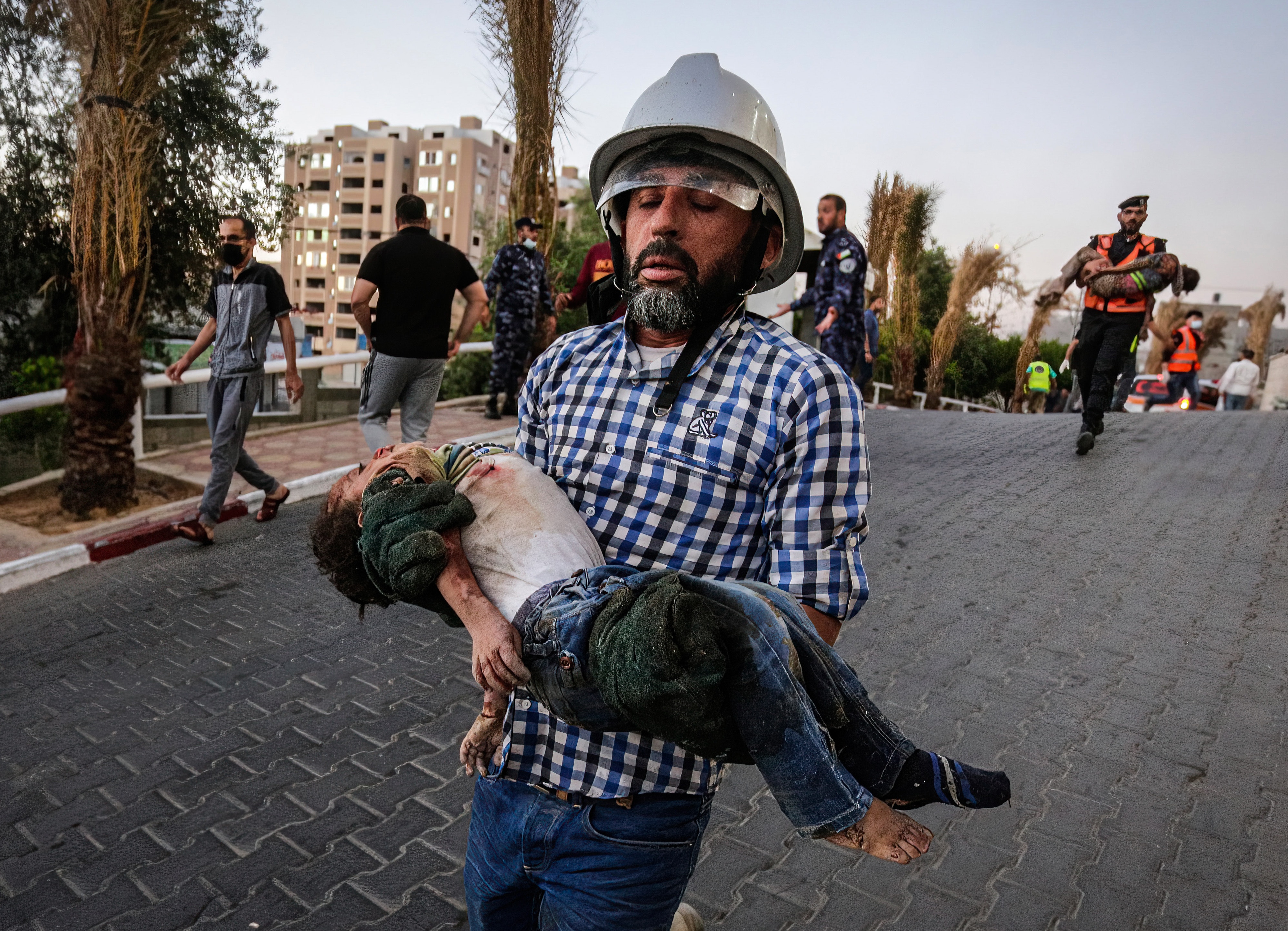
Hamas is firing rockets into Israel. That’s obviously a bad thing, so maybe Israel does have the right to retaliate against journalists, and the right to ensure that children are just under one third of all Palestinian deaths. Given that life expectancy in the area is so short that the median age is about 21 years old, it’s just statistically likely that there would be disproportionately younger victims. It’s simple math! But wait! Why is life expectancy so short in Palestine? Now a lot of folks don’t like talking about that because that means you’re bringing context into the conversation. Context would require us to look at what happened before Hamas started firing rockets into Israel, and if we do that, then maybe it doesn’t look so much like defense after all…

The body of a Palestinian child, killed during an Israeli airstrike, is carried to Al-Shifa hospital in the Gaza Strip, Palestine, on May 13, 2021. Photo: Mahmoud Issa/SOPA Images/LightRocket via Getty Images
Oh shit! Context!

What had happened just before the rockets was a police raid on the Al-Aqsa mosque in East Jerusalem. There were a whole bunch of Muslims praying there because, you know, Islam, and it’s the third holiest site of Islam, and it’s the month of Ramadan, so some Muslims wanted to do some praying. At the same time, some Israelis wanted to do some celebrating of Jerusalem Day to commemorate their invasion and occupation of the area back in 1967. Since the mosque is technically owned by the Muslims (though the grounds are patrolled by Israeli forces), the police banned the revelers from the area. They decided to plan their parade anyway. The police opened fire on the Muslim worshippers with rubber bullets, tear gas, and stun grenades; the worshippers were, at most, throwing rocks. If you were wondering, those revelers were still able to enjoy their party as flames leapt over the mosque! It’s not a great look.

East Jerusalem wasn’t bent out of shape for no reason, either. In the Sheikh Jarrah neighbourhood, Israelis were doing their best to forcibly evict Palestinians from their homes in order to claim them for themselves. It’s not like the Palestinians were behind on their rent or anything; the Israeli settlers just wanted to take their homes. So they did.

“If I don’t steal it, someone else will!” Well, they might, but it’s unlikely they would be an Arab.

We’re trying to look at context, so what’s the context of all this? What happened before? Well it started with the Nakba, or the ‘Catastrophe’, where over 700 000 Palestinians left or were kicked out of their land when Israel first became a thing in 1948. There were likely some atrocities to encourage them to leave, but these are being hidden by Israeli authorities. It’s pretty straight forward really. The British gave Jewish people a homeland thanks to the Balfour declaration, but it’s not like the land they were ‘giving away’ was empty (the British had also promised the land to the Arabs for helping them out with another thing, but you know, who gives a shit I guess?). Also, what’s the morality of a colonial empire ‘giving away’ land that it only ‘owns’ in an exploitative context? Anyway, the whole thing was a shit show, and all the Arabs in the area were kind of pissed for pretty obvious reasons.

In 1967, Israel decided to expand. To give a bit of nuance, a bunch of neighbouring countries were lining up military forces along Israel’s border, and overall tensions in the Middle East were high (the fact that there were hundreds of thousands of Palestinian refugees roaming around didn’t help, and Arabic countries kept trying to invade Israel to undo the crime they believe had been committed). However, Israel attacked first and attacked hard. To be clear in the context of this blog’s title, defense is not aggression. In about six days, Israel drove beyond its borders, and then annexed a bunch of the land it had invaded. Israel tripled in size at the further expense of the surrounding Arab countryside. This was (and still is) hella illegal under established international law, and the United Nations passed Resolution 242 to point out that you can’t just invade and take people’s land if you’re trying to establish peace in the Middle East. For comparison, when Russia annexed the Republic of Crimea, everybody got mad and imposed a bunch of sanctions even though Russia said that since Crimea was part of the USSR back in 1991 and had been a part of Russia since about 1783, it was entitled to have it back. Israel claims that because Jewish stories talk about a holy land, they have similar entitlement. I wonder if there’s a movement to sanction Israel, or at least boycott or divest investments…

Your laws mean nothing to me!

I’m not a historian, and I don’t advise utilizing this blog as any kind of historical education. There is much more to this story, and Israel arguably became a much safer country for its citizens after the 1967 expansion. The issue isn’t really related to traditional geopolitical affairs, but much more the creation and expansion of an ethno-state. Jews have what’s called a Right of Return that allows any diasporic Jewish person to easily immigrate to Israel; the hundreds of thousands of Palestinians that were displaced during its creation do not because Israel is a democracy and they don’t want non-Jewish voices influencing their political decisions. The overwhelming desire is to maintain a Jewish ethno-state. As an example, in 2018, it was enshrined in law that only Jews have a right to self-determination in Israel; Arabs in Israel, who also lost the official recognition of their language in the same bill, apparently do not. Palestinians living in the West Bank and Gaza Strip have no political voice whatsoever in Israel, despite Israel maintaining militarized checkpoints and controlling imports throughout the region.

This control manifests in many harmful ways. Checkpoints limit Palestinian ability to go to the hospital, go to a school outside of one’s ‘zone’, attend a funeral, whatever you can think of, because these checkpoints involve navigating hostile military police that can occasionally prove fatal. Israel also controls the water supply of Palestine and deprives them of this life-sustaining liquid. Israel actually illegally takes water out of Palestine to supply its own citizens. Palestinians only receive the aid that Israel allows, and with restrictions on fishing and lack of water, the food supply doesn’t do too well either. With Covid, despite Israel leading the world by having vaccinated 60% of its population, Palestinians aren’t doing nearly that well. They’re at about 5%. The conditions are so bad that the United Nations predicted that the land would be “uninhabitable” by… actually, according to their predictions, it already is.

Seems totally habitable!

Palestinians quite frequently rise up against Israel. They’re doing it right now, even, as I write this. Israel’s policy usually involves what is called “mowing the lawn“: when Palestinians get a little too uppity, the Israeli military will just come in and kill a whole bunch of them until they quiet down again. Even when Palestinians are protesting peacefully and unarmed, Israeli soldiers have been documented cheering on a sniper using them for target practice (the unit was reprimanded for taking a video, not for shooting unarmed protesters, if you were wondering). This ‘self-defense’ results in really disproportionate harms.

Palestinians aren’t too keen on all that stuff I mentioned above (and more – remember this isn’t an exhaustive blog), and Israel doesn’t want to give up its ethno-state. Really, it wants to keep expanding its illegal settlements into Palestinian territory to manifest the shit out of its destiny. Options are often framed as a binary between one and two-state solutions, but another, less discussed option is the perpetuation of a status quo that involves the gradual annexation of the surrounding territory and expulsion/extermination of the Palestinians living there.

It’s going well!

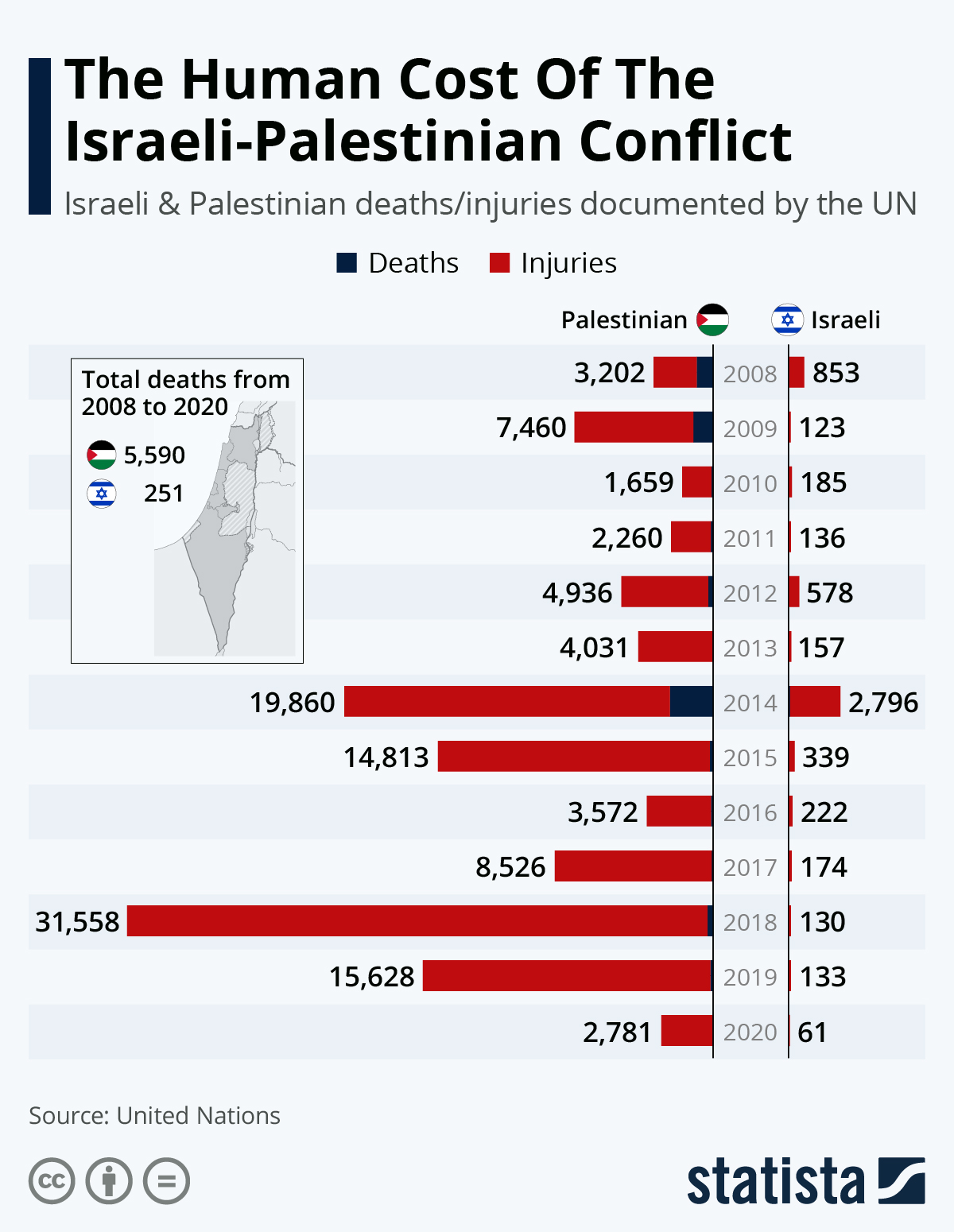
The world is trying to establish a degree of accountability. The International Criminal Court (ICC) is seeking to investigate potential war crimes committed by Israel when they were “mowing the lawn” back in 2014 (see statistics above). Hamas will also be investigated, but again, the statistics point to fairly disproportionate moral responsibility. The UN routinely attempts to condemn and interrupt Israel’s more pernicious behaviour, but the United States keeps stepping in to veto them. They’re even doing it again for the current crisis – 53 vetoes and counting! The Boycott, Divest, and Sanction (BDS) movement calls for non-violent intervention against Israel in a manner comparable to the successful international intervention that ended South African apartheid. However, in the United States, they’ve legislated against this kind of protest across the country, some places requiring professionals to sign an oath to never support the BDS movement lest they lose their job. In Canada, we’ve used our hate speech laws to stifle the BDS movement here at home as well. Elected Israeli officials offer no support either, and ‘alternate Prime Minister‘ Benny Gantz zealously seeks to develop illegal settlements with equal vigor to Benjamin Netanyahu. Israeli settlements in occupied territory are illegal under the 4th Geneva Convention. According to Human Rights Watch, what Israel is doing amounts to apartheid, but nobody ever seems able to do anything about it! Is firing rockets into Tel Aviv the best solution? Probably not, but the options available are quite limited.

Israeli violence against Palestinians cannot be considered defensive because it is an occupying colonial state – any violence is inherently an enforcement of its own hegemony. Even if Palestinians, or Hamas, or whomever, were to attack without ‘provocation’ which might necessitate ‘defense’, it’s hard to truly condemn insurrection based on the context of its evolution. We don’t cheer the explosion of Alderaan just because rebel forces might have attacked imperial storm troopers at a check point. Typical watchings result in rooting for the rebels.

The Death Star has the right to defend itself

To finish off, I’d like to quickly go over some of the counter arguments that I’ve seen in defense of Israel:

“Don’t you get it? Israel needs to bomb schools, hospitals, residential apartment buildings, media offices, and critical infrastructure because that’s where Hamas is hiding all their weapons and terrorists!!” The evidence that’s provided by the Israeli military about where Hamas might be holding its WMDs is often quite dubious. But let’s say for the sake of argument that the average, non-combatant citizen is so sympathetic to the Palestinian cause that they’re willing to let Hamas store weapons in the schools where children go to learn their ABCs (or the Arabic equivalent). Hamas is accused of using civilians as human shields, that’s part of the ICC investigation described above. Are people consenting to this? What does it say about the occupation that there are so many collaborators hidden among the Palestinian population? Maybe the depths that people are willing to go to resist Israel’s apartheid isn’t the slam dunk argument you think it is.

“Why does the left support Palestine?! Muslims hate gays, and the left LOVES the gays!! They’re all terrorists and Israel is doing what it can to keep order in a land filled with terrorists!!” Ah, I see you have chosen… racism. Demonizing a group of people as bogeymen to justify violent oppression against them is bad. No group is a monolith, and it’s quite dehumanizing to categorize them as such: hence, racism. Funny thing about racism, though: Israel is actually used as a template by some far right white supremacists for the ‘handling’ of minorities. The idea of an ethno-state is quite palatable to racists everywhere, and Israel certainly fits that bill. You can just ask Richard Spencer.

“Palestine wasn’t even a place when Israel was created! It was Syria and Jordan! It’s not their land!!” It was a territory of the British called Mandatory Palestine. Palestine has a long history of being associated with the region even if it was never established as an independent nation. It’s essentially irrelevant though: are you suggesting that they moved there from these other countries? Pretty sure the whole ordeal arises from the fact that these people were already there when was Israel was created, completely irrespective of what they were called. The problem doesn’t change! Let’s say they were truly stateless, does that mean they deserve the treatment they’re getting now? This one boggles my mind because like, this group doesn’t deserve dignity because the name doesn’t align with your understanding of history?

“You’re just being anti-Semitic! Why do you hate Jews so much!?” This is an obscenely common refrain when criticism of Israel arises, regardless of context. It’s offensive because it equates Judaism with the modern state of Israel (remember from earlier that no group is a monolith?). Plenty of Jewish organizations and individuals reject Israeli oppression. Hell, I would even go so far to say that criticism of Israel doesn’t even need to be considered anti-Zionist. Some Zionists need their Messiah to arrive before Israel can be founded, and see the secular institution of the nation as outside of their religious beliefs. Some Zionists don’t even recognize the current incarnation as a state!

Can’t we all just get along!?

Israel is in the midst of more lawn maintenance. What Palestinians are doing is fighting for their lives. This isn’t a ‘conflict’, or whatever milquetoast term some news organizations will use to try to be ‘neutral’ in their headlines, because that implies equitable forces on both sides. It’s a violent enforcement of apartheid being resisted by a group that doesn’t have many good options. Questions of ‘defense’ and ‘rights’ are often heavily loaded. When we look at all the context, the question shouldn’t involve such abstractions at all. What we should really be asking is: do Palestinians have the right to be alive?