Archives for posts with tag: philosophy

If you’ve ever taken a philosophy course, or at least had the misfortune to talk to someone who has, it’s likely you’ve heard of the trolley problem. It poses us this moral dilemma:

A trolley carrying five people is barreling towards a barrier erected by the dastardly Snidely Whiplash. You, our intrepid hero, can save these five people from certain doom by pushing a button that reroutes the train onto a different track, but alas! Snidely Whiplash has tied someone else to that track, and in rerouting the train, you will be killing that one person. What do you doooooooo?
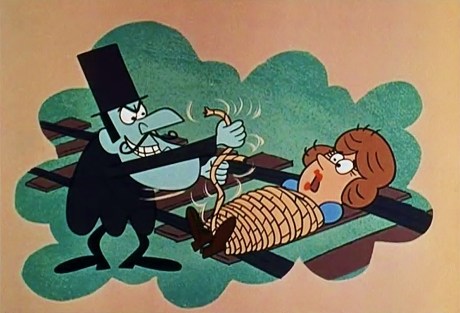
Snidely_Whiplash_Evil_Villian_2939902

That mustache is so prominent, it really distracts from the fact that Snidely Whiplash wears a dress.

Most people’s first thoughts are going to be utilitarian. Morality can be reduced to a simple mathematical formula: five people is more people than one; you should press the button. Here’s the problem: first impressions are wrong; utilitarianism is wrong; you are wrong. Consider this second example:

You are a brilliant surgeon. Snidely Whiplash has been at it again, and has, through some dastardly plot, caused organ failure in five separate individuals who are now in your operating room. Their situation is dire: their deaths are imminent. Just at this moment, a box arrives with a note that says, “Each patient has a separate failing organ, and your assistant is compatible with every single one of them.” In the box is a gun. As a brilliant surgeon, you can save those five people by killing your assistant and using his organs to save their lives, or you can do nothing and allow them to die. What do you doooooooo?
snidely-whiplash-image

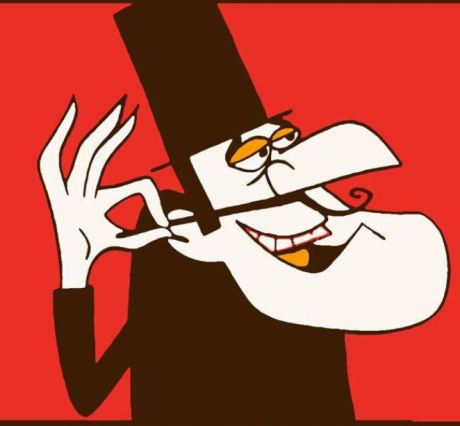
Come now, Utilitarians! T’is simple maths, m’yessss?

Despite the framing, both problems are identical in content. In both cases, you can either passively allow five people to die, or actively kill one person in order to save them. I expect that most people’s first impression of the second example is to not murder their assistant, even if they would push the button in the first one, but what causes that discrepancy?

Lt. David Grossman analyzes the nature of killing in his book On Killing, and part of what allows regular human beings to kill, who otherwise wouldn’t, is a distance from the target. It’s easier to kill someone at range than it is up close. It’s easier to kill someone through a scope than it is through your bare eyes. It’s easier to kill someone with the press of a button than it is with a gun. The consequences of our actions become diluted the further we get from our deeds. If we consider life in the abstract, life becomes worth measurably less.

Part of the reason that a nuclear bomb was dropped on Hiroshima was that nobody wanted to send in ground troops. It’s easier to kill from far away, and the horrors of a nuclear blast became justified. We care more about being ghosted by somebody off Tinder than we do about the collective deaths of the entire Syrian civil war because what happens to us up close will always matter more, no matter how ridiculous the comparison might be. We don’t want to kill our assistant because we assume that we have a relationship with that person, but we’re fine with killing a stranger tied to some train tracks, never stopping to wonder if that person might be someone else’s medical assistant.

Ethics is obviously an ongoing conversation, but the importance of the trolley and surgeon questions are what we as human beings are capable of. Are we killers? I mean killers in the sense of killing people, regardless of how far away (literally and figuratively) from the victim we are, or how little we value their lives. We are in control of our actions; that’s what we must decide.

When considering the trolley problem, think to yourself. What would Batman do? He would obviously swoop over to the train and work some kind of bat-strategy to save everyone, but he would never push that button. Know why? Because Batman is a God damn hero.

You ever notice how incredibly stupid the idea of individualism is? It’s essentially saying, “I’m going to make it on my own in this crazy world, and I’m going to do it wholly dependent on literally everyone around me.” We depend on our bus drivers to get us from point A to point B, and if we drive, we depend on our car manufacturer to provide that same function. We depend on our grocers to sell us food, who in turn depend on wholesalers, truck drivers, farmers, and so on, in order for them to get the food to sell us in the first place. We depend on strangers on the street to not stab us for no reason as we go about our day. We depend on our roommates to cover their share of rent. We depend on our actors to provide us entertainment. We depend on our athletes to provide vicarious exercise for our slovenly lifestyles.

But wait, you might say! I make my own money, and I use that money to induce others to perform those tasks for me! I am independent! But alas, no, you’re not. You depend on someone to pay you. It is perfectly conceivable to imagine a world where your employer decides not to pay you, or pays you insufficiently for what you’re worth, and then you become dependent on lawyers, judges, and the legal system in order to obtain redress. It’s also quite reasonable to suppose that there could be those you induce to take your money who do not then provide their service at all, or do an insufficient job. I suppose you could say that you could induce fair labour treatment using only the threat of the violence you personally could commit, but I can’t imagine a society like that ever thriving.

We depend on loved ones for comfort. We depend on our mentors for guidance. We depend on strangers for security. Like I said, we depend on literally everyone around us for literally everything we do. Others too depend on us in turn. You can’t criticize collectivism on the basis that it eliminates human individuality because human society is a collective. It can’t function otherwise! Certainly people are individuals with their own unique traits, but they exist in a collective within which they depend on others for absolutely everything. Individuality only serves to add colour and diversity within the collective, but it cannot possibly act as a substitute or civilization would crumble into dust.

So why do people so ravenously defend this ludicrous idea? Well, if you look at every movie, you’ll see a lone figure who abides by (his) own rules because society could not exist without (him) to keep it afloat. Sometimes it will be a small group, but generally even then there will be one (male) who stands above the rest who is the most individual of them all. We see it as social progress when that one individual is black, or female, or even a black female, though there are those who decry even that, as God forbid a woman be a lone heroine who stands outside the common rules of society to show how inadequate they are. Now I kind of want Hollywood to remake a bunch of John Wayne movies with a female protagonist. Sure it’s hypocritical of me because I’m calling it individualist propaganda in this very paragraph, but just imagine how many people it would piss off. Totally worth it.

It’s why we focus on Martin Luther King Jr. alone, despite the massive community organizing that propped him up. The Civil Rights movement wasn’t an individual, it was a collective (a movement is, by definition, a collective), but that is a narrative rarely heard. Gandhi had millions of people alongside of him, and he didn’t do all that work on his own. We love our generals, despite them being completely worthless without a collective surrounding them functioning smoothly and efficiently.

This leads us to our next question: why would nearly every piece of media perpetuate asinine individualist propaganda that doesn’t make any sense when given two seconds of casual thought? The answer, as always, is capitalism. People will be less inclined to complain if we can blame them as individuals for not pulling up their bootstraps hard enough to get out of poverty, even though, again by definition, the collective is responsible for that very situation. If we disconnect people from the intrinsic connection of human community, they won’t band together in support of that very community. Keep people distanced from one another, and they’ll be more likely to connect to things rather than to each other.

If we recognized the basic structure of civil society as a collective, we would be guided toward a more democratic method of organizing the mechanisms within it. Compassion would replace greed, as greed is individual whereas compassion necessitates an other. Communities would be measured by the success of the whole, not the success of its smallest minority. I’m not advocating a Utopian ideal, just an inclination toward a more natural social order.

Post-script: There will be those who criticize collectivism as willing to sacrifice the individual for the sake of the group. You have to keep in mind that we already do sacrifice individuals for the sake of the group; it’s called the justice system. We put people in jail who disrupt civil order. It’s not uncontroversial. The bigger concern, from what I’ve witnessed in individualist philosophies, is the willingness to sacrifice groups for the sake of the individual.

What does it mean for something to be true? You might be inclined to suggest that it is a factual representation of the world, so sure. Let’s go with that. How do we know that something is a factual representation of the world? Well, we’d have to figure out what it means to know something. The general consensus is that to know something is to hold a justified, true, belief. Let’s examine some controversy.

The Gettier Problem is a criticism of the justified, true belief model of knowledge. It is best explained using an example. A shepherd is tending his flock, and he checks in to see if all are present. He counts all but one, and then sees his last sheep on a hill in the distance, and thus knows that all his sheep have been accounted for. However, what he thought he saw was actually a dog, though his sheep was just on the other side of the hill, out of sight. The shepherd was justified in his belief since he did see something, and his belief was true since the sheep was indeed on the hill, but we would never claim that he knew his sheep was on the hill since he was mistaken in his observation.

Sheep dog

No one suspects the slightest!


I want to examine the ‘truth’ statement of the Gettier Problem, rather than its epistemological connotations. The sheep is only ‘truly’ on the hill because I placed it there as the author of this thought experiment, but in any real life situation completely removed from the abstract, how would we know that it is true? In order for it to be true, we would have to know it to have that property, and in order for us to know about that property, it would have to be true. Truth and knowledge become a chicken and egg infinite regress when we take the lessons of the Gettier Problem and infuse them into real life situations.

There are further problems with truth. Consider counterfactuals. Counterfactuals represent statements that are true, but do not offer a factual representation of the world. For example, if I say, “The cup is red,” and we can all see that the cup is red, it is a true statement because the cup in the world is red, and my statement is a factual representation of that. However, if I say, “If America focused on the popular vote rather than the electoral college, Hilary Clinton would be president,” it is still a true statement, but it is not a representation of anything in this world. Philosopher David Lewis postulated that if we wish to maintain truth as a factual representation of the world, counterfactuals must rely on alternate universes to which these statements must refer. So we either accept that infinite alternate universes exist, or we accept that truth as a representation of the world is an unfounded premise.

Lastly, let’s look at the Liar’s Paradox. “This sentence is false.” If the sentence is true, then it is false, and if it is false, then it becomes true. If something must be true or false (and how could it be both? Or worse yet, neither?), then the Liar’s Paradox frustrates the notion of truth further. However, let’s look at “This sentence is false” in the context of language rather than of truth, and compare it to, “Colorless green ideas sleep furiously.” Both sentences are grammatically accurate, and seem to point to things in the world, but both are equally nonsense. Something green cannot be colourless, nor can an idea possess either of those characteristics, nor can an idea sleep, nor can the process of sleep or ideas be angry.

Statements of any kind do not point to things in the world, but to mental imagery. For example, the Nile river is still the Nile river if it floods, if it becomes diverted or dammed, or becomes polluted to the point where there are more arsenic molecules than H20. “The Nile river” refers to our idea of “The Nile river,” regardless of its properties in the real world. “The cup is red” refers to our ideas of cups, redness, what it means to be, and the specificity of “the”. It’s not pointing to the cup in the world at all. This makes the problem of counterfactuals much less relevant, since language, no matter its use, can only ever point to mental imagery. It also negates the Liar’s Paradox, since mental imagery does not have to be coherent to the same degree as real world objects. We are not observing any objective falseness, nor analyzing a sentence in the world; both exist only in our minds.

The truth, then, is not a factual representation of things in the world, since that premise is riddled with problems and ultimately unknowable. Thus the truth is our mental understanding of what a thing means to be true.