Archives for posts with tag: power

Power is typically seen as the capacity to act – with obviously varying degrees. A prisoner can pace their cell, do push-ups, and so on, but can’t act outside the limits of their cage. The President of the United States might not have the power to verbalize a complete thought, but he can do all the things the prisoner can, and more besides. They both have power, but one of them has far more power than the other.

I think this is a narrow view of power that is lacking one of its key components: need. The variations in power aren’t so much across the capacity to act per se, but the capacity to act without considering the needs of others. The prisoner must accommodate the needs of the warden, the guard, the parole board, and so on. His needs are ranked quite low when contemplating which actions to take. The President of the United States, on the other hand, can skate by without acknowledging the needs of most of the planet. He might have to consider the needs of Benjamin Netanyahu, to a degree, as the Israeli Prime Minister has considerable power in this regard as well, but he certainly does not need to consider the needs of the Palestinians who are, for all intents and purposes, power-less.

How power is depicted goes a long way

Taking this needs-focused perspective of power opens up further understandings of how power works, and how impotent our approach to it actually is. If we consider our human needs (using Maslow’s hierarchy for the sake of simplicity), what we consider powerful can really only help us meet our most basic needs: food, water, safety, shelter. This can also help us define what might be considered ‘power’ as anything that can help us obtain these things without considering the needs of others – money, celebrity, access to opportunity (think Harvey Weinstein), and so on.

In case you need a refresher

There are way more needs than the basic ones, and power is useless in obtaining them. Love is elusive to those whose identity is based solely in their power, and this is highlighted in the common trope of the rich person worrying over whether they are loved as themselves or if those close to them are only after their money. Similarly with esteem: we think we respect power, but we really only respect what one does with it. Elon Musk isn’t respected because of his money, but because of his advocacy for free speech and his pursuit of a better world for humanity through clean energy and space exploration; or, he’s not, because of his advocacy for racism and his massive ego whose projects offset any climate good his cars might produce. His power is irrelevant; he is judged by his actions based on the capacity that he has to act – as anyone would be. Self-actualization goes without saying.
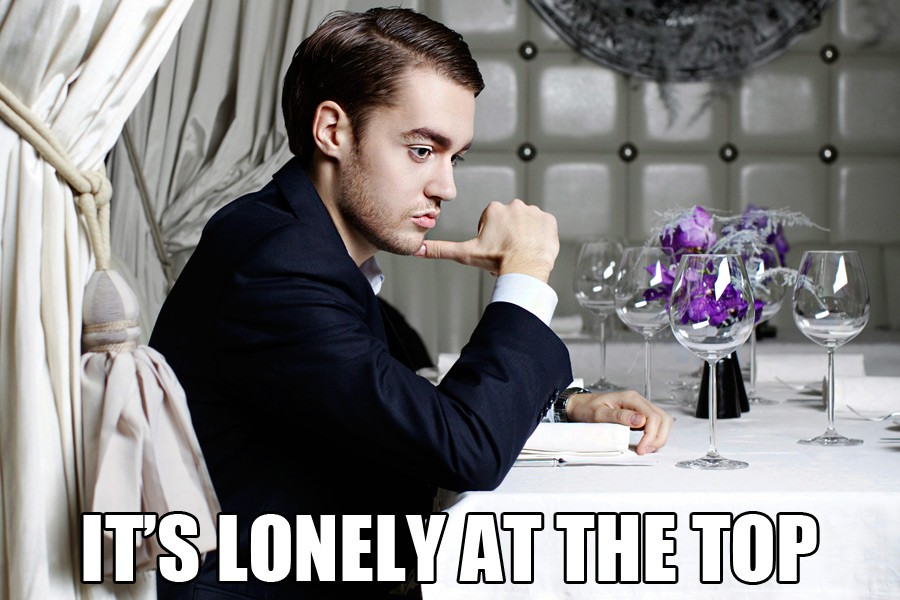
Someone with only their very most basic needs being met – such a thing to strive for…

So why is there this fixation on power? Why do so many people strive for it, often at the cost of their other needs? Why do we delude ourselves that power is somehow going to fulfill our lives when it literally cannot? The answer is obviously capitalism, you goons; it’s always capitalism.

Capitalism as an ideology requires an underclass to use their labour to produce the things needed by the more powerful. This required scarcity forces people into a situation of never having enough power, so our most basic needs can never be met. A housing market that makes shelter out of reach; low wages to make food and security luxuries; a “flexible labour market” (i.e. gig work) to make the underclass even more precarious in their ability to meet their basic needs.

We are then told that in order to get our needs met, we must compete laterally with others in our class. We must gain power by any means necessary, and that’s the only way we’ll be able to afford rent. Do not consider the needs of your neighbour; they are in competition with you! The only way for society to function is if there are winners and losers, and winners don’t need to accommodate anyone. This is the way.

Baby Yoda’s famous catchphrase, “Fuck you. I got mine!”

This isn’t to say that power didn’t exist prior to capitalism. Feudalism obviously had lords going head to head to obtain more power – it’s just that the regular people didn’t give a shit because they had their basic needs met. More people had access to a more diffuse power: land. If you had access to land, you had food, security, family, and so on, and didn’t see the point in striving for anything else. If you didn’t have land, there was still the commons which allowed a degree of needs to be met. There wasn’t as much wealth as we understand it today, but there didn’t really need to be; people had enough. Industrialization created urbanization which increased inequality and poverty which reduced the average person’s power, and the shrinking of the commons increased commodification which reduced normal people’s ability to get their needs met as basic needs became more and more unaffordable. As the West went through this transition, we peasants and proletarians gained political power through the institution of democracy, but lost it economically as the means of production shifted more and more to the ownership class.

This blog is technically more anarchistic than communistic, but Party Marx will always be welcome for discussions around the ownership of the means of production

This manufactured scarcity and proselytized ideology has deluded us into thinking that with power, we’ll finally be able to live the lives we want to have. To a degree this is true: we cannot achieve anything without our basic needs being met, and power is required to obtain them. The delusion arises when we forget that our goal is to get our needs met, and not power in-and-of itself. We want money in seeming ignorance that the entire purpose of money is to buy stuff – do we want the money or do we want the stuff? Do we want the power or do we want to have our needs met?

Also, wasn’t this article supposed to be about superheroes?

It has been this whole; you just had no idea!

Superheroes have superpowers which would include them in this analysis. It’s a little campy, but being more powerful than a locomotive is technically a power. As David Hume said, “Strength is a kind of power; and therefore the desire to excel in strength is to be considered as an inferior species of ambition.” Could Superman achieve his basic needs without taking into consideration the needs of others? Absolutely! That’s how we get Injustice and Homelander. This shit counts, however nerdy an ambition it might be.

Superman, of course, would never do such a thing in the traditional canon. That’s what makes him heroic. He doesn’t use his power for himself, and I’m going to argue that he doesn’t do it for the people of Metropolis either. The people of Metropolis don’t exist – they’re fictional. Superman doesn’t technically exist either, but the story of Superman does. The writers are producing this power, and the power of Superman is used to meet the needs of person reading his story. We feel secure against the threat of Zod. We feel safe from the machinations of Lex Luthor. This is how empathy works.

If our needs don’t supersede the needs of the hero, they become the villain. This is why the villain Homelander is still seen as a hero in an ever-increasing fascistic America – the people who watch The Boys don’t see any issue with what he’s doing, and their needs remain met by his actions. But traditional villains rob banks and try to take over the world, using their superpowers to meet their own needs. Disney’s new “sympathetic” Marvel villains have high ideals, but don’t consider the needs of others in their quest for it – this is how their villainy is displayed despite the validity of their ideology.

The face of accommodating the needs of others

The thing is, this glomming on to the powerful with the assumption that they’ll meet our needs exists outside the world of the superhero as well. In the traditional model, women (who are limited in their power) will seek out powerful men as a means of linking themselves with his power to help them get their own needs met in a world that wouldn’t allow them to be met otherwise. If there is abuse or violence, it is often endured out of a fear that her needs won’t be met without him – his power is all she has to keep herself from becoming powerless.

Under capitalism, there are more powerless people than just trad wives. Many of us live our lives with the bare minimum of power, scraping by as best we can. Wouldn’t it be nice to attach ourselves to some hero who would use their power to uplift our own? This is the allure of the tyrant. Surely I’ll be taken care of if we give more power to this person with whom I identify! Surely my station will be reduced if they are overthrown! We connect to the tyrant as we would to Superman, as some of us bizarrely do with Homelander – they will use their power to keep us safe. Our needs will be considered; the needs of the outsider be damned. But is the solution to our abusive boyfriend to make sure we land a nice one, or to adjust society so that women and men are equitable in their power, limiting the potential for abuse to happen in the first place? Such a world appears to be possible!
People are alive today who have witnessed significant changes in systems of power

The thing is, power is the capacity to act without considering the needs of others. The powerful don’t need to consider us, so why would they? That’s how power maintains itself, so why abandon the working model? We, however, as a collective have more power than any individual. This is why platitudes are made about how the powerful will take care of us, as a manipulation. We are given speeches and scraps to delude us into thinking that we are better off with them having all the power, with us remaining powerless and allowing them to go unchallenged. Superman is a propagandic myth: the boyfriend who tells his girlfriend to never leave him, he’s going to take care of her, trust him.

Power cannot escape what it is; we have to escape power. We have to recognize the value of our neighbour and accommodate them accordingly. We have to recognize the life beyond our basic needs. Both of these perspective require giving up our pursuit of power. Power will never go away, our basic needs will always need to be met, but we can diffuse it. Just as democracy diffused political power, we must identify other aspects of power and diffuse them as well. Power where it exists today must be counterbalanced – this is often the project of the Left as we try to convince governments to allow the otherwise powerless access to their basic needs. It’s a faulty system as power remains relatively undisturbed, and this liberal redistribution does not address the root causes of the concentration of that power, but it’s what the system currently allows. We still have room to dream for more.

To quote a super-villain (notably, one later purchased by Disney), “When everyone is super, no one will be.” And we’d be better off for it.


Despite the Dawkinsian rise of the New Atheists, true religious rejection in contemporary society is actually fairly low. Not literally believing that two of every animal could fit on a wooden ship, or that a man could survive inside of a whale is not new, and theologians have been discussing the purpose of religious allegory since religion has been around. It is a discussion that takes place within religion, not outside of it. Beyond this theological non-argument “against” God, there are asinine claims like religion could never contribute anything like the iPhone, as if that is the purpose of religion, or even something worth striving for at all. These are not rejections of religion; these are a waste of time.

I want to talk about true rejection. Friedrich Nietzsche deconstructed the entire Christian faith and found it abhorrent. Nietzsche wasn’t rejecting God qua God, he was rejecting an entire social order that a belief in God entailed. “God is dead” was the death of Christian morals, beliefs, social norms, and institutions, and that void where God-as-institution used to be is what Nietzsche set out to fill. Nietzsche sought to take the power that resided in God and install it into man (yes, man, Nietzsche is quite famous for his misogyny). Not just any man, as Nietzsche believed that the pussification of Europe had created the 19th century equivalent of the cuck (soyboy? I think I’m falling behind in my alt-right slang…), but a future man who would rise above the beta herd: the Übermensch.

5d6

The Alphamensch

A slightly earlier contemporary of Nietzsche, who rejected religion with just as much enthusiasm, was Mikhail Bakunin. However, rather than a Promethean heist of power from God, Bakunin saw the religious subservience to God mirrored in subservience to the state, and, recognizing the oppression in both, rejected the notion of power entirely. Not necessarily authority, as he says that when it comes to matters of the railway, for instance, he defers to the engineer, but he would never allow the engineer power over himself. Bakunin saw the same problems as Luther, but rather than try to rectify the problem with more God, he wanted to pull it out by the root.

If someone follows the rules without question because they perceive some degree of moral infallibility in their authors, whether they are the secular laws of the state, traditional social mores, or the divine scriptures of revelation, then they possess religious fervor essentially indistinguishable from any other fundamentalists. Atheism means questioning the face of religion regardless of the mask it wears. Given how religion was founded in power (power over morals, the family model, social hierarchy, sexuality, and so on), if we reject religion, that power has to go somewhere, and allowing it to disperse throughout other institutions is just infusing religion into other aspects of our lives; rejecting it becomes absurd hypocrisy.

stock-photo-model

I’m against gay marriage. Not for religious reasons, I just think the institution of marriage is sacred. I am basing this on literally nothing.

Nietzsche’s vision is Hobbesian in nature. He believed enemies were more important than friends, and a friend that wouldn’t stab you in the back wasn’t worth having at all. The continuous warfare between “friends” was supposed to keep the Übermensch in top form, I guess until he slips up and takes a blade between the vertebrae. The lives of others are supposed to only be seen as instrumental to the Übermensch’s goals, since the only thing worth having is power, and we should all live, constantly striving for more. Like with Hobbes, it seems the only way there could be any form of social cohesion is if the most Über of all the mensches can seize power, might making right, and use his totalitarian control to ruthlessly enforce his will until one of his “friends” overthrows him in a vicious coup. This libertarian wet dream (minus the social cohesion) is one possible direction we could follow if we decide to take God’s power and make it our living goal.

Luckily there are alternatives. What would abolishing power look like? Bakunin’s vision had societies organizing their institutions democratically. Industry would be managed by its employees. There would be no state government because Bakunin believed that we could collectively run our own affairs without overarching regulations so long as everyone had an equal say. Bakunin’s methods for achieving this utopia may be even more violent than anything Nietzsche might conceive, but the vision itself for a world without God is certainly much more palatable.

utopia-denied

Communism ≠ Anarchism, but this image is just amazing.

Regardless of your approach, be it Nietzschean or Anarchistic, rejecting God requires recognizing the multifaceted power that historically has belonged to God. Institutions that rely on power require justification for that power; without God, scrutiny becomes a social necessity, lest we fall into hypocritical dogmatism.

Since pop culture seems to generate page views, I’m going to make a reference to a graphic novel that is almost 30 years old, but don’t worry because it has a film adaptation from only six years ago. I am nothing if not topical and relevant here at Blog for Chumps. I refer of course to Watchmen. If you haven’t read/watched it in the time that it has been around, then I sincerely doubt you care that I’m about to spoil it for you.

Anyway, the premise is that humanity is about to kill itself. It’s set during the Cold War era, and it is assumed that America and Russia are going to nuke the shit out of one another. This story is actually super philosophical in its telling, and each character represents a different outlook on human nature. However, the unifying principle is that mankind is a savage beast, and the characters can only act with that principle to guide them. The Comedian embraces the savagery, and revels in the chaos and violence that naturally occurs in society. Rorschach uses the savagery against itself, hoping to use fire to quell the flames. Ozymandias realizes that nothing can actually stop the barbarity of humanity, and so he devises a plot to use it to secure peace: he utilizes the Us vs. Them conflict mentality and creates an outside hostile force (how he personifies that force depends on your medium) that unites humanity against it. Hilariously, the character representing God is only ever a puppet of the government or the ego-maniacal power monger.

Must we accept this basic premise, though? Are we naught but savages? There is a theory that says that life is not based upon conflict but on symbiosis. Natural ecosystems function because each individual species plays a specific and significant role in its upkeep. Predators and prey can never overwhelmingly succeed over the other because of a mutual need to survive, and so when life is in balance, they don’t. Even human beings are covered in tiny microorganisms which call us their home, without whom we would perish pretty much instantly. If life is based on symbiosis, then interdependence would be our natural modus operandi instead of conflict. Human beings today, and throughout history, attempt to reject this natural way of life, and this is why we live in conflict both with the world and ourselves. The basic premise of Taoism teaches similar ideology of not straying into discord by maintaining our natural selves. There are also many examples of pre-civilization humans and aboriginal tribes who lived in harmony with nature and were able to function on egalitarian basis, and it was only with the advent of agriculture, and therefore the accumulation of wealth, that humanity began its downward spiral into jackassery.

I mean, this might make it seem obvious that a communist revolution would ultimately lead to peace and goodwill among men. Get rid of accumulated wealth, and the discord will disappear. However, I don’t think it’s as easy as that. As early as Plato’s Republic have people been aware that material wealth leads to corruption and oppression. Possibly even earlier, I don’t know. That’s just the earliest book I’ve read that mentions it. If we knew of the problem over 2500 years ago and it still seems to be around, perhaps it hints at our natural disposition towards it.

I was once told that capitalism was a relatively recent construction, and therefore its hold over society was not as tenable as our one percenters would try to assure us that it is. It’s true enough; Wealth of Nations only came out in 1776, and deregulated Capitalism 2.0 was only as recent as Reaganomics. But if you recognize capitalism as the relationship between politicians, wealthy business owners, and everyone else, you would realize there have been rulers, aristocrats, and plebeians since the dawn of civilization, and the only differences throughout history have been how those three groups interact.

Capitalism is power over others gained by the acquisition of monetary wealth. In Soviet Russia, power was gained by political clout. In medieval Catholicism it was measured in spirituality. Throughout most of history it has been measured in the quantity of land. Hell, even in high school power over others is based on popularity; the accumulation of social status. We seem to create hierarchies in all aspects of our social culture, at every period in time, which lends credence to the argument that there will always be some form of oppression in our midst. Even if we somehow manage to create an egalitarian, harmonious society, all it would take would be one individual to disrupt and fracture it and the cycle would begin anew. As much social progress as Shah Akbar created as the ruler of India or Caesar Augustus in Rome, it was only a few generations before it all went to shit.

Niccolò Machiavelli points out that the goals of the aristocracy are always to increase their lot in life, and the goals of the people are simply not to be oppressed, to live out their lives unencumbered by the machinations of the elite. It is up to the rulers to decide how that dichotomy will play out, and rulers are not always good ones.

Is human existence as simple as a dualism between two factions to be refereed by an overseeing body? The proletariat and the bourgeoisie is but one example, but there are many. Criminals versus law enforcement. Men versus women. Young versus old. Black versus white.

In Ancient Greece, we coined the word ‘barbarian’ which meant someone who wasn’t Greek. ‘Barbarian’ comes from the strange ‘bar-bar’ language that outsiders would speak. This xenophobic blanket term carries on even today, when we have words like the pejorative Yid to denote someone of Yiddish descent, or Chink to ridicule the speech of the Chinese with their strange ‘bar-bar’ language. Nigger simply means black, making something as trivial as the tint of one’s skin to be one of the most significant aspects of their lives. Even my titular ‘savage’ comes from a slur for the “uncivilized” natives that European explorers found in the new world.

This Us versus Them dualistic conflict is of course overly simplistic. There are always players on the fringes that choose not to be involved, or barter for cooperation, or switch teams, or whatever, but it seems that majority of people in one group with their own culture, mores and beliefs will inherently reject or oppress those in another. These groups could be class, race, religion, gender, sports team, gaming console, favourite Quentin Tarantino movie…

Gay marriage was just legalized in the United States, and yet, the acceptance of Muslims is decreasing at an alarming rate. From my own experience, I saw this:

The views expressed in this image are not necessarily shared by the author of this post.


about a month ago walking down the street. We can all think that love will conquer all until we realize that that puts us into conflict with those who disagree, and there will always be those who disagree. Even relativism assumes absolutely that relativism is the proper method of thought.

This… this is why I’m cynical. Do we really need a Them to unify us as an Us? Machiavelli tells us that the quickest way to unite warring factions within a city is to attack it. Well, warns us, really; this is told in the context of whether or not it would be a good time to invade. Does that make Ozymandias correct? Is world peace only achievable by some outside, imminently hostile and powerful force? Bertrand Russell in his book The Practice and Theory of Bolshevism points out that a discrepancy in wealth is tolerable so long as everyone has enough. Is that really the best we can hope for if no egalitarian society is possible? Must we be satisfied with “good enough” if the perfect utopia is truly unattainable outside of more conflict?

Charles Eisenstein is a contemporary thinker that is a proponent of the “life as symbiosis” argument that I explained earlier. He argues that we don’t rape and pillage our neighbour not because of the laws in place that tell us we shouldn’t, but because we naturally are against that type of practice. Which again is true, for most people, but there will always be exceptions and it is those exceptions that have to be regulated in order for society to function as best as it can; be it a rapist, a capitalist, or an inquisitor. Life may be symbiotic and interdependent in nature, as the example of a functioning ecosystem clearly shows, but that does not mean that the species within that ecosystem will necessarily exude that characteristic. Typical prey animals without a predator will without fail over-consume to the point of self-caused extinction (you could argue that humans getting rid of the predators would make it our fault, but we didn’t force the deer into overpopulation once all the wolves were gone), and that could just be the perfect metaphor for our human achievement. Maybe the reason early tribes were equitable societies was because they had predators to keep them in line, and now we’re just unhunted squirrels hoarding our nuts because we’re biologically-inclined to think that the winter frost is on its way.

I am not one to endorse biotruths of any kind, so please keep in mind that my last few examples are conjecture at best.

Nietzsche describes human nature as the Will to Power; Freud describes it as the Will to Eros/Thanatos; Sartre, the Will to Freedom; Frankl’s Will to Meaning; and Schopenhauer’s Will. Each thinker in their observations of humanity makes valid points towards the disposition of our being, and in all likelihood a single Will to Anything is probably untrue. Human beings are complex, if nothing else, and an amalgamation of many of their ideas is probably closest to the truth. Even if one drive is stronger in one individual than another, those drives will always exist. Is it possible to overcome them, however? Could we potentially evolve, if not biologically, then socially to the point where regulatory bodies keep our less desirable natures at bay? Is it even a worthwhile goal to stymie ourselves in such a way?

I’m not really sure this post has much of a point outside of venting my cynicism to hopefully subjugate it to my Sisyphean idealism. It’s not really working. We are naught but savages, and I think the best we can do is recognize that aspect of ourselves, and work it into whatever world peace plans we come up with. Anarchy is clearly out.