Archives for posts with tag: religion

I find quite often people referring to seemingly justice-oriented events as karmic in origin. Bad things happening to bad people; good things happening to good people; mediocre things happening to the rest of us.That’s karma. If the alleged consequence is after only a brief amount of time, the karma becomes instant; like cosmic pudding, available in minutes.

Except… that’s not karma. Karma is a universal justice, spanning eternity. The tribulations or treats one endures in this lifetime are the result of the countless lifetimes one has existed in prior to their current incarnation. If you punched a granny and then slipped as you strutted away proudly, that retribution was thousands of years in the making. The consequences of our current deeds will be felt in our lifetimes to come, not immediately after the fact. THAT is karma.

This position is not unique to the western bastardization of Indian religions. Even within Christianity we lament that God works in mysterious ways when terrible things inexplicably happen to us, and we question how God could allow this injustice to occur. However, I’m pretty sure the Bible is clear about its distribution of justice: heaven for good folks and hell for the bad ones. That is not mysterious. That is the opposite of a mystery. Granted you could counter with the Providence doctrine where God has actually laid out a predetermined plan for us all, but then your acceptance into heaven and hell has already been preordained, and if that’s the case, who gives a fuck? You either got the Grace or you don’t, and worrying about it isn’t going to change anything. If you’ve got free will, then Providence is less relevant, and you’re stuck with the traditional cosmic justice of working for your golden ticket.

Why do people reject these firmly established religious tenets in favour of their own made up doctrine? Why do we purposefully misinterpret cosmic justice for the more immediate and personal substitute? I suppose it could be we’re just a lot less patient than we used to be, and waiting til we’re dead before we experience justice does seem a little bleak. However, I think the reason is that immediate justice is much more palatable to human beings, and being able to experience justice delivers a much more significant weight to it.

The thing is, the world is the human realm. Cosmic justice is important to the nature of reality, but existence itself is outside of our jurisdiction. Our justice is our justice. When we see bad things happening to good people, it is up to us to provide redress for that imbalance. Externalizing that justice only seeks to pass on the responsibility that we otherwise would need to sustain.

If you want to include karma in your spiritual choices, that’s fine, but building better lifetimes means building a better world, and a better world is the result of human effort and human diligence, not any interference from divine forces.

Conservative Government Reacts to Influx of Buddhist Terrorism

http://www.kymonews.com/news/national/conservative-government-reacts-to-influx-of-buddhist-terrorism/article5633562/

As more and more extremist Buddhists rain terror down on Rohingya Muslims in Burma, the Canadian government has issued statements condemning the violence.

“Terrorism could begin in a basement, a temple, or somewhere else,” Prime Minister Stephen Harper said in a press conference last Thursday.”We are in the process of introducing plans to make a lack of serenity mandatory while participating in the citizenship ceremony. Enlightenment is not congruent with Canadian interests and values. If you are one with the universe, you are not one with Canada.”

Locals are becoming uneasy, fearing their neighbour could be a Buddhist terrorist waiting to strike. Resident Laura Walker was interviewed, and told KYMO News of her concerns. “What’s stopping a Buddhist from walking into an airport, and self-immolating themselves on a plane? Anyone willing to sacrifice their own life for their radical idealism has been brainwashed by their religious leaders, and is a threat to us all. Eliminating the public display of serenity is not enough to fight back against those Saffron-Robers, we need stricter airport security measures to keep these extremists from hurting innocent civilians! It even says in their holy text that they want to bring nirvana to all of humanity. I looked up what nirvana means, and it means extinction!”

While some claim that Buddhism is a religion of peace, the debate rages on about how far Canadians should allow the freedom of religion guaranteed by the Charter to accommodate a religion shown to commit terrible violence against an oppressed Muslim minority.

There are many reasons for spiritual belief. Some of them are written up quite eloquently and humbly here. However, organized religion gets a bit more flack because, as an institution, it’s more rigid in its dogma and has an easier time enforcing it. Of course, that’s how organizations work. If ideas aren’t preserved, and organizations aren’t built up around them, they perish. As much as Jesus may have done while he was alive, if it wasn’t for Peter, there would be no Christianity today.

On the other hand, being advented 2000 years ago causes a lot of the problems many people have with Christianity today. But think about Planned Parenthood. The brick and mortar of this institution is built on eugenics and racism. Margaret Sanger, the founder of Planned Parenthood, is often misquoted as saying terrible things. Here’s an actual quotation from Sanger:

Birth control is not contraception indiscriminately and thoughtlessly practiced. It means the release and cultivation of the better racial elements in our society, and the gradual suppression, elimination and eventual extirpation of defective stocks — those human weeds which threaten the blooming of the finest flowers of American civilization.

Doesn’t she sound lovely?

Denying the less-than-illustrious origins of Planned Parenthood is naive and disingenuous. So too is denying the good that came of it. Ideas, like everything else, evolve over time. Christianity is not the same as it was 2000 years ago, and arguing that it is is preposterous.

Leviticus, the book that harps on gay people the most, is also chalk-full of disparaging comments towards shellfish and tattoos. Today, you don’t see anyone going to prison for refusing to give someone their tramp stamp. And as much as you want to blame religion for the hatred of gays, remember that the Bible doesn’t say anything about hating black people or Mexicans. Homophobia comes from the same place as racism: hate, and hatred is borne out of xenophobia and ignorance, not religion. I’ll say it again: beliefs change with the times, just like everything else.

Some might argue that the Bible purports the “truth”, and the “truth” cannot evolve. Maybe; maybe not. However, our understanding of the truth certainly can.

But Dan, why is arbitrarily casting aside some beliefs while holding on to others okay? That doesn’t make any sense. In fact, there is a lot within religion that doesn’t make any sense!

True enough, Other Dan. There is irrationality within religion.

Think about ‘hope’ for a minute. Think about ‘worry.’ We can’t know the future, so attributing a positive or a negative to it is pointless. Now think about ‘love’ and ‘trust.’ We can never truly know the mind of another individual, and we are often surprised by the actions of people we thought we understood. Why would we ever cherish these totally irrational emotional connections?

Many things about human existence are without logic, but perhaps that’s because the human race needs something more than reason can adequately provide on its own.

Historically, religion has a pretty bad reputation as well. Critics relish pointing to the inquisition and the crusades as damning evidence of religion’s evil. They always seem to forget that England and France went to war for literally a hundred years! (Literally 116 years) They also went to war for literally (yes, again) the same reasons the Church perpetrated the crusades and the inquisition: the accumulation of power and wealth.

The Church also brought Europe into the dark ages by burning books and declaring heretical any knowledge that disagreed with their teachings. Stephen Harper eliminated the long form census, defunded environmental agencies, and muzzled climate scientists. FOR LITERALLY THE SAME REASON! DOUBLE AGAIN! If you want to consolidate power, keep people ignorant of views that might oppose your own.

There are oppressive power structures within the religious institutions, yes. But condemning religion for that oppression is the same as condemning men because of the oppressive power structures of the patriarchy. It’s easy and a lot of fun, but ultimately it’s ineffectual and alienating because it’s not the root issue of the problem and you’re going to piss a lot of people off for no reason.

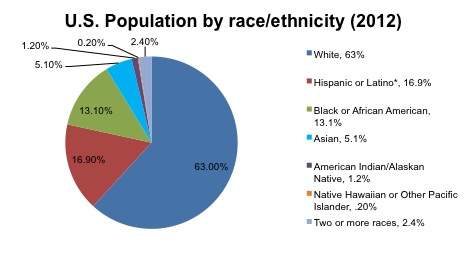
For those wondering, Margaret Sanger’s dream of “extirpating” “racial” “weeds” is still progressing at a fine pace. Look at these pretty graphs:

That's a lot of abortions!

That’s a lot of abortions!

Did they make white people "blue" so that they wouldn't disappear into the background of the graph?

I wonder if they made white people ‘denim’ for any reason in particular.


For those who can’t figure it out from these graphs, despite being 63% of the population in the US, white people account for only 34% of abortions. Blacks, at 13.1% of the population make up 37% of the abortions, and Latinos, for 16.9%, make up 22%. That’s pretty fucked.

I think most everyone recognizes that the racial effects of Planned Parenthood do not lie in the institution, however, but in the systemic racism that puts racial minorities in segregated, impoverished neighbourhood. It is, after all, poverty that typically leads people toward abortion, so an attack on the institution that provides them is infantile.

So why attack the institution of religion? Promote plurality instead of xenophobia. Education instead of ignorance. Peace instead of war. Fight oppressive power structures, but identify them appropriately as separate from their attachments. Ideas and beliefs can only change when the world around them does first.