Archives for posts with tag: transgender

I tend to dislike identity politics. I find it shallow and regressive, and as a straight, white man, it is none too fond of me either. I had heard rumblings about liberal backlash against identity politics after the election of Donald Trump, as if women of colour existing had suddenly brought about the rise of fascism, but I disregarded this because it’s stupid. Then, like too many stupid things, it became my problem when I had to listen to someone defend this position in a podcast that I follow. They asserted along similar lines that because the Democrats had too closely linked themselves to identity politics, that Trump was able to seize the economic narrative and soar to authoritarian heights on promises of increased prices through tariffs and trade wars with traditional allies. Clearly a persuasive argument.

This was promised and intentional, and was the bar Democrats needed to surpass in order to win the economic argument. I’m not saying that the stock market is representative of the financial situation of most people, but it’s a simple enough symbol for our purposes here.

At this point I think it’s important to define our terms because what was described in the podcast was any reference to white supremacy or gender issues as “identity politics.” This is never how I’ve ever understood the term. Identity politics in the pejorative sense is the inclusion of a traditional minority into the established mainstream and calling it progressive without changing anything real or substantial. So Disney remaking all of its classics with women of colour in the lead role is identity politics because it’s a shallow cash grab pretending to be something new and edgy because Ariel is black now. Or Hilary Clinton platforming her gender as the primary reason to vote for her in the “I’m With Her” campaign slogan. Or corporations coming out with rainbow-tinged logos for Pride month while raising prices to accommodate such woke largesse. All this capitalistic tokenism is then interpreted as leftism because homosexuality and vaginas are seen as intrinsically leftist concepts! It’s all stupid and fake, but because the people behind this empty astroturf ideology often have all of the money, it becomes the focus of political discourse because it’s so polarizing and in your face (Am I saying that women of colour shouldn’t be movie leads or run for president!?! How dare I!? Get at me in the YouTube comments!).

I’ve always felt there weren’t enough gays toppling leftists governments, but I guess that’s because of my woke mind virus!

I didn’t see a ton of that in the last election from the Harris and Walz campaign, and though I didn’t obviously see every single campaign ad, I certainly heard contemporary coverage approving of that campaign for not fixating on Harris’s identity as a Homeric blasian heroine. Somewhat ironically, the worst I saw were ads focusing on Tim Walz as the folksy white football coach, trying to pander to the superficial identity of the traditional right. Frankly, I saw more identity politics from the Republican side with Trump literally questioning Harris’s blackness, and their ad saying that, ”Harris is for they/them, and Donald Trump is for you!” using the identity of non-binary people in purely shallow framing to fearmonger an Us versus Them dynamic. Per this metric, identity politics were actually quite successful in this last election, and maybe the Democrats should have done more to categorize people into these simplistic labels for the sake of petty politics!

But… but… how can this be identity politics if Tim Walz doesn’t have a vagina of colour!?

The important thing to keep in mind during this tiresome deliberation is that class is a marker of identity! To suggest that the Democrats ought to focus solely on the economy and not “identity politics” is to miss the truism that all politics is inherently based on identity! The suffragette movement was identity-based. The civil rights movement was identity-based. The New Deal’s G.I. bill was identity-based – it was dedicated to veterans! Drug laws are for drug users; prostitution laws are for sex workers; healthcare is related to the spectrum of ability. All of us exist across intersections of identity, and all laws and policies bleed across them in varying ways. The G.I. Bill brought so many Americans into the middle class after World War II, but only if we define those Americans as white. So too the Nazis brought Germany out of the Great Depression, but their own infamous identity politics left much to be desired beyond the economic recovery. Class and more populist economic policy is something the Democrats certainly need to absorb into their political philosophy (as per their stunning defeat to Donald Trump on this issue), but this literally cannot be detached from identity, nor should it. We cannot talk about Trump barring refugees from everywhere in the world save for those “fleeing” from a manufactured genocide in South Africa without discussing white supremacy. We cannot talk about the impacts of overturning Roe without acknowledging that the people affected by that the most are those with a uterus. These are atrocities, and ignoring them is tantamount to ignoring the “identity politics” of the Nazis as they resurrected Germany’s economy. We cannot and should not. Identity is a web; class is connected to everything else which is in turn connected to class.

So what the fuck are people even talking about? The podcast guest later in the show gets in a heated argument with the host over how Palestinian deaths aren’t being fairly reported in American mainstream media, in blatant hypocrisy to his earlier dismissal of identity politics as worth mentioning. Per his meltdown, you would think he had forgotten that being Muslim or Palestinian is just as much an identity as being white or a woman. Should we ignore the genocide in Gaza? He would disagree, strenuously, but that is “identity politics” per his definition! I guess identity only matters when it’s one of your own. While this was not explicit in the show, and I think I’m just extrapolating this from the broader political discourse and think it’s irrelevant to what they actually think on that podcast, but this disregard toward identity is entirely about trans-people. When people say that Democrats should focus on the economy and not on “identity politics” without giving a definition of what that means, they mean that they’re fine with throwing trans-people under the bus if it means that everyone else can get the Medicare for all. This is the only thing that makes sense given the arguments and hypocrisies they are making.
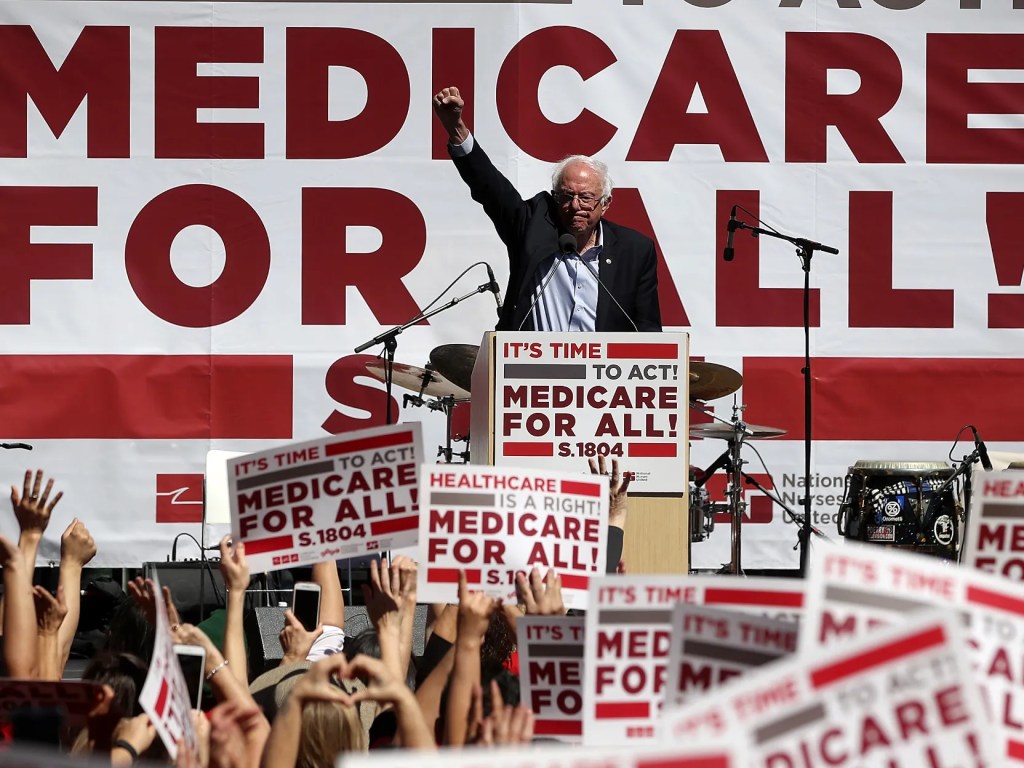
Unless you need it for hormone replacement therapy, in which case, tough shit

Harris was criticized because she believed prisoners should be able to access gender-affirming care if they needed it. This is not identity politics in the actual definition of the term, this is a genuine, honest-to-goodness policy. It’s policy for a particular identity, in the way that voting rights have historically been for particular identities, but it’s healthcare policy. People on the left and the right spoke about it as if it were superficial and unnecessary identity politics because acknowledging the healthcare needs of the transgender community is seen as superficial and unnecessary, akin to a rainbow Nike swoosh. If we don’t see transgenderism as a real thing, if it’s a disguise for attention or sexual predation, then it’s easy to dismiss their legitimate needs as shallow and fake. This isn’t something unique to the right. Much of the so-called left struggles with the needs of transgender people too, which, to be clear, is mostly social acceptance and healthcare and is not to participate in elite-level sports.

Democrats, and liberal governments across the globe, are failing in how they address the economic needs of their citizens, and it is fair and necessary to criticize them on that failure. More than criticize, disrupt and dismantle them for something better. Do not, however, try to suggest that “identity politics” is the barrier to that kind of economic and social change when you really mean acknowledging the existence of trans-people. Corporate gimmicks and Disney remakes should also be criticized too, but they are not leftist; the capitulation to fascism among the ownership class shows the hollowness of their “progressivism” quite clearly. You can continue to trash identity politics, as I am sure I will too, but be honest in your bigotry and stop pretending that you’re advocating for a social restructuring for all.

We all know what words mean, right? They mean whatever it says next to them in the dictionary. This definition is agreed upon by professional dictionary writers which must be the objective truth, because, as we all know, there is never any debate, disagreement, or human error within academic bodies. The divine wisdom of these truth-holders means that the dictionary definition is more infallible than the Pope. Dictionary writers are ordained by God to give the final decree on language, and that’s why language is static and unchanging.

Except words are just the socially agreed upon tags that we attribute to concepts. Like a “river” for instance, is still called a river whether it floods, dries out to a trickle, is polluted to the point where the H2O is barely detectable within it, or whether it changes course entirely. The make-up of a thing barely impacts what we call it, unless we possess an alternative concept like that of a canal, in which case a river just needs some specific minor changes (like some walls and human direction), and voila! It’s no longer a river. Or if it remained a trickle for too long, we might start calling it a stream because we have a word for that concept too. We might use adjectives to convey the connection between multiple concepts, a “flooded” “river” is still not a “lake.” Our history with a concept will alter our viewpoints as well. An old timer who remembers the stream when it once was a river might still have an understanding of it as a river, while a newcomer might think the old timer is simply delusional. A stream is a stream!

literally

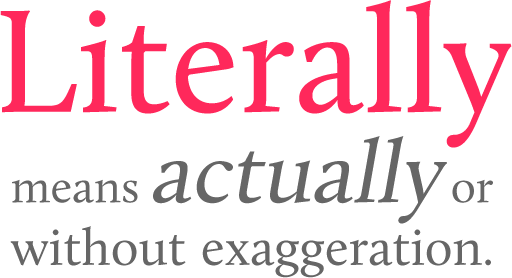
Until enough people decide that it means “figuratively“, and then it means “figuratively,” and there is literally nothing you can do about it.

This brings us to language as it is applied within the LGBT community. Wouldn’t you know it, there just so happens to be a debate around the definition of words: like marriage! If you believe that “marriage” is defined as being between a man and a woman, then gay marriage becomes a nonsensical concept. A triangle is defined as having three sides, and along comes these degenerates who think that it can have four? Linguist Willard Quine tells us that human language in a community is like a collection of sculpted plants. Even if they all look the same on the outside, the branches and twigs on the inside that make up the sculpture will be different in every instance. How we learn our language shapes our understanding of that language, and even if we have a pragmatic functionality that allows us to get by in day to day conversation, those differences can create problems.

If marriage is defined not as between a man and a woman, but instead as being a loving relationship between two people that is recognized as legitimate by its having legal validation, then not only is gay marriage entirely reasonable, it is positively oppressive for them not to be able to access it. Of course, this definition eliminates polyamorous relationships from being recognized as legitimate, as well as defining legitimacy as something that the state applies through legal policy. Do I really need the government to tell me that my love is real???? How we define things has real world social implications beyond just conversational understanding.

dreamstime_s_18882968

I asked him, “when?” and he told me, “After the midterm elections, baby. I promise!”

When I have a concept, and you have a concept, and we use the same word to describe both our contradictory concepts, then yeah, there are going to be problems. This can be solved by either changing the socially accepted definition of the word, which involves changing society around the word, or it involves inventing a new word (like “canal”) to accommodate the minor changes in concept. I have actually heard an argument saying that gays should have the same legal relational rights as straights, but that their relationships should just be called something else. Unfortunately, the history of a concept and its legitimacy can’t just be erased like that. If there was “married” and “gay married,” you can guess it would follow the same “separate but equal” treatment of water fountains. There are certainly instances where new terms are required for new concepts (it is unlikely there was any controversy when the term “canal” was introduced), but when it comes to forcing whole categories of people into a term they never agreed to, then you’re creating bigger problems than semantics.

Another perfect example is gender. What is a “woman”? Is a woman someone who was born with the XX chromosome? Is a woman someone who looks and behaves like a woman? Is a woman someone who feels like a woman, regardless of how she was born or how she looks and behaves? Two people can be talking about women and may never discover that their definitions are incompatible. Branches within a sculpted plant, remember. How we define “woman”, however, is going to have a distinct social impact on transgendered human beings. Cisgender, the term, was coined only recently because there was seen a need for a new concept. For those who believe that gender is related to birth sex, the term is unnecessary, or even offensive because they do not see the need for a conceptual distinction. This shows the difficulty of introducing new terms because all of society needs to accept the distinction.

canal

I’m sorry, but this is a RIVER because even if you dress it up, it’s still made up of H2O! Facts don’t care about your feelings, libtards.

What is a woman? We could always have a distinction between “woman” and “transwoman,” right? Who cares? We’re just hashing out concepts, and in the end, the definition doesn’t really matter all that much because human society can just adapt. The problem is that there are casualties to this debate. Transgender people are dying while this linguistic nitpicking rages on. Why don’t we choose a definition where nobody gets hurt?

They’re just words, folks. Remember: sticks and stones may break my bones, but words are the foundation of my ideological system, and any fluctuation in their social acceptance means that that ideological system is in peril. Meanwhile, others are enduring sticks and stones, so maybe hurry the fuck up with your existential crisis, k?

Transgendered people are individuals who believe that their self-hood does not align with their sex at birth. So for example, someone who was born male but identifies as female would be called a transwoman. This apparently causes problems when it comes to bathrooms, but something I once read, but can now not find to cite, said, “If you care about the gender of the person in the stall next to you, you don’t have to pee badly enough.” That about sums up my feelings on that controversial topic.

Where does transgenderism come from? Well, some say that it is a mental illness. Transgendered people are delusional; their genitals ought to have precedence when determining their mental make-up, so if there is a discrepancy, a quick peak beneath the trousers should clear up any confusion. Let’s go with that for right now. For the sake of argument, being transgender means that you are suffering a mental illness.

I’m going to make a patently false assumption and say that when we consider someone with a mental illness, we want to help them get better. We wouldn’t want to abuse them, sexually assault them, murder them, or commit violence of any kind against them. We wouldn’t want to vocally condemn them as freaks. We would want them to get better. People who abuse the mentally ill are typically considered monsters.

Perhaps transgenderism is morally unacceptable. That certainly would make bullying and harassment a reasonable reaction, I’m sure. The Bible is quite clear in its endorsement of throwing stones. Except we can’t be morally responsible for things outside of our control. If someone declared you morally bankrupt for failing to save the life of a child trapped in a coal mine on the other end of the planet, that would be absurd. It is an impossibility. If you were local and had the skills available to rescue that child, then yes, some degree of culpability could be admonished, but in order for moral responsibility to be present, a measure of ability to perform that action must be present as well. Transgenderism, which research has shown develops concurrently to the overall identity development of the child, as a mental affectation is not a choice, and therefore moral culpability, whatever your argument against transgenderism might be, cannot apply.

What can we do to help transgendered people if judging them and abusing them is out of the question? If we compare their plight to another delusional and incurable mental illness, say, dementia, perhaps we can discover an appropriate treatment plan. Dementia patients frequently believe that they are living in the past, and mistake their adult children with their own siblings, and so on. As it turns out, if well-being and quality of life are our goals, the best treatment plan available to patients with dementia is to acknowledge their delusions and allow them to live in the reality within which they identify. In the context of transgenderism, this would mean that acknowledging the preferred identity is the superior treatment to… verbal abuse, I think is the predominant method today. Some might say that tolerance “encourages” transgenderism, the same way I suppose that treating schizophrenia to a degree that their lives become livable encourages people to become schizophrenics.

I want to take a bit of a detour here. What is an illness, especially a mental illness? If we wish to attribute illness to transgenderism, it’s important we know what we’re calling it. The initial thought could be, “an affectation of the mind or body that produces an uncomfortable feeling.” This is why we consider headaches and the flu to be illnesses, since they make us feel uncomfortable. This can’t be attributed to transgenderism though, because it is their assigned gender that makes them uncomfortable, which would mean that transgenderism is actually the cure to the illness of gender. We’re working under the assumption that transgenderism is the illness here, so this cannot be the case.

Perhaps a better definition might be, “an affectation that produces abnormalities.” The transgendered are a small minority of the population, which would make them technically abnormal, but this is unfortunately too inclusive. Left-handedness is abnormal, but certainly isn’t a mental illness. Nor are green eyes a physical disability. Just because something does not bear a likeness to the majority does not mean it is an illness.

The best definition of illness is something that prevents suitable integration into society. The flu prevents us from working or functioning properly at all. Bipolar disorder produces unpredictable behaviour which leads to social discord if left untreated. The destructive aspects of dementia lead to an inability to communicate with others, or participate in society, and ultimately the greatest alienation from society of all: death. If someone is compelled to deliver puns at every opportunity, this is not considered a mental illness despite how I might think because it only alienates them from people with taste. If someone is compelled to drink at every opportunity, this is considered an illness because they can become destructive, and the long-term physiological damage prevents future social function.

If we view illness as predicated on social ability, then this opens up a serious question. If someone is paralyzed from the waist down and is stuck in a wheelchair, we consider them disabled because they cannot function in our traditional, stair-filled world. However, if there are ramps, suitable desk jobs, household and work accommodations to allow general independence, then wouldn’t this person not be considered disabled at all? If there was a legless human commune somewhere that functioned autonomously without difficulty, then this detriment in our society would be considered the norm and conceiving of it as a disability would be impossible. Left-handedness was once considered a sinful mental affectation because the world was built for right-handed people. Illness, therefore, is not dependent on anything outside of society’s ability to allow it to adapt.

So yes, of course transgendered people are mentally ill because they are indeed unable to adapt in a society that hates them. A society filled with intolerance would not allow a transgendered individual to flourish in the way that a more tolerant society would. I invite you to wonder, then, as to a possible cure.