Archives for category: Politics

I’m not a huge fan of identity politics. My reasons are the common ones: they’re unnecessarily divisive, and they tend to ignore practicality. I’m not against the idea of identity politics; every identity has a right to celebrate themselves in an empowering fashion, but when that mental process is expanded to the grander scale of actual politics is when things fall apart. Luckily, I found a brilliant video that disagrees with me, and it puts forward the best case for identity politics I’ve ever seen:

Here’s a summary for those who opt out of watching this almost 12 minute video:

Identity politics is based on arbitrary distinctions between two groups, and those distinctions don’t necessarily even need to be defined all that well. Politics on the whole, as defined by Carl Schmitt, is the distribution of power along those hazy boundaries. Consider the One-Drop rule that governed the ‘blackness’ of individuals during the 20th century: insane nonsense, but still firmly embedded in the cultural psyche and accepted by the whole as a means of dividing power. To quote, “True political conflict isn’t about facts – it’s about the fight against other identities, however arbitrarily we might point them out.”

Politics therefore isn’t about policies, government programs, or their austere lack, but about “who is allowed to have power over themselves, and who is not.” The arguments over any other issue is what Olly, the presenter, calls, “management disagreements.” Those who focus on these management disagreements as the basis for their political identity are less zealous than those who adhere to Politics as defined by Schmitt. The zealotry behind a dogmatic identity can literally kill while milquetoast liberalism could never achieve such an extreme. Because of this, a government that runs on the ideologically weaker managerial proceduralism platform will be dangerously vulnerable against any group fueled by identity-based fanaticism that is big enough to threaten it. This means that anyone who doesn’t take into account power and identity when they are discussing politics will be doomed to lose every time.

Olly then goes on to say that when one considers the identity politics of the Left and compares it to those on the Right, there is a crucial distinction to make because they are not mirror images of one another. In this Us vs. Them mentality, the opposition to the Left is less rigid than the opposition to the Right. For example, when the Left defines itself as against the rich, a rich person could simply redistribute their wealth and they would be accepted by the Left, whereas gay people, transgendered people, Muslims, etc. who are the dichotomous Other to the Right, cannot change who they are because their identity is not a choice. He concludes by saying that the centrists who focus on liberal democracy and forget, or purposefully ignore, the role that power and identity inherently play within politics are essentially condoning the violence that those two factors play in every day lives.

Like I said: good stuff. I myself have written about the perilous implications of a possibly universal Us vs. Them mentality, and given that that would encompass politics as well, then Schmitt’s Identity Politics are truly the only type that need to be addressed. However, if that’s the case, then Olly’s argument fails on one critical point. Consider Vladimir Lenin. Or Mao Zedong. Or Pol Pot. These were identity politicians on the Left who engineered a violent, inflexible attack against their identity-based opposites: the bourgeoisie. There was no talk about allowing the rich into the loving warmth of their Leftist ideology. There were massacres. The same could be said for Malcolm X who did not want white people to end their racist ways, he simply wanted them gone in a black-people-only utopia. The Left can be just as ideologically vicious as the Right when they are inflamed by their identity-based righteousness. If politics is only Identity Politics, and both sides at their extremes work only to eliminate their opposites, then ultimately we’re just fucked.

In a glimmer of hope, let’s consider this excellent Al Jazeera article that has a similar theme to Olly’s lovely video. It mentions a similar distinction between the populism on the Right and the populism on the Left, but uses an example of Bernie Sanders demonstrating left-wing populism by wishing to break up the big banks as the contrast to the Right’s anti-pluralism. Olly hints at this as well when he says that the rich and powerful can give up their oppressive ways to become a friend of the Left. It is not the identity that is at issue in these examples, but the practices of those who possess that identity. In order for Schmitt’s Politics to have a happy ending, the Other needs the capacity to change.

It could be argued that this is simple: give up racism, or sexism, or homophobia, and people will be welcomed into that loving embrace of the Left I was fantasizing about earlier, but unfortunately this is too simplistic. Consider the arguments of Anne Bishop, who declares that everyone possessing oppressor traits (straight, white, male, able-bodied, etc.) will always be oppressors because regardless of their deeds, they will always benefit from the privileges that those identity markers bestow upon them. In addition, they will have grown up under conditions that reinforce their superiority, and undermining that conditioning is an infinite process that can never successfully be accomplished. Bishop claims that the person who believes that they have finally rid themselves of their oppressor qualities becomes more oppressive for holding these impossible beliefs. What Bishop is essentially saying is that the dichotomous Other of the Left cannot shed their incompatible identity any more than the Other of the Right. Are we just fucked then?

Since identity is inescapable from either side, then we must look elsewhere for solutions. The key lies in the example I used from the Al Jazeera article where Sanders wants to break up the big banks. Breaking up the big banks has absolutely nothing to do with identity. In fact, it is closer to what Olly might call a management proposal. This management proposal, however, is the mechanism for change that would allow the rich to absolve themselves of their oppressive identity to something more acceptable to the Left. Or consider the Black Lives Matter campaign demanding an end to the shooting of black men by police. This is Schmittian Politics because so long as police are trained to use deadly force, and crimes are still committed by black people, even if racism is taken out of the equation, this will always produce the use of deadly force against black people. It is an impossible demand for change. Further evidence is the call to defund the NYPD and expel the police department from Pride Parades; clear indications of inflexible dogmatism. This isn’t allowing capacity for change, it’s demanding the elimination of police from within the Leftist fold: an explicit Us vs. Them mentality. Instead of an overarching ban on police, or calls to defund and therefore ultimately abolish the institution of policing, why not look at mechanisms for change? In the UK (save Northern Ireland), cops do not carry firearms, and if this system were imported into the United States, it would certainly eliminate the police killings of black men. While I am by no means saying this is the panacea for the shootings of black men by police, and other, better solutions are certainly available, it is one example of a mechanism for change that does not call for vindictive polarization.

If we are to accept the implications of Schmittian Politics, then the passionate zeal that drives us must be directed against the management disagreements that Olly insists are not involved in that type of Politics at all. Creating a Them out of an identity marker, no matter which direction it is coming from, will only ever be destructive. My initial critique was right: we must avoid divisiveness and focus on practical, real-world solutions. Identity must be dismissed in favour of these mechanisms for change, as they are the only way to bridge the friend and enemy divide. I mean sure, maybe that is an impossible request, and we are hardwired to pursue an Other based on arbitrary identity markers. If that’s the case, then, as I’ve been saying, we’d just be fucked.
In Germany, the crippling Treaty of Versailles contributed to the democratic election of their notorious, inhumane despot. It imposed harsh financial debts on the people of Germany, forbid their voices from being heard in its construction, and punished them for over a decade as a consequence for the actions of their leaders. When the Great Depression rolled in, the finances that the US was loaning Germany for its recovery disappeared, destroying the final remnants of the already ravaged German economy. The people sought to lash out after their global bruising, and were offered a scapegoat by right-wing populism in the form of the Jews (and gays, and the disabled, and gypsies, and Christians…).

So America, what’s your excuse? It may sound contrived and a little petty, but it’s a question that needs to be asked, and it’s a question that needs to be answered.

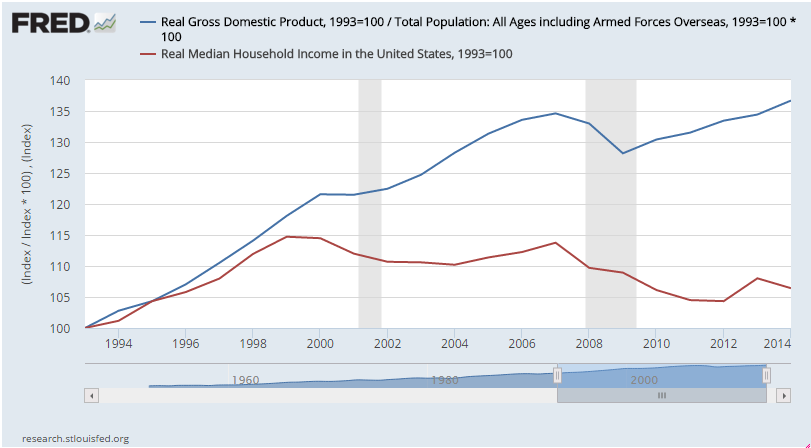
America did not have an outside coalition enforcing punitive economic policies onto their country, but rather, it slyly enacted them itself. The increasing personal debt, the outsourcing of jobs, the apathy of the elites for the working class; all of this is reminiscent of Weimar Germany but without the diktat of outside countries. The Great Recession moniker that was ascribed to the recent economic crisis should have been the ultimate foreshadowing of who was to come. The cause of that Great Recession is multifaceted and complex, but many attribute it to the repealing of the Glass-Steagall act back in 1999; notably, an event perpetrated by a Democrat. Repealing the Glass-Steagall legislation removed the banking regulations created in response to the Great Depression, another harbinger of history repeating itself.

You can also just look at this. It illustrates pretty nicely that the institution of America left its people behind a long time ago.

You can also just look at this. It illustrates pretty nicely that the institution of America left its people behind a long time ago.

When the inevitable market crash violently ripped across the country, the proposed solution was to bail out the banks. No punishments for the culpable, no legislation was changed, the banks were simply given back the money they had swindled from the hapless people. Again, this disgrace of justice was meted out by yet another Democrat.

America’s descent into totalitarianism was almost preordained. It is undeniable that there were elements of misogyny hindering Clinton’s campaign, but even if she won, what kind of monstrous candidate would have arisen after four years of more of the same? Clinton denigrated unions, she ridiculed environmentalists, and is just as entrenched into corporate welfare as any of the less insane Republican candidates. Progressing along the status quo that spawned a Trump campaign would not have improved with age.

Those who fear the journalistic sanctions under a Trump presidency should be aware that the mainstream media has been complicit in perpetuating the discourse of the status quo for ages. Even recently, Democracy Now! journalist Amy Goodman was charged with criminal trespassing for covering the Dakota Access Pipeline protest. Though the charges were dropped, it appears we do not need to wait for Trump to be sworn in before dissenting voices are criminalized. In addition, you might consider the unprecedented crackdown on whistleblowing under the Obama administration as further disregard for accountable governance. America has been tailspinning for a long time now, and it is of no use to pretend like it would never crash. Looking at historical precedents, someone like Trump is not entirely unsurprising.

I know I’ve been picking on Democrats, and maybe there are some of you demanding I account for the Republican congresses that blocked progressive legislation or Republican presidents that put forward their own destructive policies, and yes, those exist. This isn’t a problem created solely by the Democrats, but by the American political institution itself. When government becomes structurally plutocratic, even overt partisanship becomes more of a charade than an allegiance to any particular group.

Some have already begun blaming third party candidates for the failures of Clinton and the Democratic party (as if Gary Johnson, who wanted to eliminate taxes and abolish all government programs, would siphon votes away from the Democrats), when the reality is that a vote for a third party is a rejection of that broken political system in the vain hope that, this time, maybe people might pay attention to the shards of their democracy lying on the floor and decide to do something about it. Voting for a third party is not a vote for the greater of two evils, it is a refusal to participate in the system that enables constant concessions from the left as the Democrats can essentially behave however they want, knowing full-well that they will always have a Republican bogeyman to point at each election. Constantly voting for the lesser of two evils under this pretense will only allow its evil to grow.

Many people wish to attribute this grave election loss to racist individuals who have succumbed to the xenophobic rhetoric spewed by Trump, and judging by the endorsements given to him by white supremacist groups, it is a likely contributor. But the alt in alt-right intrinsically defines it as outside of the mainstream, so the pockets of racist support backing Donald Trump is difficult to attribute to the majority. In fact, blaming the election on the fear of the Other could very well be blaming the racial scapegoating rather than the cause of the necessity for scapegoating in the first place. Was Hitler’s rise attributable entirely to Germany’s antisemitism, or were there other factor’s at play? Hint: think the Treaty of Versailles

It might also be convenient to claim that this is a racist backlash against having a black president. Except Obama had two terms, meaning that a majority did not seek to punish him for his race the first time around. If we consider when the Civil Rights act was implemented in 1964 by Lyndon B. Johnson, which might have garnered comparable racialized political backlash, we could expect a similar white supremacist to emerge in the next election. Except LBJ won 44 states to 6 in the subsequent election, and when the Democrats lost the following election to a Republican, this ended up being Richard Nixon, who worked on desegregating schools in the South, enforced the controversial busing of black children outside their neighbourhood to accommodate equal representation in schools in the North, and implemented the first federal affirmative action plan. However much backlash there may have been in interpreting the Civil Rights act in certain states, the federally elected official (Nixon) maintained a greater degree of racial sensibility than either political candidate in this last election.

Today, the voices standing up for racial equality tend to make broad, denigrating statements about white people in order to get their messages across, while during the civil rights movement, Martin Luther King was very purposeful in his inclusion of them. If we want to attribute Trump’s victory to a racist backlash, we must consider that the large number of white people who voted for Trump may have ignored those voices simply because they were tired of being attacked. If we, as progressives, wish to create allies or a dialogue, we have to be aware that maligning entire demographics of people is not an appropriate way to gain their sympathies. If, however, progressives insist on attacking whites, they may become so disillusioned with progressivism that they might elect Donald Trump! Oh wait. I suppose we can’t get that one back, can we…

Part of Trump’s success is also due in part to the media’s insatiable desire to tell Trump shock stories, knowing full-well how many papers his antics will sell, and in the process distract from the real drivers pushing forward his campaign. Arlie Russell Hochschild is a sociologist who went deep into Trump country to find out what attracted voters to Trump, and found that it was generally people who felt as though they had been left behind by the establishment and believed in Trump’s sales pitch that he could do something about it. What differences might there have been had the focus of the Democrats been on acknowledging the failures of the system and promising to adjust them, instead of attacking the character of the “deplorables”?

The Tea Party movement began in the wake of the bank bailouts, driven by anger at having been betrayed by the banks and the government. Yes, there was racism involved, but that was only ever an auxiliary motivator for the disdain of the government. Unlike the Occupy movement which preferred to abstain from actively creating change, the Tea Party successfully rallied behind their leaders and managed to vote in several political candidates. Regardless of how you feel about the Tea Party and the recent political movements of the Right, they were quite successful in establishing themselves in practical ways within the system to effect change, and now, one of their leaders is the president.

I’m aware racism is a thing, and I’m aware it played a role in Donald Trump’s success. I literally compared this election to Nazi Germany, and saying that I’m ignoring the impacts of race is telling me I’m ignorant of the hatred of Jews during the Holocaust. My point is that we can’t ignore the factors that have exacerbated American xenophobia, we must find alternative ways of discussing racial progress so as to not alienate the majority of the population, and the broken democratic system of America needs to be reformed. Cowardly hiding behind the Democratic party should no longer be considered morally acceptable.

If we believe this to truly be a cycle of history, then I expect that, after the upcoming World War III, the equivalent of the Nuremberg trials for America will not be as forgiving as the Obama administration was on the war crimes committed during the Bush era. That is, of course, if anyone is left to hold America accountable for its failure to stop a Trump presidency.

There is a Marxist belief that if something is inaccessible to the poor, then it can be neither radical nor revolutionary. Following the trend of ironic tragedy that history sardonically and incessantly throws in our face, the decrease in book reading, both in adults and teenagers, points to a culture that would struggle to read The Communist Manifesto, let alone Das Kapital. As one would expect, the impoverished and the uneducated are those who are reading the least. There are neither sparkly vampires, teenage wizards, nor BDSM-enthused misogynists to incite mass interest in Marx’s seminal works, so I suppose they too must be discarded into the dustbin of irrelevancy to revolutionary thought.

The internet has opened up social dialogue to include everyone with internet access, seemingly giving the unheard voice of the proletariat unprecedented access to speak out, yet in reality has only allowed the opinions of troglodytes to swarm rational discussion, turning it into a cesspool of vomit and bile, defiling the very notion that a reasonable outcome is possible. Unfortunately, the Pandora’s Box of the internet cannot be closed, and this is now the discourse to which one must adhere.

Donald Trump has capitalized on this phenomenon by devising his most successful populist propaganda within the 140 character limit of the Twitter universe. Hilary Clinton, not one to be outdone, shines brilliantly in her campaign slogan: I’m With Her. The “I’m” captures the essence of social media narcissism, letting everyone know what this campaign is really about; me! The “With Her” is, of course, reminiscent of the purposefully vague and noncommittal identity feminism of the Tumblr era. Both of these demagogues are pandering to their respective demographics with their own promises of revolution, yet I do not believe either of them represent what Marx had in mind.

Philosophy is notoriously relegated to the ivory tower, despite Diogenes and his abandoned cup. And while some might claim that the greatest philosophical question is why there are essents rather than nothing, the original Greek schools, including Diogenes’s Cynics, utilized philosophy as a means to discover how to live the good life. Aristotle’s Aretê or Zeno’s Stoicism both offer methods to live virtuously. Without the dogmatism associated with the religious side of this conversation, philosophy allows us to seek with constant refinement how to live; a critical necessity in this tumultuous time.

Slavoj Žižek, Slovenian philosopher and possibly rabid communist, belabours the point, saying that despite the impending global consequences, we need theory now more than ever. The instinct to act is strong but must be overcome, as postmodernism has deconstructed everything without creating substitutes to put in its place. To act now would be to seek anarchy. End racism. End sexism. End capitalism, but how? And replace it with what? Ideologies cannot be eradicated, only changed, unless our revolution is to end in genocide.

How do we conduct the dialogue of this contemporary philosophy? I mean, analogies to the Greeks these days might not reach as large an audience, but I can predict with the inevitable alienation of Cassandra that referencing the feud between Taylor Swift and Kanye West will not carry the same lasting weight. The trials of Odysseus are eternal, and thus possess a portion of truth to which humanity will forever have access, whereas Famous will be out-of-date within the year.

The intellectualism associated with philosophy and social theory by its very nature divorces itself from the reach of the bulk of the people. Do we wade into the depths of thoughtless memes and Youtube comments to wage our revolution with the masses, only to discover that we too have become thoughtless in the process? Or do we stand above it, confident on our pillar, helping up those who have recognized the shadows on the cave wall? The disenfranchised need to be acknowledged, certainly, and their voices heard to the extent that we are aware of the depths of their circumstances, but acknowledging this does not require fetishising it. Educated progressives gnash their teeth over the large swathes of people who vote against their own interest, yet this is most often due to demagogues like those mentioned earlier who are savvy in the ways of exploiting those demographics, and know exactly how to pander to their base nature. If something is accessible to the poor, who is to say it is in their best interest?

We do not begrudge climate scientists as elitist when they claim their knowledge gives them more insight on the subject. We cynically laugh at those who do, as they are the obstacle to the required change climate science demands. Granted, philosophy and sociology are softer sciences, yet there can still be an accumulation of wisdom gained from the relevant reading and research.

Those who come up with a new economic system should know the theories of Marx, Smith, Keynes, and Friedman among others if only to know what works and what doesn’t. They should be aware of the history and context surrounding those successes and failures. A fruitful discussion of social order would require knowledge of Republic, On Liberty, Leviathan, and more: books that have shaped Western society as proper change requires an understanding of what has come before. The discussion should not burdened by a responsibility to be accessible to everyone, as not everyone has the time, inclination, or resources to pursue the knowledge necessary for that discussion. To demand that from the poor is indeed insulting to the circumstances of their existence.

I will not abide a system of thought that decries Marx as neither being radical nor revolutionary, even his own Marxism. Contrary to my condemnation of capitalism and my communist allegories throughout this blog, I do not embrace communism. Like I said, the importance of historical context is shown when we see that centralized power is no different from any other fascist government. I do recognize, however, that a knowledge of Marxist thought will be necessary for whatever economic and social utopia the future may produce. Philosophy is necessary for the future of our species; let’s not hobble it with undue limitations to its content.