When it comes to highest global carbon emissions, Canada is ranked 11th overall, contributing about 2% of the world’s CO2 emissions. On a per capita basis, however, Canada joins other oil producing nations of the Middle East and jumps to 7th place, ahead of the two largest polluters in absolute terms, China and the United States. Because Canada is supposed to be the “nice” country, we make claims of producing “ethical oil” to allay the fears of Western oil consumers not wanting to give their petro-dollars to evil Muslims. Our way of syphoning oil from the ground may make Canadians one of the biggest polluters on the planet, but we’ll be damned sure to do it politely. This brings us to the current debate around pipelines in Canada.

Pipelines are the practical manifestation of ethical oil. They reduce carbon emissions in long-distance transfers of oil (when compared to rail), they produce less spillage than rail, and they are typically built further from communities than rail. If we assume that oil production is going to continue into the near future, which is a safe bet all things considered, then the use of pipelines could be considered a harm reduction approach. If we are going to be polluting anyway, let’s pollute in the least pollution-y way possible. I mean, oil advocates also say that the pipelines are good because they’re going to expand the market, which would indicate more pollution since additional oil production will likely offset the reduction of carbon emission created by pipelines, but let’s sweep that one under the rug for now. All us hippie progressives love harm reduction when it comes to our drugs, why not embrace harm reduction when it comes to CO2 emissions?

It’s okay because the world has access to a needle exchange program

Vancouver is known worldwide for its harm reduction approach to drugs. They give heroin to heroin addicts, so surely their methodology is suitable for examining pipelines from this perspective. Vancouver invested in a four-pillars approach to fighting drug addiction in its city. These pillars are prevention, treatment, enforcement, and of course, harm reduction.

When looking at the pillar of harm reduction, its big caveat is that it does not condone the usage of drugs, but highlights that abstinence is not an immediate goal for some users, thus necessitating a pragmatic approach. Oil isn’t going away any time soon no matter how hard we might wish it to be so, so the first point goes to harm reduction.

Next, it wants to define what the harms actually are. Physical harms of drugs are obvious (death and illness, for example), but there are also psychological harms (the fear of crime/violence/family breakdown), social harms (the breakdown of social systems), economic harms (lost productivity, workplace accidents, health care costs, etc.), and community harms (public disorder, drug litter, etc.). Harm reduction is literally the name of the game, and pipelines do reduce the harms listed above. I mean, there are harms that pipelines ignore, like the aforementioned problem of expanding markets. Also, if we assume the jobs, jobs, jobs promised in pipeline development addresses economic harms, we have to ignore that oil is still a dying industry and renewable energy is the 8th fastest growing market in Canada. Short-term economic benefits may result in long-term harms, but I’m still fine burying my head in the sand over this for right now. Let’s just say that pipelines reduce measurable harms because they still technically reduce some harms.

You know, from this perspective, it looks like oil is going to last forever!

The next course of action within harm reduction is to maximize intervention options. Drug users need clean needles, sure, but they also need stable housing, supervised consumption, safe supply, street drug testing, and so on. Pipelines are one issue. While you can certainly find centrists who will advocate for pipelines being built alongside investments in renewable energy (the current Liberal government is one such example), those investments paints a different picture. Canada spends about $4.8 billion dollars a year on fossil fuel companies; this is not direct cash payments (though cash does appear occasionally, such as money for oil well cleanup costs – $1.7 billion), but includes things like tax breaks, research and development support, etc. Our environmentally conscious Liberals spent $4.5 billion on a pipeline that may actually go nowhere. In the wannabe petro-state Alberta, they spent $1.5 billion on a pipeline that the Biden administration very predictably cancelled. Alberta’s government also spends millions of dollars on a propaganda outlet that takes to task such things like the accurate reporting of the New York Times and cartoons. Remember these are tax dollars, not Big Oil corporate expenditures. When you realize that 10-30% of what the world’s governments spend on fossil fuels could pay for the entire green shift to renewable energy, it becomes clear that this is where we depart from the harm reduction philosophy. In order to truly reduce harm, we actually need to be putting real effort into moving away from fossil fuels.

Are you telling me that being nice about our oil isn’t actually enough to stop climate change??

The final aspect of harm reduction within the four pillars approach is the respect of basic human dignity. Drug users are human beings. They have endured trauma, and in order to cope with that trauma, they use drugs. It’s not a perfect system, but society needs to approach the problem with compassion and respect. However, the planet isn’t emotionally coping with anything. There is no autonomy to respect. The dignity of the Earth does not demand pipelines in the way that the dignity of a human being demands shelter and livelihood. Harm reduction is actually a failed metaphor because the planet is not doing this to itself. It’s an assault that we need to prevent from becoming a murder. Beating someone to death with a cushion may hurt less than a ball-peen hammer, but just because it takes longer doesn’t mean it still doesn’t ultimately lead to death. Harm reduction is allowing a person to do what they’re normally going to do in the safest way possible; the same kind of concession would mean allowing the planet to do what it would normally do as best it could with human beings dicking around on top of it. We are the ones addicted to oil. We are the ones needing intervention. Pipelines are the addict telling his family that he’s quitting for sure this time, but he still needs to borrow $40. A pipeline is not a clean needle. It’s a lie.


People have a hard time with the concept of privilege. No one likes to feel like they didn’t earn the good things that they have in their life, that they just had them handed to them on a silver platter, and that their struggles are illegitimate. Not saying any of these are a reality, but this is a common thought process in response to conversations around privilege. These people tend to get a bit defensive because they interpret privilege as an accusation, as a judgment, but it’s not. Privilege is simply a fact about the world. Take being Canadian, for example. I am a Canadian, and as such, I have the benefits of Canadian systems and institutions. Even a homeless Canadian can walk into a hospital and get a wound stitched up without cost. Other countries don’t have that. I can’t logic my way out of that privilege: I am embedded into the structures of Canada, and I just have to own that.

How dare you accuse me of privilege! I built this universal healthcare and independent judiciary with my own bare hands!

Granted, national privilege is not often the example given when privilege is discussed. Usually it’s things like male privilege, white privilege, etc. For example, men make up 88.1% of all the billionaires of the world, and women make up ~60% of minimum wage workers in Canada. Again, this isn’t a judgment, it is a factual statement about the world. It’s simple math that if you are a man, you are statistically more likely to be making more money than the average woman. Same thing goes with race as white people will make more money than racialized minorities. When people say “white men are privileged,” it’s typically shorthand for pointing out these statistics. Not all statistics are created equal, sure, but denying these things usually requires peer-reviewed rebuttals of methodology. Unfortunately, it does get a bit more complicated: as another example, 72.9% of the folks in homeless shelters are men. So if you’re a man, you’re more likely to both be homeless and a billionaire.

Checkmate, libtards!

But how can this be!? Those are two sets of completely contradictory statistics! The thing is, having a home is a privilege. Having money is a privilege. Being a man might make you statistically more likely to fall under a certain category, but that doesn’t mean you necessarily will. No group is a monolith, and everyone is going to have an array of privileges and barriers. Unless the statistic is 100%, there is going to be wide diversity across the spectrum, in all categories. Even for us privileged Canadians, there exist barriers for some of us in accessing our allegedly “universal” healthcare. Having access to healthcare is a privilege. Again, these are not judgments. Some people may frame them as judgments, but you don’t have to listen to the opinions of everybody. Healthcare is a good thing to have. Money is a good thing to have. If you have them, you are privileged. This is best explained by an example from the followers of Jesus Christ.

The Christian tradition of saying Grace before a meal is a basic acknowledgement of privilege. It doesn’t matter how hard you worked for that food, you have food on your table, and others don’t. You say ‘thank you’ to God because you are acknowledging that there have been things outside of your control that brought you this privilege, and it is better to humbly acknowledge that fact rather than be a jerk about it. Privilege obviously scales here, because someone with an abundance of nutritious food is obviously more privileged than someone with scraps. The idea is that having a good thing is a privilege, and what matters is how you behave with it.

Humility with privilege may not be widely practiced, even within the Christian community, but it’s still a good idea

I recently received the Coronavirus vaccine. This is a privilege. Millions of people around the world are literally dying to have one. People are committing fraud in order to obtain this coveted prize. I received it because I am completing my Master’s degree in a hospital setting. One can wonder whether I earned this position, quantifying the family affluence needed to obtain a higher education mixed with my social background and the opportunities made available for me, or wonder at the risk I am enduring by being in an acute healthcare setting. However, what it boils down to is I have something that is a good thing. It is a privilege. Am I more at risk than warehouse workers and other workplaces that have the second highest transmission rates who aren’t being recognized as vulnerable likely due to a paucity of labour coverage in Canada? Is it less of a privilege because those in the Downtown Eastside of Vancouver are being vaccinated? Of course not. I have a good thing. That is a privilege. Crackdown is a podcast that explores the lives of substance users in the DTES as told by their peers, and the host of the show worries that drug users need to take advantage of the privilege of vaccination while they can, because historically they are a forgotten demographic, and given enough time, this privilege will be taken away as the vaccine rollout moves on to more affluent populations. It is a privilege for homeless people to have the vaccine. It doesn’t matter that they are homeless, just as it doesn’t matter if you are a man or white; everyone will have some privileges and some struggles. There will be some people with an imbalance between these two poles, certainly, but ultimately everyone will always have at least some of each. Again, what matters is what you do with it.

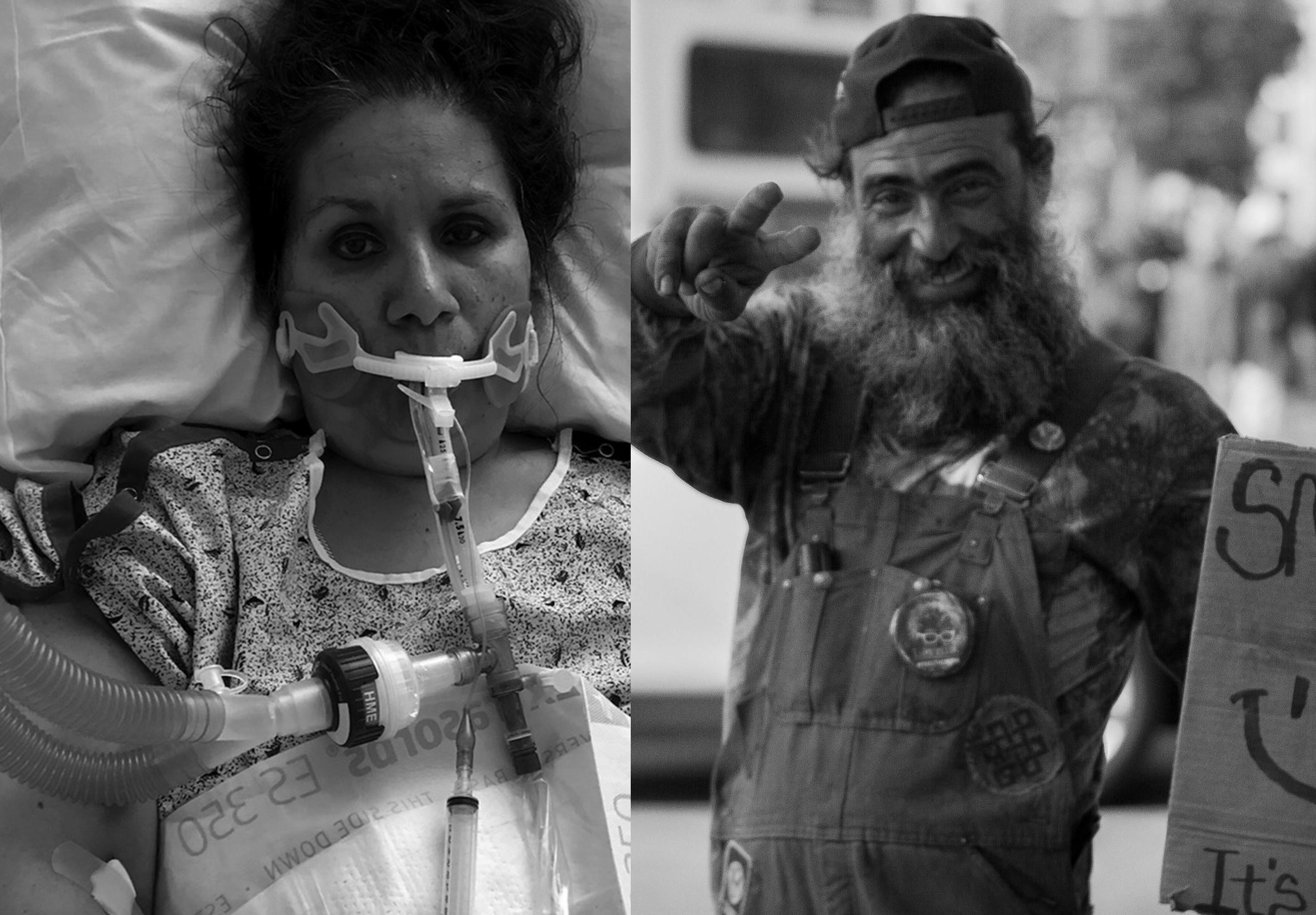
Who has the privilege? Well, one has the privilege of a vaccination, the other has the privilege of healthcare. They both also have their pretty severe struggles. It’s not supposed to be a contest, you guys.

To reiterate, privilege is simply having a good thing. The important thing is what you do with it. To bring us back to Canada again, this country has the highest number of secured vaccine doses per capita in the world as a result of the diverse portfolio of contracts that were negotiated under our government. Our rollout is a little slow because we hedged our bets across multiple horses, but as additional vaccines are approved and become available, Canada is likely going to benefit greatly in the long run. We have access to a high number of vaccines. That is a privilege. What is Canada doing with that privilege? It’s taking vaccines out of COVAX, a vaccine charity organization, because it paid for them and is now staking its claim. It’s like if you participated in one of those ‘buy a pair of shoes and a second pair of shoes will go to a developing country’, but there is a worldwide shortage of shoes, and, despite already having a bunch of shoes, you decided to make sure you got the extra shoes before the people who are shoeless get theirs. It’s little wonder Canada is being criticized by human rights organizations for this.

You can be greedy with privilege. You can reinforce your status against those without your same privileges. Or, you can use your privilege to alleviate the suffering of others. Privilege itself is irrelevant to the path the individual who has it will take. Once privilege is acknowledged, you can also reflect on where this privilege came from. Community members in the DTES received the vaccine in the early rollout because activists (notably people with the privilege of enough time for activism) have been working on humanizing this marginalized demographic for decades. It is unlikely that many residents currently receiving the vaccine participated in that humanizing process, but they are receiving the benefits of it nonetheless.

Myself, I too have been vaccinated. When I get my second dose, I plan on visiting my parents, giving them a big hug, and I’m not going to have to worry about whether or not I am killing them in the process. Not everyone can do that right now. I hope I can do so with humility and gratitude.

In the wake of the treasonous insurrection that beset the US capitol building, Joe Biden was quick to claim that this does not reflect the “true” America. This is a fantasy. It is a fantasy just as much as Trump’s claim that he won the election is a fantasy. Childish Gambino summed it up in song long ago, but dissidents have known this for even longer. Noam Chomsky identified the Republican party as the most dangerous organization in human history, pointing to its self-enriching climate denial and nuclear militarism, necessarily fed by a distracting, rabid ideology that led to the Trumpism that is incinerating the country (and the world) today. This isn’t new. This isn’t shocking. This kind of thing doesn’t just appear out of nowhere; it’s a creeping infection.

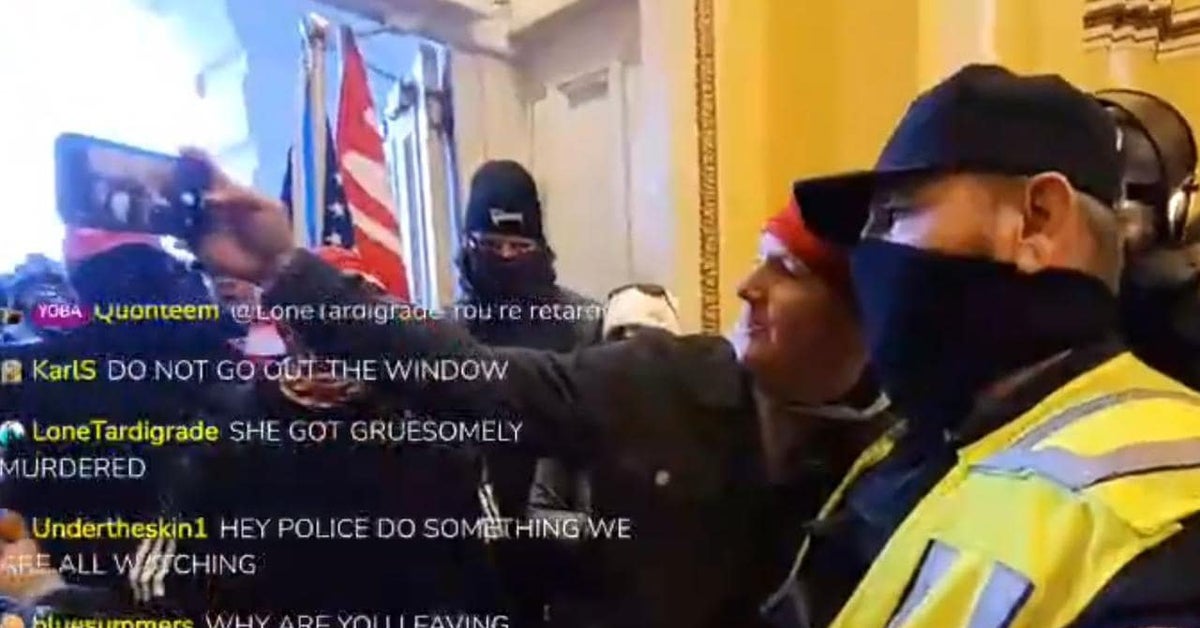
Consider this. During the insurrection, police were videotaped opening the barricades to allow the traitors to storm the capitol. They were similarly taking selfies together. This harkens back to when police thanked Kyle Rittenhouse for his “vigilantism” during the George Floyd protests almost immediately prior to him murdering two Black Lives Matter protesters, and then allowing him to walk right past them after he was done. The police are the arm of the system, and the tacit, systemic allowance of far-right radicalization and extremism that has permeated the country is emblematic of its culpability. Far-right terrorism is the greatest domestic threat to the country, but federal law enforcement prefers to investigate environmentalists. This radicalism has been built up over decades and decades, and is egged on by political malfeasance.

Law and Order for some

Joe Biden wants to “reach across the aisle” to work with Republicans in order to unite the country after four years of increasing divisiveness. I guess he thinks that further tax cuts, greater environmental deregulation, and more law and order will bring the QAnon fanatics back to reality? The image of Democrats created by Republicans is as Venezuelan Bolsheviks. Democrats will tank the economy through hyper-inflation, impose a totalitarian invasion of personal privacy, and lock up in the gulags anyone who so much as blinks the wrong way. Obamacare, née the Affordable Care Act, was literally created by a Republican, but because of its adoption by the liberal side of the spectrum, it needs to be dismantled. If Biden wants to work with Republicans, he’s going to have to consider that 70% of them believe he stole the election through widespread voter fraud. How do you compromise with a false reality that won’t even bother to acknowledge your effort to connect? Well, it seems like Biden is making his attempt by trying to silence activists who want to defund the police because he doesn’t want to be framed as soft on crime. Biden could claim that he would increase funding to the police, or choose a tough-on-crime prosecutor as his Vice President, and neither of those things will placate the Republican accusations. Biden will impose anarchy in the USA, and he could execute all the BLM leaders in front lawn of the White House, and he would still be a socialist enabler. How can you appease someone who thinks you’re a pedophilic cannibal who worships Satan? Why would you even bother?

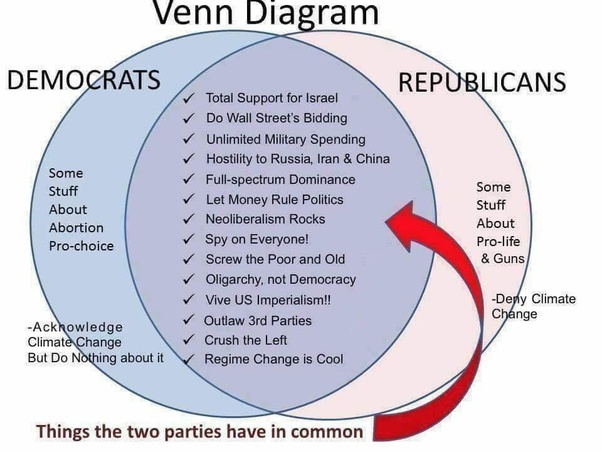
Maybe there is an argument that the “adults in the room” will reassert control after the departure of the current fascist. However, do you remember when John McCain denied that Obama was an Arab which is now looked at so fondly as a Republican who knew how to handle conspiracy theories? Take a look at the video in the hyperlink again. When the woman says the word Arab, John McCain smiles before saying “No ma’am.” While Trump was profiting off the Birther movement, the establishment Republicans were well aware of the narrative they were subtly weaving. The “adult” Republicans introduced the “Southern Strategy” and have been using dog-whistle racism for decades. This current chaos is the child of these “adults”, and they seem to have no inclination to issue any consequences. Yet the Democrats seem to think that acquiescing to bad faith madness is an appropriate strategy, and they’ll stymie potential allies who are looking to actually improve the world in order to do it. The thing is, the Democrats are just as culpable for American decline as Republicans through their enabling and mutual goals of self-enrichment.

The Democrats will frame it in the language of care and the importance of process, while the Republicans will frame it in the language of might, but the underlying content will remain the same

Americans want progressive change. Government healthcare is actually increasing in popularity across the spectrum, yet Joe Biden is against it even though it is ultimately more popular than he is (63% compared to 55%). Florida, in addition to voting for Donald Trump, voted to increase their minimum wage. Other States, who only marginally supported Biden, passed laws to decriminalize all drugs (Oregon) and increase taxes on the rich (Arizona). When removed from tribal politics, the things that will obviously improve the lives of citizens are quite popular. These ideas have legs when they are sampled at the grassroots level, but always seem to die when they reach the political heights. Perhaps it is because the needs of the people have been consistently ignored by both national parties that the country is burning, and only competing delusional narratives dominate the political discourse, whether the immigrants are invading or that everything is fine for everyone. No wonder then that people cling to delusions to justify their situation and then fight to defend them.

The next panel is the dog nostalgically reminiscing about the original arsonist.

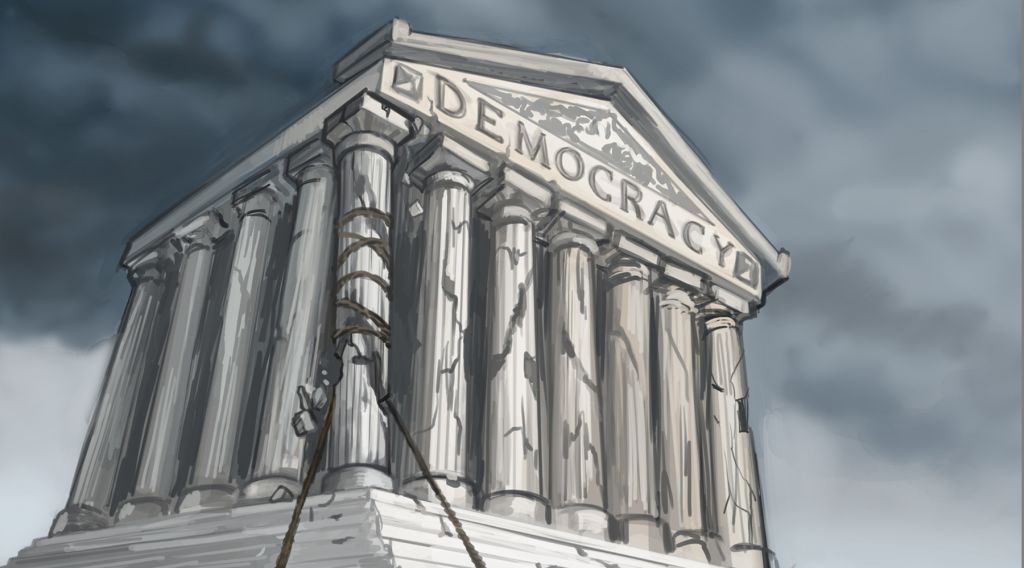
The institutions of America appear to be standing firm, for now. Biden did win the election, and it was certified by the electoral college as well as congress despite attempts to supplant the democratically elected leader with a tyrant. The court challenges were all thrown out. Arrests are even being made, despite police complicity, though the treatment of those attempting to overthrow the government ought to be compared to those who were protesting police violence. The point is, it is unlikely that this coup attempt will succeed due to the sustained functioning of democratic institutions like elections and the court system. However, it could just be Trump’s incompetence that allowed the American experiment to limp on. A proper dictator would have followed through on his promise to join his militia in their storming of the capitol, but Trump just went home to Tweet. It’s blind luck America developed a fascist so lazy he can’t even be bothered to participate in his own overthrow of democracy.

Unfortunately, it is unlikely that these institutions can be sustained forever in a culture as cancerous as American politics. Republicans seem intent on dismantling them for their own benefit, and Democrats only appear to be willing to make stern but futile gestures of superficial frustration. They will run campaigns based solely on the perpetuation of the establishment while portraying Republicans as bogeymen without ever actually capitalizing on mobilizing platform ideas that Americans are begging for. Who will the Republicans put forward for 2024 after the increased popularity of their last brutish fascist, and how tantalizing might that choice appear to a population fed only moralizing platitudes during one of the most dismal times in American history? The modern day Marie Antoinette is a Democrat dismissing cries for help by suggesting “thoughts and prayers” to assuage their crisis. How successfully will democratic institutions protect modern civilization if they are not repaired from the sustained assault they have been enduring for years?

Once the Orange Man is gone, I’m sure that’ll clear right up

I’ve written before about how post-Truth is more about accountability than it is about truth. When the atrocities of American torture were revealed, Obama wanted to “look forward” rather than hold his predecessors to any form of legal or moral accountability. This bore fruit when Trump elected torture-enabler Gina Haspel to lead the CIA, and the wheels kept on turning. The lies, the delusions, the mayhem: these things need to be accounted for. The only way for America to avoid destruction is not to reach across the aisle. Appeasement toward fascism doesn’t really have any successful, historical precedents. Democrats need to implement the beneficial, popular agendas that the people actually need regardless of how many lies are spun, and hold accountable those who are literally committing treason, up to and including the 45th president. This isn’t partisanship. It’s sanity.