Keith Burgess-Jackson, a name literally no one will recognize, wrote an article that whined about how nobody in ethical circles takes egoism seriously. Why can’t we just look after number one and claim to be acting morally? Ayn Rand had some valid points, right? Now, most people would say, “Of course not! Ayn Rand was a psychopath and should be relegated to the Young Adult Fiction section of the library next to the Twilight Saga.” Unfortunately, the ethical beliefs of Ayn Rand, much like the Twilight series, has gained mind-boggling popularity, so I will grant Burgess-Jackson his request, and take the time to explain why egoism fails as an ethical system.

Burgess-Jackson’s main thesis is dependent on the comparison between egoism and utilitarianism. Utilitarianism, even when rejected, is shown academic respect, but egoism is laughed out of the cafeteria. Both are consequentialist, but one measures the consequences as they relate to the group, the other as they relate to the self. Egoism takes the utilitarian maxim of “the greatest good for the greatest number” and turns it into, “the greatest good for the greatest guy: this guy!” The egoist would then point at himself with his two thumbs.

3udcqe

Jack Black: A stand-in for the abstract concept of ethical egoism

This isn’t as stupid as it sounds. There are plenty of problems with utilitarianism (to the point where I consider it an invalid system), but the difference between maximizing the benefit for all and the benefit for the self is just arbitrary preference. If a reason were demanded, all a utilitarian could say is that it’s “nicer” than only looking out for the self, but that would certainly not be enough for the egoist, who is only nice insofar as it would work for their personal benefit.

Let’s look at the same ethical dilemma as Burgess-Jackson: should one steal the pensions from a bunch of old people, and then retire to some sandy beach island with your ethically-gotten gains?

man-stealing-purse-from-old-woman_rrgcqofxo__S0004

You know your ethical system is a winner when something like this is considered a dilemma

Luckily, Burgess-Jackson says no, and I’m sure we’re all breathing a sigh of relief. His reasoning is a little different than most people’s, though. We shouldn’t steal the pensions from retirees because we might get caught and go to jail. Consequentialism, remember? The egoist ought to weigh the possible outcomes and act according to maximum utility. Not for the pensioners, mind you, just for himself. He posits rule-egoism, comparable to rule-utilitarianism, which suggests that the egoist ought to follow rules that would in general maximize his personal utility, like the law and common social norms.

Much like rule-utilitarianism, however, rule-egoism has the same flaw: if it maintains its original consequentialist principles, it cannot truly exist. If an act would, on its own, create greater utility than following the rule, one ought to act on it. For example, if our egoist had an opportunity to rob senior citizens with a guarantee of escape, he certainly would. Alternatively, if he could obtain their pensions legally (such as by lobbying for tax cuts that are paid for by cutbacks to social security), then he’s going to do that. Hobbes’s sovereign (Burgess-Jackson’s exemplar of rule-egoism) is only obeyed insofar as those underneath don’t see a way to thwart their sovereignty. If the rules are deemed absolute, then the system abandons consequentialism and becomes deontological.

Albert Camus, a philosopher with a lot more name recognition, said, “Every ethic based on solitude implies the exercise of power.” If you’re seeking to make things right only for yourself, you’re going to need power to do it. This is where egoism fails as an ethical system.

Donald Trump

You might think it’s odd that robbing seniors of their pensions didn’t disqualify egoism as an ethical system, but just remember, who’s got two thumbs and became president after bragging about sexually assaulting women?

When everyone is looking out for themselves, those with more power will always succeed over those with less. If I’m looking out for me, and you’re looking out for you, and we come into some kind of conflict, and you possess more power than me, I lose. It’s pretty simple. That’s not great if I’m an egoist who wants to maximize my personal benefit, now is it? Within the egoist system, egoism itself does not provide the maximum utility. It cancels itself out. Perhaps you might argue that it can still survive if only I am an egoist, and I successfully convince others to be, say, utilitarians, then my personal utility is again maximized. However, a system of ethics is a social system. If it cannot function on a macro level, it is no longer a system. If it only works when one person does it, it’s no longer a morality, it’s just selfishness.

So throw Ayn Rand back on to the garbage fire that is her metaphorical equivalent, and think about how your dumb actions impact other people for once in your God damn lives.

If a tree falls in the woods, and no one is around, does it make a sound? While some believe this is an unanswerable koan designed to clear the mind and achieve zen enlightenment, there actually is an answer: no, it does not make a sound. What it would create would be vibrating particles that require a hearing recipient to understand it as “sound.” Consider if there was a bat present at this spontaneous tree felling; it would not produce a sound so much as a sonar “ping.” The bat would translate this event in a much different sense than a human being. Without an interpretive subject, a tree falling in the woods essentially becomes describable only in mathematical terms.

Falling-Tree

Ask not, did it make a sound? Instead ask, what does having sensory organs at all tell me about my relationship to reality?

Consider an alternative: if a fire hydrant is in a pitch black room, is it still red? Again, the answer is no. Colour requires the reflection of light off of a surface, to be interpreted by the rods and cones in our eyes. If there is no light bouncing into our eyeballs, there is no colour. Presumably there is still the hydrant’s aspect of “red” that would be present while the light is gone, to be reinvigorated when the light returns, but our understanding of it as red is so far removed from its objective aspect that to call it “red” is a misnomer and used only for the sake of comprehensibility. It’s not difficult to imagine a different kind of biological organ that interprets light differently from our human eyes, similar to how a bat would differ from us in interpreting sound waves. The essence of a thing and how it interacts with the world around it outside of how a subject perceives it is thus quite impossible to experience.

This is what Thomas Nagel would refer to as The View from Nowhere. Immanuel Kant would call it the noumenal world. A conceptual world that is unavailable to us based on the fact that our understanding of “worldness” comes entirely from our uniquely human senses. We may be able to understand it in conceptual terms, and science has certainly given us more refined definitions with which we can do so, but its existence in any sense of the word that might have value to us is completely irrelevant to how it objectively “exists.” Music, colour, sensuous touch, and decadent taste; these things have meaning insofar as they are wholly human, oblivious to any other interpretation. Even our scientific tools can only function along the spectrum that our senses allow us to interpret, meaning that the concepts we have of the noumenal world may be far from its totality.

Contemplating a tree falling in the woods should not lead to a conversion to Buddhism, but to philosophical revelation about our relationship to reality.

It seems almost unconscionable to ascribe a moral quality to ill health. It’s absurd to think that someone who has caught the common cold is some kind of sinister deviant, but as far back as the lepers being shunned and shuttered out of society, humanity has pointed at the unwell and called them devils.

Europe blamed the Black Death on the wrath of God, who was furious over the alleged impiety of His people. The mentally ill used to be incarcerated alongside criminals, their characters indistinguishable. Even lately, the AIDS epidemic of the 1980s seemed only to punish those considered perverse. Consider how we inquire after cancer: did they smoke? Did they eat processed foods? Did they stay too long in the sun? What was their lifestyle like that earned them a terminal illness?

Disease is an unquestionable evil, but why are we so quick to point to its host as having responsibility for it? When disease becomes a moral choice, the pure among us become immortal. The myth that bad things only happen to bad people convinces us that if only we maintain our righteousness, we will be spared. Righteousness only as a veneer, of course, as compassion for the ill could only ever be a supererogatory act. Far simpler to pillory the sick and use the blind luck of our good health as evidence of our sanctity.

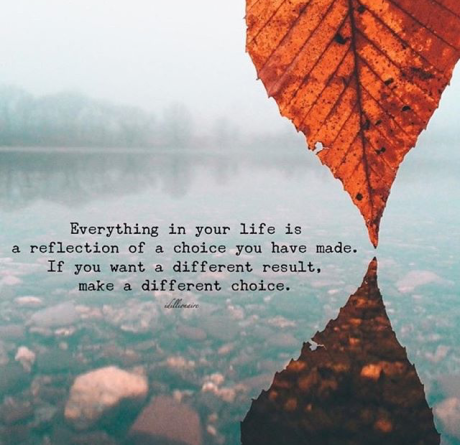
everything-in-your-life-is-a-reflection-of-a-choice-you-have-made-if-you-want-a-different-

A meritocracy of health. God, I hate memes.

Where this demonization of illness is most prevalent is the disease that seems to be built on a long series of choices: addiction. It’s so immoral that it is literally a crime. Mitch Hedberg satirizes this mentality with his quip:

Alcoholism is a disease, but it’s the only one you can get yelled at for having. “Goddamn it, Otto, you’re an alcoholic!” “Goddamn it, Otto, you have lupus!”

One of those two doesn’t sound right.

Addiction is a reaction to trauma, neglect, and mental illness. Addiction is what happens when reality is so brutal that the body seeks any kind of escape from it. Addiction isn’t so much of an illness as it is the medication for when life is a sickness, and then through the obsession of escape it becomes a part of that sickness. Any sense of “choice” in the matter is illusory, any kind of “morality” illegitimate.

But people continue to yell at those whose lives have become diseased. Consider the top rated comment on a CBC article saying that in the first 8 months of 2017, the number of overdose deaths in BC had reached 1,013, compared to the entirety of 2016 which was 922:

I have a real hard time feeling sympathy for these people who have died. They knew fentanyl was out there. They knew that over doses were on the rise and out of control. There’s absolutely no way they didn’t know the risk that they were taking! Yet, they chose to anyways. So no. Finding sympathy is very hard for me.

1,013 human lives extinguished. That’s 1,013 families that have to deal with the grief and guilt of a loved one they will always wonder if they could have done more to save. Of course addicts know that there is Fentanyl in the streets. Some of them ask for it directly. The “risk” isn’t the point. The cure may be worse than the disease, but for many of them it’s the only option available, and some might see the risk of overdose as a potential escape from their sickness altogether. Can we truly judge those adrift at sea who drink saltwater rather than endure the agony of thirst?

But it’s fine. Sympathy is for the bleeding hearts. That could never happen to me because I am morally righteous. I am pure. I am better than them because I wasn’t raped, or abandoned, or abused, nor do I have voices in my head that only shut up when I shoot heroin into my veins. I get to tell myself that it’s my choices that make me noble. My fear of death, a bold reminder in the face of an addict, is well hidden behind the vitriol I espouse. But death cannot come for me. I am pristine. I am immortal.