I’ve been having a hard time with the recent Dallas shooting of 12 police officers, almost entirely because the progressive people who I have on my Facebook friends list, who make a point of acknowledging that the terrorists attacks in Turkey or Sudan are just as worthy of sympathy as the ones in France or Belgium, are noticeably silent about it. My guess is because they interpret Martin Luther King’s quote, “Injustice anywhere is a threat to justice everywhere” as applicable only to the dominant group. Of course, there are far more victims of police shootings than officers being shot, but when violence is carried out in the name of a progressive movement, and to be clear that is exactly what happened, then a good, hard look is required.
Our first look needs to be this. This is a photo of a Dallas police officer who made it home:

This image is equally necessary to all the images of the black victims of police shootings to create the full context of that discussion.
There are five families who didn’t get to have this moment. Injustice anywhere is a threat to justice everywhere.
Yet I am conflicted. One of the things I did soon after the shooting was reread a previous blog I had written about violence as a response to oppression. I was not unambiguously against it, and was clear in reminding people that violence is often a reflection of the extent of oppression being committed against that populace. Black people face disproportionate violence from police officers, that is incontestable. Is the extent of that oppression creating this violent response? Are we just living in a time of revolution, and learning the humbling tragedy that revolution inflicts on everybody?
Malcolm X is famous for fighting for the rights of black people “by any means necessary.” He believed that without a violent response, “whites would not have to worry about a revengeful response to their brutality.” His unflinching rhetoric made no distinction between enemies and allies in the white race, and he made claims like all whites are responsible for “urban black ghetto[s] where drugs, poverty, crime, unemployment, and bad housing are its defining characteristics.”
Malcolm’s success was in the creation of a proud black identity. He advocated that “black people wherever possible, however possible, patronize their own kind … and start to build up the black race’s ability to do for itself.” He believed that black people had the ability to be exceptional, and he fought for those beliefs. One article that I desperately searched for but could not find suggested that without Martin Luther King, black people would not have the vote, but without Malcolm X, black people would not have their identity.
Now, Malcolm had interesting goals. He believed in creating a nation within the United States where black people could live autonomously outside of the rest of white America. He actually conferred with white supremacists, who were quite happy to kick black folk out of their towns, toward the achievement of this goal. To Malcolm, “segregation is that which is forced upon inferiors by superiors. But separation is that which is done voluntarily by two equals – for the good of both.” Now one could simply look at India and Pakistan to see how effective that would be in practice, but those were his views.
Most importantly, Malcolm’s actions and rhetoric reflected his plans. He could promote violence against white people because they did not have a place in his society. He could make blanket statements about white people because they were irrelevant to his goals. Malcolm has often been criticized for his open hatred of white people, but when his goals are considered, his hatred is reasonable toward their achievement.
What about the Black Lives Matter movement? They practice non-violence, so they must be more akin to Martin than Malcolm, right? I mean sure, there are fringe groups chanting for dead cops, but the vast majority choose non-violent methods. Martin said, “We can’t solve this problem through retaliatory violence… We must meet violence with nonviolence… Love your enemies; bless them that curse you; pray for them that despitefully use you. We must love our white brothers… no matter what they do to us.” Surely a movement that hearkens to Martin’s methodology would mirror his rhetoric, but that does not seem to be the case.
Advocates against racism today frequently use generalized language, directing their messages toward ‘white people’. Examples here, here, here, here, here… I’m not arguing that the information that’s being given is incorrect, but the way that it’s being presented paints the clear villains as ‘white people’. A feature length film was even created called Dear White People that examines this phenomenon. The systemic racism in North America is still being attributed to ‘white people’, and that sounds a lot more like Malcolm than Martin. Memes such as this:
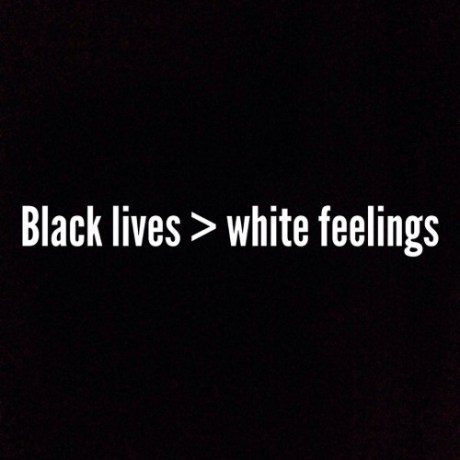
literally put black people and white people on opposing sides, as if there is a necessary conflict between the two. This article calls the Dallas shooting unsurprising considering the state of American affairs on racial inequality. The author uses a cake metaphor to illustrate this lack of surprise, whereas Malcolm simply said about the national tragedy of his day, “The chickens were coming home to roost.” Even the fight for the exclusion of police officers from the Toronto Pride festival is reminiscent of Malcolm’s aim of separation.
So what did Martin say? Well, he said in his I Have A Dream speech that, “The marvelous new militancy which has engulfed the Negro community must not lead us to a distrust of all white people, for many of our white brothers, as evidenced by their presence here today, have come to realize that their destiny is tied up with our destiny. And they have come to realize that their freedom is inextricably bound to our freedom.” His dream was “that one day on the red hills of Georgia, the sons of former slaves and the sons of former slave owners will be able to sit down together at the table of brotherhood.” He dreamed that one day the “little black boys and black girls will be able to join hands with little white boys and white girls as sisters and brothers.” He acknowledges all the troubles of black people, but his rhetoric is firmly entrenched in an alliance with white people. Memes like this:

People in glass houses…
illustrate the ignorance people have of Martin’s beliefs because his dream, if you listen to the recording, was a lot closer to the message of #AllLivesMatter than anything else. He was very purposeful and clear about his inclusion of whites, and going by the themes of his speech, he would likely have said that “white lives are inextricably bound to black lives.” Martin believed in the supremacy of unity. He wasn’t about anger, but hope. It was this oration of hope and unity that got him the ear of two presidents to fix the systemic problems of his time, whereas Malcolm only raged in the streets.
Even Malcolm rescinded a lot of his rhetoric after his pilgrimage to Mecca, and afterward he said, “I’m a human being first and foremost, and as such, I’m for whoever and whatever benefits humanity as a whole.” He also cites regret at having dismissed a potential white ally on the steps of a college in his fight for the black race:
Well, I’ve lived to regret that incident. In many parts of the African continent I saw white students helping Black people. Something like this kills a lot of argument. I did many things as a [Black] Muslim that I’m sorry for now. I was a zombie then — like all [Black] Muslims — I was hypnotized, pointed in a certain direction and told to march. Well, I guess a man’s entitled to make a fool of himself if he’s ready to pay the cost. It cost me twelve years.
When the grandfather of anger-based identity politics likens that approach to being a mindless zombie, that is a harsh indictment.
Yet I do not believe that Martin could have succeeded without Malcolm. In my blog I refer to a yin yang approach, and Malcolm even addressed this when he said, “If white people realize what the alternative is, perhaps they will be more willing to hear Dr. King.” It’s the good cop/bad cop routine, but with racial politics.
Today though, the only rhetoric allowed is that of Malcolm. Identity politics rules. People are angry, and rightfully so, of course, but we’re missing our Martin. The methodology is meaningless if it does not match the rhetoric or the goals. Are people screaming to love the police, no matter what atrocities they commit? No, they’re banning them from progressive events. The most prominent criticism of the Black Lives Matter movement is the #AllLivesMatter campaign, which is typically dismissed as white ignorance, when really it’s a question about the role the rest of society has within the movement. A Martin today would address that question rather than pass it over with disdain as Malcolm would.
I really don’t know if this is the result of a lack of clear progressive leadership, or the degradation of political movements over time, but Black Lives Matter really needs to analyse its goals to see if they truly match its rhetoric and actions. Is the goal separation or unity? Hatred or love? Identity politics or actual politics? Violence against police officers and racial divisions can only increase given the current discourse because, as it stands right now, the dream is dead.
Post-script: all quotations, unless otherwise cited, have come from here.


