Archives for posts with tag: addiction

I wrote something for the BC election, and had it published by a small independent online news outlet. You can read the published copy here:

I’d also like to include the original article. A lot of the vitriol was removed from the piece, and I’d like to share my anger with my sweet Chumps. Cheers!

There appears to be a surreal and growing consensus between the two poles of British Columbian politics. Presumably as a preamble to fully dissolving the party and endorsing the Conservatives, the NDP has embraced a series of regressive policies that leaves one wondering if the party of the radical woke Marxists is truly living up to the moniker. This whiplash shift in the Overton Window began when the NDP caved to political pressure and ended their decriminalization pilot project halfway through its run time, then caved to pressure and abandoned the life-saving harm reduction vending machines providing discreet access to disease-free supplies, then caved to pressure and pledged to withdraw from the carbon tax at the earliest possible convenience, and then finally the latest surrender to conservative pressure has been the promise to, once again, force people who use drugs into treatment. If it is not consensus, it is – at the very least – brazen cowardice.

As mentioned, the latest endeavour of this Craven Coalition is to snatch all the people off the street who use drugs and jail them, allegedly for their own good. It’s “treatment,” after all! Of course, they can’t send anyone to actual drug and alcohol treatment centres because there aren’t even enough beds for the voluntary clients, nor can they place them in dedicated mental health facilities or hospitals because those are all spilling over too! I suppose jails were chosen through a process of elimination. The NDP will retort that it won’t be prison guards or wardens administering these units but licensed medical professionals – as if that somehow changes the facility this all takes place in or the dearth of licensed medical professionals in the hiring pool. It will be a locked unit with many security personnel, and it sure won’t be an ambulance bringing in the new inmates! Following the trend of recriminalization, the NDP is choosing to meet the Public Health Crisis that was declared in 2016 with the full force of the carceral system.

Perhaps I’m being unfair. This is a deadly serious problem, and there is a treatment for it! It’s literally in the name! If we can overcome the logistical impossibilities of this kind of program and force these recalcitrant sticks-in-the-mud to just get a little help, then so many lives will be saved, so many families will be happily reunited, and so many people will continue to vote for the incumbent government. Is that not something noble worth striving for?

I worry that when people hear the word “treatment” when it refers to addiction, they think it works like an antibiotic: you party too hard over the weekend, catch a smidge of an addiction, you take some penicillin as prescribed, and it clears right up! Forcing someone into treatment under those circumstances might make some sense; if someone stubbornly refuses their dialysis, they’re often assessed as incapable, forced into the medical procedure, then sent back into the world until their organs start failing again. The coercive dream seems to be a brief intervention that measurably prolongs a life through medically-sound practices.

This is not, however, what drug and alcohol addiction treatment looks like. I worked for a couple of years in a licensed treatment centre, and continue to work as a social worker with people who use drugs. In my experience with treatment centres, they typically have programs like art therapy, music therapy, trauma-informed yoga, group therapy, one-to-one counselling, Cognitive Behavioural Therapy to help establish healthier links between thoughts, feelings, and actions, Dialectical Behavioural Therapy to help regulate overwhelming emotions, and so on. A pattern is beginning to emerge here! Even 12 Step-based programs (like Alcoholics Anonymous and the facilities that embrace it) function along the lines of non-judgemental and accepting communities that provide a caring environment for residents who typically feel isolated and stigmatized out among the rest of society. I believe if John Rustad ever learns how much Social and Emotional Learning goes into addiction treatment, he would abandon the whole project.

Going into a bed-based treatment centre means going into a 90 day therapy session. The reason for this is that addiction arises from trauma. In fact, all the people who use drugs that I’ve worked with use them to cope with that trauma. Drugs are the treatment for trauma. I will say it again: drugs are the treatment that people with addiction use to help them live with their debilitating trauma. These facilities exist as 90 day therapy sessions to provide alternative coping skills to the numbing and euphoric effects of drugs – quite tempting when sobriety is a living hell. The reason these facilities aren’t always effective is because addiction manifests itself over years or potentially decades, accumulating compounding trauma throughout the process, and three months of therapy before returning to the same environment that spawned all that trauma and drug use in the first place is unfortunately not the “cure” that people want it to be. Remember, if they have them, people have to go home when they’re done. If people are being taken off the street, where does the NDP intend to send them once their “treatment” is complete?

If the NDP thinks forcing people who use drugs into therapy is a good idea, I would invite David Eby to tell his wife, “Just calm down!” the next time they’re having an argument and report back on how well it went. There is a reason that 99% of treatment facilities are unlocked: people need to want to be there. The idea is to regain control of your life, and taking away that control at the outset is so obviously counterintuitive to the therapeutic process that it makes me wonder if the NDP actually knows any more about addiction treatment than John Rustad. Abducting people off the street, forcing them into jails, telling them this is for their own good, all of this is going to add to their trauma, not reduce it. Calling this “treatment” in line with the other resources that are available is going to terrify people struggling with addiction away from getting any kind of legitimate help. Rather than force people into addiction recovery, the results from this would have the NDP forcing people away from it.

Who is this for? This anti-therapeutic model was clearly not designed with people who use drugs in mind, so what is the NDP’s goal here? The reason this disaster of a policy was introduced was because a 13 year old girl fled her foster care and overdosed in a homeless encampment. Why not promise improvements to the foster care system? Why not promise additional supports for families so that kids don’t end up in care? Why not promise additional funding to Child and Youth Mental Health services to cut down on wait times? Why resort to this asinine model? Unsurprisingly given the NDP’s sea-change from orange to yellow, we’re following the traditional conservative trope of being Tough On Crime: ignore all the complex reasons that the scary thing is happening and warehouse the scary people so that they’re out of sight and out of mind. If we can stoke people’s fears and promise simplistic solutions to resolve them, we’re sure to win!

This provincial election is an embarrassment. With Kevin Falcon having sabotaged his own party into oblivion, the two surviving contenders appear in lockstep to dehumanize and discard people who use drugs. I’m not so naive to think that the Conservatives will provide any kind of reasonable or humane drug policy, nor any kind of other policy, so as a progressive voter, I will likely swallow the caustic bile festering in the back of my throat and vote NDP – only because the Greens are not viable in my riding. We desperately need to do better. We desperately need to actually look at the evidence when trying to address addiction, and start addressing trauma. If there are any politicians remaining who are capable of feeling shame, I hope they’re crippled by it.
Part IPart II

2023 is over, and while the final numbers are yet to be tallied, it’s generally expected to be another record-breaking year for drug overdose deaths. What surprises me the most about this is that Vancouver has had an injection of additional police, 100 of them in fact, and the abysmal numbers of equally promised mental health nurses certainly would be irrelevant. Drug deaths are the result of degenerates not having sufficient consequences for their actions, so surely there must be some kind of mistake. I can’t imagine that venerated and Oscar-snubbed documentary Vancouver Is Dying would mislead me in any way. Surely my fears should be allayed; my condemnation of drugs vindicated, and yet, the fear persists, and drugs keep killing.

I deadly serious. And don’t call me, Shirley.

I’m sure Aaron Gunn, the auteur of this masterpiece, would suggest that it’s all that darned harm reduction that’s keeping these deaths high. In fact he does. I’m doing a bit; perhaps you’ve forgotten since it’s been so long since my last blog on this, but I’m trying to provide an analysis of this… whatever Vancouver Is Dying is supposed to be. Harm reduction paradoxically perpetuates harm, as per Gunn. His masterclass in logic points to the fact that Insite, the supervised injection site, has been around since 2003, and yet drug deaths have soared since then. And it’s true! Drug deaths have soared. It’s a weird leap of logic though because Insite has reversed 11,856 overdoses since it started collecting data in 2004. So like… yes, deaths have gone up, but it’s pretty easy to argue that the number of overdose deaths would be even greater by 11,586 if Insite wasn’t around, right? Like that’s pretty simple and straightforward. Perhaps there are other things going on that contribute to growing drug addiction beyond the measures society has taken to make that problem safer for the people who are stuck with it.

Of course, harm reduction isn’t actually about making things safer. Gunn argues that this is a gaslighting technique used by progressives to hide the fact that harm reduction is about reducing stigma. Stigma is a good thing, actually, because it discourages people from smoking cigarettes or drinking and driving (two notably legal and heavily regulated substances, I might add). We should stigmatize drug users to achieve similar ends (I would love legal and heavily regulated, but I don’t think bullying is the way we’re going to get there, Gunn). Anyway, there is just so much stupidity to unpack in just this small little point then I’m going to take a quick break for a picture.

Pictured: a good thing we should do more of

First, harm reduction and stigma reduction are separate things – both of them are good. Does giving out clean needles for free reduce more harm or stigma? Well, they do a really good job of reducing the risks of contracting bloodborne diseases like HIV and HEP C. Does Gunn not consider those harmful? Needle exchanges and similar programs do reduce stigma in the sense that they tacitly suggesting that people who use drugs don’t deserve to die needlessly, so maybe he’s right. But then he appears to be suggesting that people who use drugs deserve to die needlessly.

This brings us to stigma being good. What?! Education campaigns like those surrounding smoking and drunk driving do not increase stigma; they increase education. People weren’t collectively bullied into abandoning these pursuits – cigarettes became heavily regulated as people became more informed about their harms and demanded it, and when they were informed about the dangers of drunk driving, drug users made informed, rational decisions about being safe while using their drug of choice, i.e. they started using designated drivers and taxis because even though they enjoyed using drugs (alcohol), they didn’t want to die while doing it. Gunn gets really close to encroaching on these obvious parallels to harm reduction and safe supply that would suggest a more rational approach to drug policy, but then just skates by obliviously… or intentionally. I mean, he does suggest that there is no evidence for harm reduction strategies, so the odds are he’s just a moron. It’s not hard to find the citations I’m using here.

And these drug users don’t need an education campaign! They know, better than literally anyone else, the harms of drugs. It’s their friends, partners, and loved ones who are dying. It’s them playing Russian Roulette with their drug dealers. They’re the ones ending up in the hospital with cellulitis from an unsafe injection. They fucking know already. The unbelievable callousness of this infuriating garbage to presume that stigma gussied up as education is in any way necessary for people addicted to drugs, let alone something verging on a solution to their problems. The vilest of slurs would still be too high praise for these contemptible sociopaths.

All of the above

Reducing stigma is about seeing people who use drugs as people. People aren’t a disease. People aren’t inherently a threat. People are worthy of love and kindness. If people who use drugs are people, Gunn is out of a thesis. His goal, remember, is to utilize violent consequences to enforce sobriety within a particular and nefarious demographic. He refers to the “imagined persecution” of drug users because if it was real, if they are people, he’s a fucking monster.

But Gunn loves junkies! He shows this by dismissing their views, demonizing their behaviour, calling them zombies, and convincing the rest of us that more of them need to die. Gunn loves junkies so much that he doesn’t want the government to give them drugs. We’re giving people drugs and then watching them overdose! How foolish of us! He literally suggests that the weight of the drug user vote is pushing governments to adopt safe supply policy – the excess funds of drug addicts are going toward lavish lobbying groups. It’s drug users and their allies with all the political clout these days! All the normies are cynically getting into the safe supply market and profiting off of it, just like Purdue Pharma making money off the deaths of OxyContin – no citations given. All these malicious actors and the naive babies that are drug users that he needs to protect are pushing the government to come together with those who are addicted to drugs like fentanyl, carfentanyl, benzodiazepine, diacetylmorphine (Ha! If only!), and give them… hydromorphone!!!

If all drugs are exactly the same, that makes my argument much stronger, so… let’s make some bold assumptions!

Gunn argues that safe supply perpetuates an illness (I’ve already addressed this last time by saying that drugs aren’t actually the problem of addiction, so I won’t repeat myself here). Safe supply is what is actually causing the crisis that was declared in 2016: a pilot program that started midway through 2021! You see, giving drug users a drug is suggesting they are past the point of saving (of note, being saved means never doing drugs again, not staying alive). Gunn wants to save junkies by putting them into privately-run treatment centres that certainly have no financial incentives in promoting abstinence-only policies!

So what does giving a tiny fraction of opiate users (around 5,000 people get prescribed safe supply out of an estimated 225,000 opiate users) a drug they never really wanted to take in the first place look like? Are they truly diverting and selling their drugs as much as Gunn suggests? In a miraculous first, Gunn is finally right about something!

Getting prescribed hydromorphone when you are addicted to fentanyl is like being given a couple of Bud Lights a day when you’re normally downing an entire keg of blindness-grade moonshine. If you listen to drug users, or look at the research, the metaphor is backed up by a good amount of reality. Hydromorphone is weak-ass shit, and the comparison to Bud Light is apt. The only way Bud Light would be useful to a moonshine-oholic is if you stockpiled it for a rainy day, if you didn’t have any moonshine and were desperate for anything with alcohol in it, or if your loved one didn’t have any moonshine either, was dangerously hung over, and needed a bit of the hair of the dog to get going. Or you’d sell it because you’re addicted to fucking moonshine and don’t have any money. It’s literally the same with hydromorphone – click on a hyperlink for once in your lives and see.

Not this one!

So is hydromorphone contributing to the problem? Well certainly not the deaths, at least – they’re barely relevant on that end. Is it cheaper because it’s more abundant now than it used to be? Sure! Is that actually a problem? Well, given that it’s fentanyl that’s killing people, Economics 101 would tell us that a safer, cheaper alternative would dissuade people from going to fentanyl. So arguably, a street market flooded with hydromorphone is one for the ‘plus’ column.

Also, just quickly, Gunn suggests that doctors are prescribing safe supply to people with schizophrenia, and they are, obviously. Addiction is about alleviating suffering, schizophrenia causes a lot of suffering, so there is a disproportional amount of people with schizophrenia who medicate themselves with drugs. And like… there are problems with giving certain medications to people with schizophrenia – and those medications are for ADHD, and have nothing to do with safe supply. Gunn just wants to throw in one more scare tactic for people who don’t know any better to suggest that mental health (an already terrifying unknown!) is now becoming even more scary because of DRUGS! It’s a simple misleading claim, pulled out of his ass, mashing two ‘scary’ tropes together for the sake of weak propaganda. The use of fear to manipulate people toward a particular ideology is just so glaringly apparent that it physically hurts me.

Are there problems with safe supply? You bet! That hyperlink you clicked on earlier about the research into it suggests that people aren’t actually looking for hydromorphone because that’s not what they’re addicted to, and would be better served by something that actually touches their tolerance level. It’s also only being delivered to a small fraction of the people who need it, and that’s partly because doctors, the current gatekeepers to safe supply, are nervous about prescribing it. If things go wrong, it’s their licenses on the line. That’s why the research, as well as the Chief Coroner of BC, advocate away from a prescriber model. Read things! I strongly recommend it.

I dunno – kinda seems like bullshit

Anyway, Gunn is wrong about more than just the information he provides. He’s also wrong on more research that he never talks about! You’d think he would want to include all the evidence on safe supply in order to provide comprehensive reporting on it, right? The NAOMI and SALOME trials run out of Crosstown Clinic in Vancouver followed individuals who were provided with diacetylmorphine (that’s heroin if you didn’t look it up the last time I mentioned it) daily as a treatment for their opiate addiction. And wouldn’t ya know it, their lives improved! They were able to start working again, rekindle connections, and no longer needed to resort to crime! You know how Gunn acknowledges that drug users will do awful things like crime in order to get their drugs, but then is against safe supply for completely irrational reasons? Well, turns out proper safe supply gets rid of that crime part! Drug users would no longer be desperate, so they wouldn’t have to do desperate things! Why would you need to do a crime in order to get drugs if you’re already getting the drugs? That sounds like a harm is being reduced there – surely it must be a stigma thing.

The lives of the people who participated in these trials improved because they were able to get what they needed without issue, and then they could spend the rest of their time doing whatever. And turns out, that’s mostly healthy things anyone would do because, and I can’t stress this enough, people who use drugs are people. When the trial ended, the government shut down the heroin program because drugs are bad, and the participants banded together to sue the government to allow them to keep taking heroin and won. You know how if you are part of a cancer treatment trial, and the trial works so well that you’re able to live a functional life again, when the trial ends that the trial operators are legally required to continue giving you that successful treatment? Well they are, that’s why they won, and Crosstown still has the heroin program running – for about 140 people of the 225,000 mentioned earlier.

Hmm… perhaps there’s a reason it looks like there hasn’t been much progress with the safe supply program…

Looking at things like research and data, or even just listening to the drug users that he’s talking to, is beyond Gunn’s capacity as a documentarian. Perhaps his shoes are too tight. Gunn prefers simplistic solutions: drugs are bad, so don’t do drugs. Things are only seem complex because those smarmy leftists who love opiates made it that way! If you put our leaders in power, we’ll fix things by getting rid of those people and their confusing ideas! Drug policy shouldn’t be about creating a functional society, it should be about simple moral assertions about what is right and wrong. There is only one right way to live, and laws should be a reflection of that, and if reality doesn’t conform to that ‘right way of living,’ then we’ll play pretend no matter how many dead bodies stack up. Anyone talking about consequences is just trying to cause trouble. We can’t acknowledge any nuance about drugs or it will distract from the necessary truth that drugs are wholly evil because I can’t fathom a world outside of the black and white. Simplicity must prevail over any other factor. There is no limit to how simple a solution can be when it doesn’t have to conform to reality, and that is the kind of solution that Gunn is advocating for here. Drugs are bad, so don’t do drugs, mmkay?

I thought we all learned this was a joke years ago

Back in reality, harm reduction, safe supply, and reducing stigma have all been shown to improve the lives of drug users. The question that Gunn dances around but never asks is, what if we could reduce the harms of opiates to the point where the people who use them could be functional members of society, no more socially unstable than those who drink alcohol or smoke weed? It’s possible – we used to do it before it was criminalized for being associated with the Chinese! This is where the dancing comes in: Gunn cites “normalization” of drugs as a threat that society is facing. What if opiates were as normal as alcohol and weed? This terrifying outcome does not come with any evidence as to why it would be bad – the fears of increased crime and death would be negated by the reduction in those harms from the process of the aptly named ‘harm reduction.’ Gunn can’t imagine a society that does not fit into his moral framework. He’s fighting to obtain that fantasy.

The use of simplistic fears to generate simplistic political outcomes is ubiquitous. The ‘right’ way of doing things needing to be reflected in law expands well beyond drug use. These strategies to manipulate reality to suit a moral panic aren’t unique to Gunn and his absurdities. There are real world consequences to these kinds of delusions, and Gunn arguably made a significant difference with this shit. To find out why I’ve been wasting so much of my life on this gibberish, tune in one last time… whenever I get around to it. Hey, I have a job!

Part IV

Freedom sure sounds great, doesn’t it? It inspires whole convoys, after all. There is an entire American congressional caucus dedicated to it! We’re supposed to let it ring, and for that privilege, we are charged a buck-oh-five. There are statues dedicated to the very notion of liberty, and yet it remains vague and undetermined, generally on purpose by those advocating for it. Typically ‘Freedom’ in the political sphere means rich people not having to pay any taxes, but that’s never explicit, and so people often have this vague, fuzzy feeling about the term that’s generally positive. So what does freedom actually entail? Is it more than just feeling secure against the threat of terrorists and commies through lower corporate tax rates?

Freedom, when pressed, is obviously about the freedom to choose. We can’t choose anything if Sharia Law is enforced and we all have to convert to Islam, or the communists have us all wearing the same grey sweatsuit lining up for the same loaves of bread. Freedom means being able to choose between loaves of bread and the freedom to convert to Christianity!! Right? To an extent. Freedom in its most absolute sense would be all the choices from choosing between two loaves of bread to killing yourself. If we are truly free, there are an infinite number of choices available to us at any given moment.

Memes, you’re definitely growing on me as an educational resource

Does this sound terrifying? It should! The freest person in the world is the recovering drug addict. Their entire lives were previously dedicated to all aspects of doing drugs: grinding to get the drugs, doing the drugs, a short grace period to do some wallowing, and then grinding again. It’s a loop that’s hard to escape, but it does happen. When it does, that person has only known a very constrained lifestyle, and now, without any of it, they are free to do literally whatever they want. Maybe they might go back to school, or start working again, or reconnect with their sober friends. Or maybe they might travel, or go to a treatment centre, or move to a new home away from their drug den, or go for a walk or a movie or the library or the mall or a drop-in centre or a counseling session or a swim in the ocean or a music festival or back home to their parents or a cry in the shower or, as has been established, just end it all. These are choices that must be made every second of every day without any idea of when this flood of choice will end. People off themselves all the time in recovery, and part of the reason is the amount of freedom that they have. The experience of absolute freedom is a void of unknown and infinite possibility, an expanse of overwhelming nothingness ahead of you, and you are the only person responsible and capable for taking that desolate void, both outside and inside of yourself, and turning it into a worthwhile life. Alcoholics Anonymous tells recovering addicts to take things one day at a time simply to limit the number of choices people in this precarious and vulnerable position have to make. The existential anxiety of making a choice is so great that many people relapse simply because the miserable cycle of drug use is at least a known quantity and has a degree of comfort in taking those choices away. Anyone calling them a coward for this has never undergone the experience.

Limiting freedom is actually quite healthy for normies too! You ever hear of structure and routine? They’re great ways to stay healthy. People have a hard time making it to the gym when they have to choose to go to the gym, but when it becomes habit, and they are no longer actually choosing to go, they now have a routine. This is actually incredibly beneficial! If someone is feeling low and unable to do much, their bodies will automatically follow the routine they’ve habituated, and voila! They’ve still made it to the gym despite their blues, and you know what? They’re probably feeling a bit better because of it. Obviously the reverse is true with bad habits, but creating a good life is about creating good and healthy habits. Even something like making a list is helpful because it forces our decisions into a box that restricts our choices to the items listed – they get done because we don’t allow ourselves to choose outside of that box. The irony of freedom’s celebrity is that the goal of life is reduce the number of choices we actually have to make on a day-to-day basis; we just automatically make lunch for work the next day, or go to bed at a reasonable hour, or use the healthy groceries that we buy rather than leave them to rot in our refrigerators. Success comes when our lives are mostly automated, and an automated lifestyle is not a free one.

Pictured: successful humans

This seems somewhat intuitive. Has anyone faced a major life choice and thought: wow, this is a pleasurable experience! Or was there a lot of anxiety and catastrophizing about what the future might look like whether you choose this or that? Especially once you realize that not making a choice is also a choice, and allowing the status quo to perpetuate itself is one of those infinite choices you have to deal with. If a choice seems easy, it’s likely because you’ve been culturally primed to accept that choice as typical and normal – and how free is that of a choice, really? Jean-Paul Sartre, notorious philosopher of freedom, tells us we are “condemned to freedom.’ Choosing negates all other possible choices, and is a terrifying, inescapable, and necessary experience.

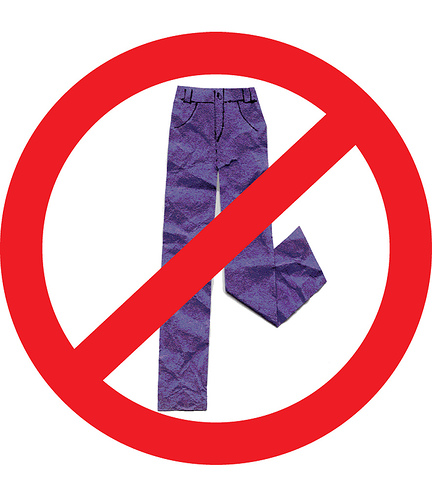
And I do think it’s necessary! Don’t get me wrong: I’m not against freedom! We must choose. Having someone else making these major choices for us is an unforgiveable oppression. Just, as with everything, in healthy moderation. Even those Freedom Truckers wore their seatbelts on their drive to Ottawa, and had nothing to say about seatbelt mandates, or traffic light mandates, or pants mandates. No one was out there protesting their freedom to not wear pants, only masks, even though the arguments against pants are way more grounded in science than the arguments against masks!

Don’t you just hate them?

So why is freedom, something that actually kinda sucks, celebrated like it’s the fundamental aspect of Western civilization? I mean, I think it’s reasonable to yadda, yadda, yadda over the escape from the tyranny of the British monarchy since the freedom I’m describing goes well beyond the fight for democracy, but I think the Freedom of today has far evolved beyond that democratic rebellion oh so many centuries ago. Given the link between the fascistic elements of Western society and claims of Freedom, I think that much is clear! So what is it? My personal thoughts are that Freedom has come to represent the dream of a meritocracy. We obviously aren’t living in a meritocracy, but if we are Free, then we must be! I earned my life through the choices I’ve made, and if there are outside social factors subtly influencing my position in life, then the value of my merit is lessened. If I am Free, I am not determined. Whether my life is good or bad, it is my own. I have carved out my place in this world, and the only way that that’s going to change is if the commies and terrorists are allowed to come take our Freedoms away. When people talk about Freedom, they aren’t actually talking about freedom at all since, as discussed, freedom is an incredible burden foisted upon us by an uncaring universe. They’re talking about dignity. I matter because I am Free. Their vitriolic shouts of Freedom and spittle aren’t a call for action, but a plea to have the meaning of their actions recognized.

Freedom is a good thing in the same way that democracy and socialism are good things; we ought to have a choice in our governments and our workplaces. We ought to have choices in our own lives even as we aspire to limit them. Those choices can be painful, and an overwhelming amount of freedom is such a sublime threat that I pray none of you ever have to face that kind of dread. Freedom is… fine, I guess. We’ve become kinda weird about it, but that’s because society has become kinda weird. We’ve become so disconnected from the world around us that we actually insist on it now; if the world is connected to me in any way, then what I do doesn’t matter! How broken of a culture is that? Freedom with a capital F has seemingly become the last bastion of being okay with ourselves while all other forms of meaning are being erased by those who profit off our existential despair. This is why Freedom and fascism can exist in tandem. The thing is though, we can create our own meaning without having to believe that we are alone in creating it. Being alone sucks, but being free around other people means respecting their freedom which often means limiting our own. Given we’ve established that limiting our freedom can be a good thing generally, this shouldn’t be seen as a threat, but as a way to lead a happier, healthier, and more cohesive lifestyle.

I am choosing to add this image to this blog, not because it is relevant in any way, but because I want to. Or am I only doing it to adhere to the goal I set for myself in my previous blog? How free of a choice was this really?

Freedom is like eating our vegetables. We don’t want to do it, but we have to, and if we can find a way to make them more appealing by dousing them in the ranch dressing of moderation, that’s probably for the best. What we don’t want is for Freedom to distract us from the reality of freedom. Freedom more often than not needs to be limited, whether that’s to avoid existential dread, to have a healthy routine, or simply to get along well with others. This doesn’t eliminate meaning, but enhances it. Freedom with a capital F is a lie. Freedom with a lower case f is all we have, all we are condemned to endure. Best to make the most of it!