Archives for posts with tag: DC

The Todd Phillips Joker-verse and HBO’s The Penguin create their respective monsters out of very similar clay. The world is unfair: society is heavily stratified, inequality is high, and the odds of transcending the hell of your poverty are grotesque – or laughable, depending on your rogue. These two pieces of entertainment understand the tragedy of modernity, and portray us with depressing accuracy. Our world is dying, and the thoughts of too many are perseverating only on how to profit off our deaths. We vulgar plebeians are damned, cogs in the machine generating our own demise. The West and its contradictions are primed for villainy, and there is no Batman to crash through the sky light. No one is coming to save us. How these two DC antagonists are manifested in their barely-fictional worlds is probably one of the better lenses to understand the monsters in our own.

And no Kevin Conroy to save us! RIP Best Batman…

The Joker begins his foray into villainy in a way that I’m fairly confident was not intended by the creators of the film. Arthur Fleck is a man struggling in poverty, loneliness, and despair. He has a shitty job and worse prospects. His arc culminates in violent anarchism, rebelling in fury against his condition. Arthur lashes out as The Joker against an elite that has only ever looked down on him, smug in the certainty of their position as arbiters of the structures of the world; banker bullies whose material success has come at Arthur’s expense, and Murray Franklin, the talk-show media figure who laughs at and degrades him.

In short, this is Trump’s story of America. The establishment has taken advantage of you; liberal elites look down their noses at you, laugh at you. Any kind of systemic reform is secondary to simply turning it all to ashes. As an Alfred once said, “Some men just want to see the world burn.” Arthur Fleck is representative of the so-called Basket of Deplorables who are judged by the mainstream, and this is their response to it: fuck you. The only reason that I’m confident that the creators didn’t intend to celebrate Trumpism’s bloody revolution is that Arthur is an unreliable narrator, and the scenes that consistently show his delusions are the ones in which he’s connected to others, where he’s loved. The devoted crowd cheering at Joker’s murderous performance is not real. I believe the original intention of Joker was not to valorize a Trumpian antihero, but to show and empathize with the unhinged mind of a school shooter. Joker is canonically a villain. The appropriate response to a broken world is to fix it, not to break with it. Somehow that villainy was missed, and my interpretation has not been the popular response to the film. A sequel was required.
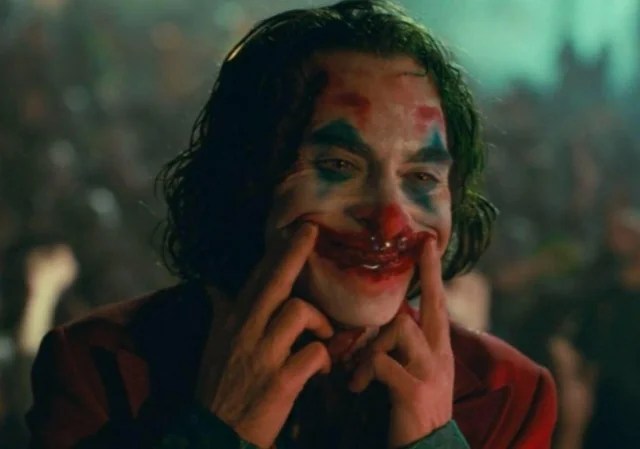
Clearly a man to be emulated

Joker: Folie à Deux has been universally panned, and for good reason. It’s a bad movie! But also for very bad reasons because some people seem to think that it is a rejection of the first film, and that’s simply not true. Arthur as a character rejects the lessons of the first film, but it’s ambiguous if the film does so as well. The second film canonizes the celebratory mob at the end of the first film as real, and, fine. Sure. Arthur gets caught up in the fantasy of his own greatness in response, but ultimately rejects that fantasy because he recognizes that his homicidal approach was incredibly traumatizing to his only friend, Gary Puddles. Joker isn’t a revolutionary, he’s a bully too. His approach to the broken world is to embrace what broke it in the first place: cruelty, degradation, and all of it at the expense of vulnerable populations. It’s this insight that enlightens Arthur to the meaninglessness of his crusade, that he is reinforcing the harms of society rather than rebelling against them. But being the Joker is out of his hands now. His corruption had already infected the populace, and Joker’s revolution continues without him. Viewers are confused that perhaps the minor character Ricky was supposed to be the canonical Joker all along, but in truth, all of the clowns dressed in their makeup who blow up the court house are the Joker. His ideology has won, even if he himself now sees it as folly. The explosion at the court house is indicative of this new ideology’s rejection of establishment institutions, highlighting their dystopic vision of a new America. Trump parallels continue to abound.

Accountability for crimes!? I thought this was America!!

Folie à Deux is a psychiatric condition where two people with mental illness are enmeshed together who begin to share the same psychotic delusions about the world. While it is assumed that Harley Quinn is the second ill person in this dyad, she is only an individualized symbol of the broader delusional support for Joker’s Robespierrean justice; the delusion that this savagery is a worthwhile response to systemic oppression. They are all of them enmeshed into this cult of vengeful destruction.

This is why the second film is not a rejection of the first. It does what any sequel is supposed to do and expands on the themes of the first one. Joker’s Trumpian philosophy has broadened in appeal, and regardless of its instigator’s opinions, it will continue without him. Trump’s chaos is here to stay. The film is also just as ambiguous of its support for this ideology as the first one. The singing in the film is an obvious metaphor for the mania that drives Joker’s methods. In the end when Arthur confronts Harley (I refuse to call her Lee), he asks her to stop singing, to come back to earth, and she refuses. Whether the singing was any good or not is irrelevant; singing is always more fun! Joker’s revolution, however violent, however cruel, has a mischievous joy to it. The memes about cats and dogs in Springfield, Ohio are fun, and who cares about any school children who receive bomb threats along the way?

It’s just a joke! Don’t get so triggered, liberals! Why so serious?

The Penguin begins his own journey along more antiheroic tropes. He is an underdog, and while it’s clear that his lies are ubiquitous and sociopathic from the beginning, we root for him because he comes from a similar background to Arthur. He’s easy to applaud as the antithesis to the opulence of the Falcone family. He’s dirty in a way that poverty dirties everyone it touches; his grimier aspects are not something our modernity rejects, but something it connects to and empathizes with as we too scrounge in the dirt in envy of the wealthy. Oswald also loves his mother and takes as his ward the young Victor, allegedly sharing a journey to transcend their lot as all of us yearn to. He could easily have been a nuanced hero.

But Oswald Cobb(lepot) is a villain. He murders his brothers. He murders his ward. He feels nothing for other people, even the ones he’s convinced us he does. He keeps his mother alive in her vegetative state despite her wishes in order to fulfill the dream that he has projected onto her. It’s always been his dream, not hers. The Penguin does not understand how to connect to other people, only how to fake it well enough for the cameras. We are comfortingly assured otherwise because he is a very convincing grifter, and the pathway to power that he sees as the most efficient is the one where he aligns himself with the working class. There is not a single revolutionary bone in his body, only frigid calculus. His populist deed to restore power to Crown Point was done only for his own ends and adjacent benefits toward others were not considered; Victor’s enthusiastic gratitude appears to genuinely confuse him before he catches himself and finds a way to take advantage of that edge. There is no ambiguity to The Penguin. He is clearly an unapologetic monster, and Sophia Falcone’s sarcastic scoff at him being a Man of the People is illuminating in how obvious it is in its falsehood.
The kind of guy you’d want to have a beer with!

Where Joker is a representation of Trumpism and its followers, The Penguin is emblematic of the man himself. Trump was certainly never working class, nor has he had to work hard to elevate himself above his station, but the sociopathic exploitation of working class consciousness to raise himself to grotesque power is clear. Oswald Cobblepot in the comics is an established elite, as wealthy as Bruce Wayne, but he doesn’t need to be in the show to be comparable to the president-elect because his methods are identical, regardless of his background. A grifter by any other pedigree would sound as sweet. In a broken world, the Penguin takes advantage in a way that people are desperate for. They want him to be what he’s pretending to be because they see his elevation as their own. If Oswald wins, then Victor wins – the grift only becoming obvious when the life is strangled out of him. Trump’s own escalating lies put Penguin’s to shame, but despite their obvious contradiction to reality, people cling to them as a life preserver on a sinking ship. The delusion of his proffered transcendence is a siren’s song. But they are villains; they’re both only in it for themselves.

What’s not to trust?

Villainy has certainly evolved over time. Nowadays, damsels can manage their own distress, and devils only exist in fantasy. But monsters still exist, and understanding our world means understanding the monsters that it creates. We live under the exploitation of the elites. We are, as individuals, powerless to stop them. How will we choose to respond to this? Will we gaze too long into the abyss and become monsters ourselves? Or will we settle into passive reverence at the feet of the devil, spellbound by his honeyed lies?

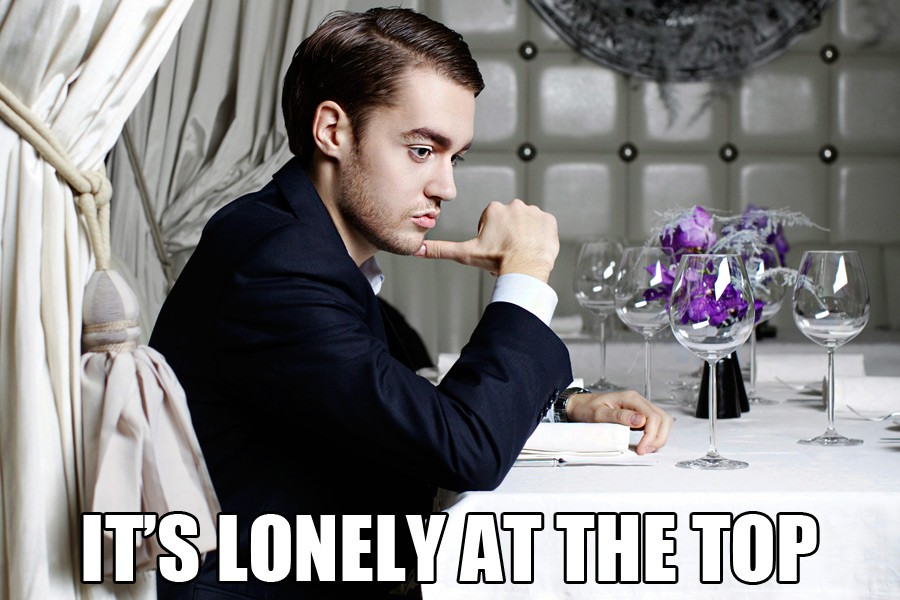
How do we resist in a world without heroes?

Power is typically seen as the capacity to act – with obviously varying degrees. A prisoner can pace their cell, do push-ups, and so on, but can’t act outside the limits of their cage. The President of the United States might not have the power to verbalize a complete thought, but he can do all the things the prisoner can, and more besides. They both have power, but one of them has far more power than the other.

I think this is a narrow view of power that is lacking one of its key components: need. The variations in power aren’t so much across the capacity to act per se, but the capacity to act without considering the needs of others. The prisoner must accommodate the needs of the warden, the guard, the parole board, and so on. His needs are ranked quite low when contemplating which actions to take. The President of the United States, on the other hand, can skate by without acknowledging the needs of most of the planet. He might have to consider the needs of Benjamin Netanyahu, to a degree, as the Israeli Prime Minister has considerable power in this regard as well, but he certainly does not need to consider the needs of the Palestinians who are, for all intents and purposes, power-less.

How power is depicted goes a long way

Taking this needs-focused perspective of power opens up further understandings of how power works, and how impotent our approach to it actually is. If we consider our human needs (using Maslow’s hierarchy for the sake of simplicity), what we consider powerful can really only help us meet our most basic needs: food, water, safety, shelter. This can also help us define what might be considered ‘power’ as anything that can help us obtain these things without considering the needs of others – money, celebrity, access to opportunity (think Harvey Weinstein), and so on.

In case you need a refresher

There are way more needs than the basic ones, and power is useless in obtaining them. Love is elusive to those whose identity is based solely in their power, and this is highlighted in the common trope of the rich person worrying over whether they are loved as themselves or if those close to them are only after their money. Similarly with esteem: we think we respect power, but we really only respect what one does with it. Elon Musk isn’t respected because of his money, but because of his advocacy for free speech and his pursuit of a better world for humanity through clean energy and space exploration; or, he’s not, because of his advocacy for racism and his massive ego whose projects offset any climate good his cars might produce. His power is irrelevant; he is judged by his actions based on the capacity that he has to act – as anyone would be. Self-actualization goes without saying.

Someone with only their very most basic needs being met – such a thing to strive for…

So why is there this fixation on power? Why do so many people strive for it, often at the cost of their other needs? Why do we delude ourselves that power is somehow going to fulfill our lives when it literally cannot? The answer is obviously capitalism, you goons; it’s always capitalism.

Capitalism as an ideology requires an underclass to use their labour to produce the things needed by the more powerful. This required scarcity forces people into a situation of never having enough power, so our most basic needs can never be met. A housing market that makes shelter out of reach; low wages to make food and security luxuries; a “flexible labour market” (i.e. gig work) to make the underclass even more precarious in their ability to meet their basic needs.

We are then told that in order to get our needs met, we must compete laterally with others in our class. We must gain power by any means necessary, and that’s the only way we’ll be able to afford rent. Do not consider the needs of your neighbour; they are in competition with you! The only way for society to function is if there are winners and losers, and winners don’t need to accommodate anyone. This is the way.

Baby Yoda’s famous catchphrase, “Fuck you. I got mine!”

This isn’t to say that power didn’t exist prior to capitalism. Feudalism obviously had lords going head to head to obtain more power – it’s just that the regular people didn’t give a shit because they had their basic needs met. More people had access to a more diffuse power: land. If you had access to land, you had food, security, family, and so on, and didn’t see the point in striving for anything else. If you didn’t have land, there was still the commons which allowed a degree of needs to be met. There wasn’t as much wealth as we understand it today, but there didn’t really need to be; people had enough. Industrialization created urbanization which increased inequality and poverty which reduced the average person’s power, and the shrinking of the commons increased commodification which reduced normal people’s ability to get their needs met as basic needs became more and more unaffordable. As the West went through this transition, we peasants and proletarians gained political power through the institution of democracy, but lost it economically as the means of production shifted more and more to the ownership class.

This blog is technically more anarchistic than communistic, but Party Marx will always be welcome for discussions around the ownership of the means of production

This manufactured scarcity and proselytized ideology has deluded us into thinking that with power, we’ll finally be able to live the lives we want to have. To a degree this is true: we cannot achieve anything without our basic needs being met, and power is required to obtain them. The delusion arises when we forget that our goal is to get our needs met, and not power in-and-of itself. We want money in seeming ignorance that the entire purpose of money is to buy stuff – do we want the money or do we want the stuff? Do we want the power or do we want to have our needs met?

Also, wasn’t this article supposed to be about superheroes?

It has been this whole; you just had no idea!

Superheroes have superpowers which would include them in this analysis. It’s a little campy, but being more powerful than a locomotive is technically a power. As David Hume said, “Strength is a kind of power; and therefore the desire to excel in strength is to be considered as an inferior species of ambition.” Could Superman achieve his basic needs without taking into consideration the needs of others? Absolutely! That’s how we get Injustice and Homelander. This shit counts, however nerdy an ambition it might be.

Superman, of course, would never do such a thing in the traditional canon. That’s what makes him heroic. He doesn’t use his power for himself, and I’m going to argue that he doesn’t do it for the people of Metropolis either. The people of Metropolis don’t exist – they’re fictional. Superman doesn’t technically exist either, but the story of Superman does. The writers are producing this power, and the power of Superman is used to meet the needs of person reading his story. We feel secure against the threat of Zod. We feel safe from the machinations of Lex Luthor. This is how empathy works.

If our needs don’t supersede the needs of the hero, they become the villain. This is why the villain Homelander is still seen as a hero in an ever-increasing fascistic America – the people who watch The Boys don’t see any issue with what he’s doing, and their needs remain met by his actions. But traditional villains rob banks and try to take over the world, using their superpowers to meet their own needs. Disney’s new “sympathetic” Marvel villains have high ideals, but don’t consider the needs of others in their quest for it – this is how their villainy is displayed despite the validity of their ideology.

The face of accommodating the needs of others

The thing is, this glomming on to the powerful with the assumption that they’ll meet our needs exists outside the world of the superhero as well. In the traditional model, women (who are limited in their power) will seek out powerful men as a means of linking themselves with his power to help them get their own needs met in a world that wouldn’t allow them to be met otherwise. If there is abuse or violence, it is often endured out of a fear that her needs won’t be met without him – his power is all she has to keep herself from becoming powerless.

Under capitalism, there are more powerless people than just trad wives. Many of us live our lives with the bare minimum of power, scraping by as best we can. Wouldn’t it be nice to attach ourselves to some hero who would use their power to uplift our own? This is the allure of the tyrant. Surely I’ll be taken care of if we give more power to this person with whom I identify! Surely my station will be reduced if they are overthrown! We connect to the tyrant as we would to Superman, as some of us bizarrely do with Homelander – they will use their power to keep us safe. Our needs will be considered; the needs of the outsider be damned. But is the solution to our abusive boyfriend to make sure we land a nice one, or to adjust society so that women and men are equitable in their power, limiting the potential for abuse to happen in the first place? Such a world appears to be possible!

People are alive today who have witnessed significant changes in systems of power

The thing is, power is the capacity to act without considering the needs of others. The powerful don’t need to consider us, so why would they? That’s how power maintains itself, so why abandon the working model? We, however, as a collective have more power than any individual. This is why platitudes are made about how the powerful will take care of us, as a manipulation. We are given speeches and scraps to delude us into thinking that we are better off with them having all the power, with us remaining powerless and allowing them to go unchallenged. Superman is a propagandic myth: the boyfriend who tells his girlfriend to never leave him, he’s going to take care of her, trust him.

Power cannot escape what it is; we have to escape power. We have to recognize the value of our neighbour and accommodate them accordingly. We have to recognize the life beyond our basic needs. Both of these perspective require giving up our pursuit of power. Power will never go away, our basic needs will always need to be met, but we can diffuse it. Just as democracy diffused political power, we must identify other aspects of power and diffuse them as well. Power where it exists today must be counterbalanced – this is often the project of the Left as we try to convince governments to allow the otherwise powerless access to their basic needs. It’s a faulty system as power remains relatively undisturbed, and this liberal redistribution does not address the root causes of the concentration of that power, but it’s what the system currently allows. We still have room to dream for more.

To quote a super-villain (notably, one later purchased by Disney), “When everyone is super, no one will be.” And we’d be better off for it.

It should be fairly common knowledge that Batman is the greatest superhero of all time (Suck it, Achilles, you knock-off Beowulf). People have been trying to figure out why this truism exists since it’s fairly difficult to qualify superheroism outside of subjective preference. It has been argued that since he’s just a guy in a costume facing off against the same world-ending events as an invulnerable Kryptonian, it is his courage and willpower that makes him the greatest. He is the most at-risk, and continuing to fight in those circumstances is more noble than say, someone who is constantly protected by a lime-green hue.

I disagree. I don’t think people really believe that Batman is more at-risk – he’s fucking Batman. He figures it out. He’s fine. What makes Batman the greatest superhero of all time is his villains. What people love about Batman is he fights against Jungian versions of his shadow self. Batman represents humanity’s struggle to combat the darkness in ourselves, and that is what makes his character more relatable than being a braver-than-usual fleshy meat sack.

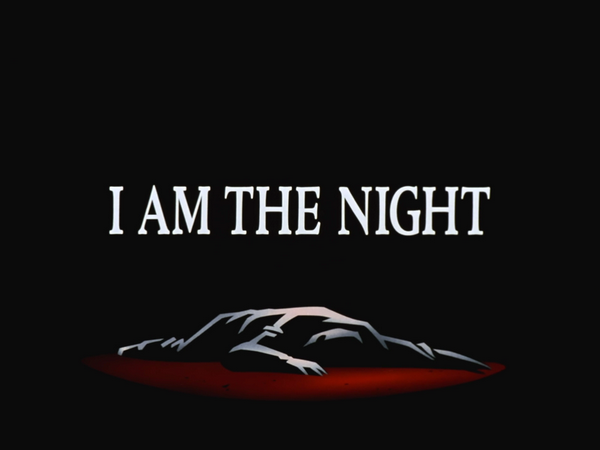
I_Am_the_Night-Title_Card

They are not at all subtle about it

Let me give you an example. Two-Face is a very clear symbol of the duality between darkness and light. Harvey Dent always begins as a friend to Bruce Wayne (in all the iterations of the character that I’ve seen, at least), and that’s why Bruce will pay for the plastic surgeries to repair the scarred side of Harvey’s face – to return the character to his lighter origins. However, thematically it’s always more than that. Bruce struggles to save Harvey from Two-Face because he needs to save the humanity in himself. Two-Face is the most obvious facsimile of Batman with one crucial difference that highlights the thesis of this post. Two-Face will always enact the dark side of his personal Manichean struggle, regardless of coin tosses, and Batman will always triumph in the light. That’s how the protagonist/antagonist relationship works.

BatmanTDKR1_055_The_Dark_Knight_Returns

It’s a comic about a guy in a bat-suit. It was never going to be subtle.

Our favourite Oswald that didn’t shoot a Kennedy, Penguin, fits into this thesis too. Penguin was born into the wealthy Cobblepot family. With that inherited privilege, he embodies the sin of greed and demands more. Penguin is the graphic representation of a Marxist wet dream excoriating the bourgeoisie. Bruce is again similar. He did nothing to earn the billions afforded to him from his familial inheritance, and he became the CEO of a mega-corporation rivaling LexCorp without any relevant education or business acumen. It is unclear what Wayne Enterprises actually does (Thomas Wayne was a practicing physician, not a businessman), but who cares. It’s been argued that a class critique of Bruce Wayne would prefer him systematically redistributing his wealth rather than acting out his well-funded revenge fantasy against “crime”, but within the liberal paradigm of Batman comics, Bruce Wayne is essentially a good, charitable dynasty billionaire to Penguin’s evil, selfish one.

Penguin

Batman is better. Batman is always better.

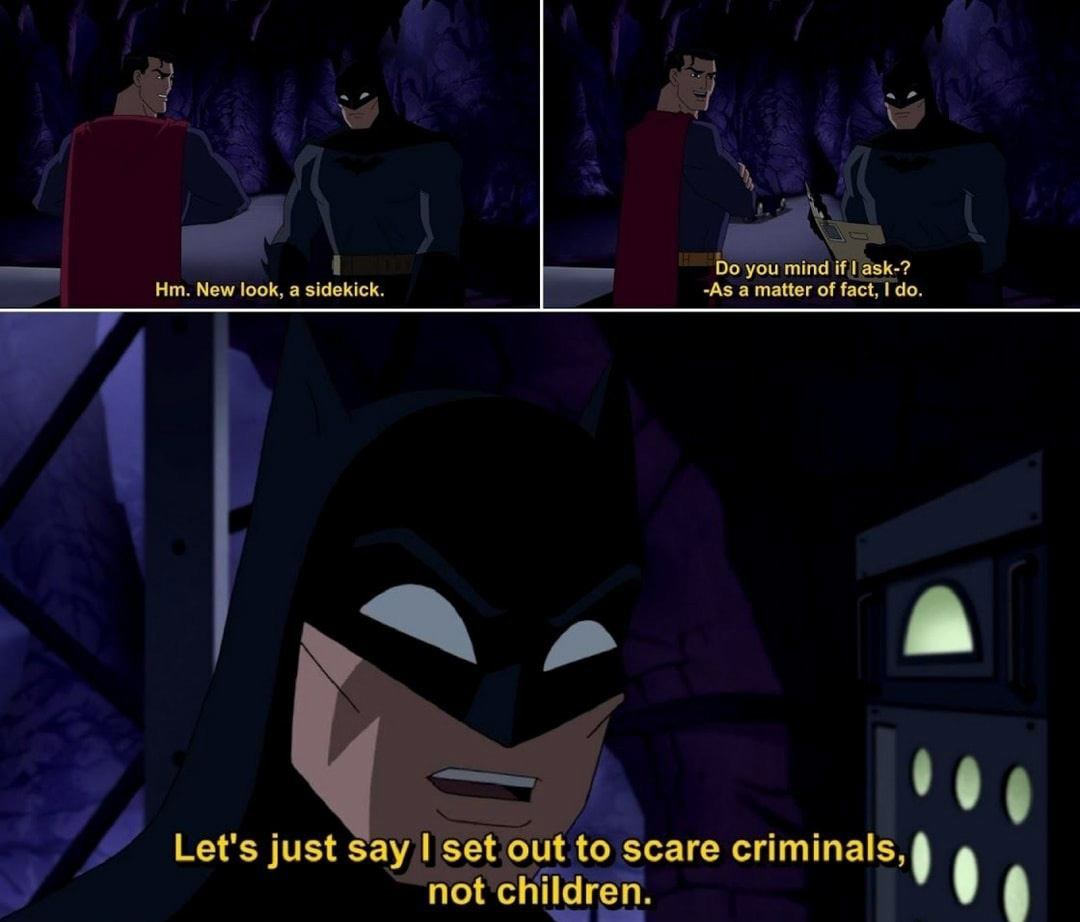
Scarecrow, Jonathan Crane, is another Jungian villain that begins to show the edge to Batman’s battle with himself. Scarecrow uses fear gas to terrify the populace into submitting to his criminal schemes. Batman dresses like a bat because he was scared of bats as a boy, and embodies that fear to intimidate his foes to make his vigilantism more effective. He uses fear just as intentionally as the Scarecrow, but on a different demographic. Fear is acknowledged as a devastating tactic, and must be precise in its implementation lest one slip into villainy. Batman walks that tightrope like a champ.

Superstitious and Cowardly

Children are a superstitious, cowardly lot

This leaves the Joker. The Joker’s whole deal is that he’s an insane clown, but not like the John Wayne Gacy type. He could have easily been a forgettable villain, overblown by too much camp and vanishing into the dustbin of history like the ICP, but against all odds, the Joker became the most iconic Batman villain. He did this by embodying Bruce Wayne’s madness. The Joker infamously believes that all it takes to drive a sane person mad is one bad day, and while he is proven wrong on many occasions, he is accurate in his analysis of Batman. Bruce had one bad day, and became a driven, megalomaniacal vigilante in response to it. He is held in check only by his single-minded focus on justice. The Joker broke under pressure, caving to unchecked violence, but Batman held on to his values just enough to stay in the light.

Two Guys in a Lunatic Asylum

What do you think I am? Crazy!? You’d turn it off when I was halfway across!

There are obviously a lot more Batman villains, and not all of them fit so neatly into this kind of categorization. Catwoman, sure, is as ethically grey as Batman, and her darkness slightly edges over the light much in the same way Batman’s light slightly edges over darkness, and as much as they want to, they can never quite meet in the middle. However, that’s just as much a Jungian conflict of coming to grips with one’s own ethical ambiguity as it is a Montague and Capulet love story. And I swear to God, if anyone brings up Calendar Man I’m going to lose it. The point isn’t that every villain perfectly represents Batman’s struggle with himself, but that the emblematic villains that define Batman as a character are lasting because they reflect his own inner demons.

This is what makes Batman the most interesting character that happens to be categorized as a superhero. The thing is, though, despite the socially agreed upon categorization, Batman is not a superhero. Not because he doesn’t have superpowers, but because a hero is someone you’re supposed to aspire to. Imagine genuinely believing that it is okay to terrify others in order to dominate and control their social behaviour – you’d be a monster. Who wants to aspire to madness? Or Manichean angst? Batman isn’t a hero, he’s a criminal. He knows he’s in the wrong, and strives for a world where he himself would not be welcome. If anything, Batman is a supervillain fighting against cartoon versions of himself in order to protect the world from his own potential for darkness.

BatmanTDKR3-135 Hunt The Dark Knight

Batman, the libertarian fantasy, pointing out the reality of the libertarian fantasy

The idea that Batman is a superhero has pretty dark implications. Kyle Rittenhouse was found innocent in his own vigilantism through claims of self-defense, which, legally speaking, would have similarly applied to the men he had killed if they had killed him instead – not exactly a glowing exoneration. The micro legality of it is less important than the macro perspective that sees a young boy leave his hometown with a semi-automatic rifle in order to protect property from those he sees as criminals. Kyle Rittenhouse and those who canonize him genuinely believe that it is right and good to basically pretend to be Batman. The reality is that Kyle Rittenhouse created a situation where people died because he wanted to live out his own revenge fantasy against “crime“. It doesn’t matter that he is legally innocent of murder, what he did is counterintuitive to the ongoing functionality of civilization.

On a more abstract level, Batman is truly a villain in that the impact of the superficial ideals of superheroism he represents is a net negative on the world. People tend to look at Batman and don’t see a man fighting against himself, they see a man fighting against incorrigible criminals. They see social systems as not being sufficient and true justice requiring individual citizens to rise up against otherwise unstoppable evil. They don’t learn to fix the social systems through collective action, they learn to use violence to bully degenerates into conforming to normative standards. They see a fairly traditional superhero.

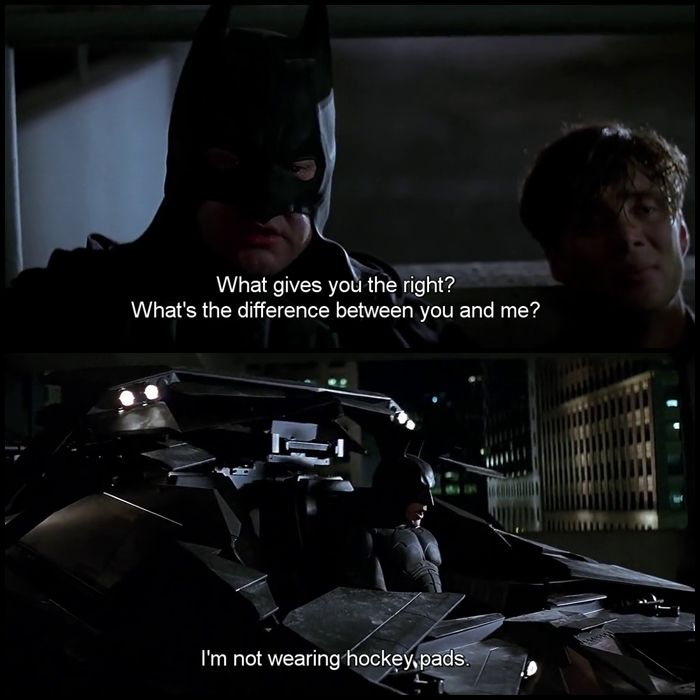
Hockey Pads

I mean, he is pretty often portrayed that way. This is really only my own opinion as a Batman apologist

What makes Batman great is that he doesn’t have to be a superhero. If we see him as a villain, then we recognize that he is no one to aspire to. He can just be an interesting character dealing with the loss of his parents by combating anthropomorphized versions of his inner demons. He can be someone we can relate to when we have to face our own shadow. He can help us find the light by repudiating himself rather than uncritically celebrating his single-minded madness. To borrow a phrase: Batman is not the villain that we deserve, but the one we need.

A dark knight.