Archives for posts with tag: the war on drugs

Part IPart IIPart III

I have outlined in broad terms why Aaron Gunn’s propagandistic pseudo-documentary fails to even begin to address the drug crisis in Vancouver. It ignores the actual causes of drug use, it cherry-picks data from already irrelevant sources, and it does not even attempt to rebut the massive amount of evidence supporting harm reduction, and, to a lesser extent, safe supply (mostly because it is a new, statistically small project with little data currently available). Instead, it demonizes drugs and through them the drug user, painting them as violent and unpredictable. He films tent cities, likely without consent, and never actually asks any of the residents how or why they’re in that situation. Drug users are a pornographic threat, dirty and alluring, and the only solution he offers is to utilize state violence to enforce abstinence by any means necessary.

The pornographic content that I know you’re here for!

Gunn suggests that he and those ideologically akin to him are the only ones who actually care about drug users. He claims the Woke Left want to keep drug users in the slums, stuck in addiction, stuck in poverty, and it is only by making drug users “better” that they can be saved. Much in the same way that infamous LGBT antagonist Anita Bryant claimed that she didn’t hate homosexuals, Gunn seeks salvation for the morally fallen. This is why there is so much emphasis in the real world of right-wing politics to force people who use drugs into treatment – they need to be saved! Of course, there aren’t enough beds out there for those who want to go into treatment voluntarily, but despite this miniscule logistical anomaly, we must force these sinners into repentance for their own good. You’ll hear talk of treatment beds as a panacea to the drug crisis without anyone actually pointing to solid evidence that bed-based/residential treatment actually works any better than anything else people are doing, with some evidence showing that the risk of overdose increases after treatment because the person’s opiate tolerance has evaporated. This is because treatment isn’t treatment in this context; it’s conversion therapy. “Beds” are only a measure of our capacity to eliminate sin. The goal is erasure, and erasure on a massive scale does not consider pesky irritants like research, studies, or the voices of the people being erased.
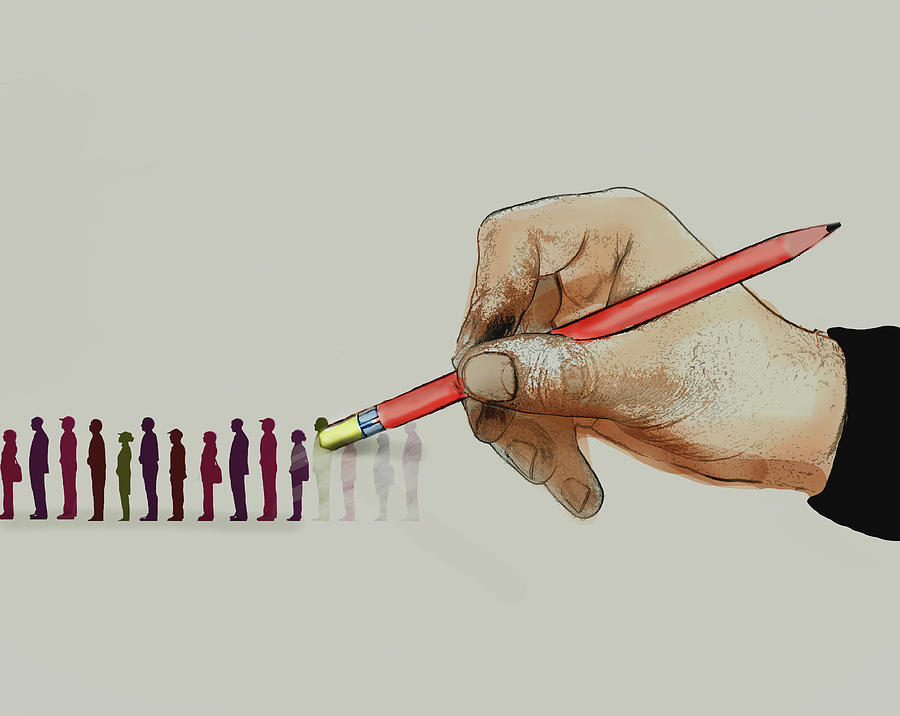
When the threat of hellfire isn’t enough!

This is why analyzing this kind of propaganda is important. Gunn released this trash leading up to the Vancouver municipal election, and the right-leaning ABC Party under Ken Sim won a solid majority on a platform nearly identical in ideology to that of Vancouver Is Dying – we need law and order to combat drug use and random violence! Interestingly, in trying to find years old news coverage about Sim’s platform, I stumbled on a fun little update to all those stranger attacks so prominent in the film – apparently there was a massive decrease in stranger attacks when the pandemic was winding down in 2022, and the police just didn’t release those statistics during the election campaign of the right-wing candidate they had endorsed. Remember how Gunn neglects the pandemic when talking about crime? Perhaps the fear of crime was sensationalized by opportunists hoping to push emotionally-driven policy with no regard for what the truth actually is. ANYWAY, I DIGRESS!
Who could have guessed??

So what does erasure look like in real world scenarios? Perhaps the event that received the most news coverage was the police sweep that cleared the encampment from Hastings Street which Gunn so callously captured in his more voyeuristic shots. This was completed without any thought as to where these human beings might go, and as expected, the problem didn’t go away – people just didn’t have their tents and meager belongings anymore. But there’s more: Vancouver’s ABC party shut down a street market that many homeless people utilized to acquire cheap secondhand goods, moving it to a less accessible indoor location with fewer stalls for vendors. These goods could be the result of theft and organized crime, dontcha know, which is scary! Getting rid of the observable and centralized market is obviously not going to reduce theft, but there is only one outcome that matters: erasure. The city of Vancouver also chose not to renew the lease for the Thomus Donaghy Overdose Prevention Site which has a centralized location close to an abundance of drug users. With overdose deaths through the roof, it sure would make sense to have a space where it could be done safely with some medical oversight! But alas, erasure demands the elimination of anything that might support the scary and bad thing. There’s more: Vancouver downsized CRAB Park – the only sanctioned tent city – for safety reasons. Tent cities are the never-ending symbol of erasure as they pop up and are cleared off with metronomic consistency, from Oppenheimer to Strathcona Park to one that popped up and was shut down near to where I live – all eventually cordoned off by the blue metal fence.
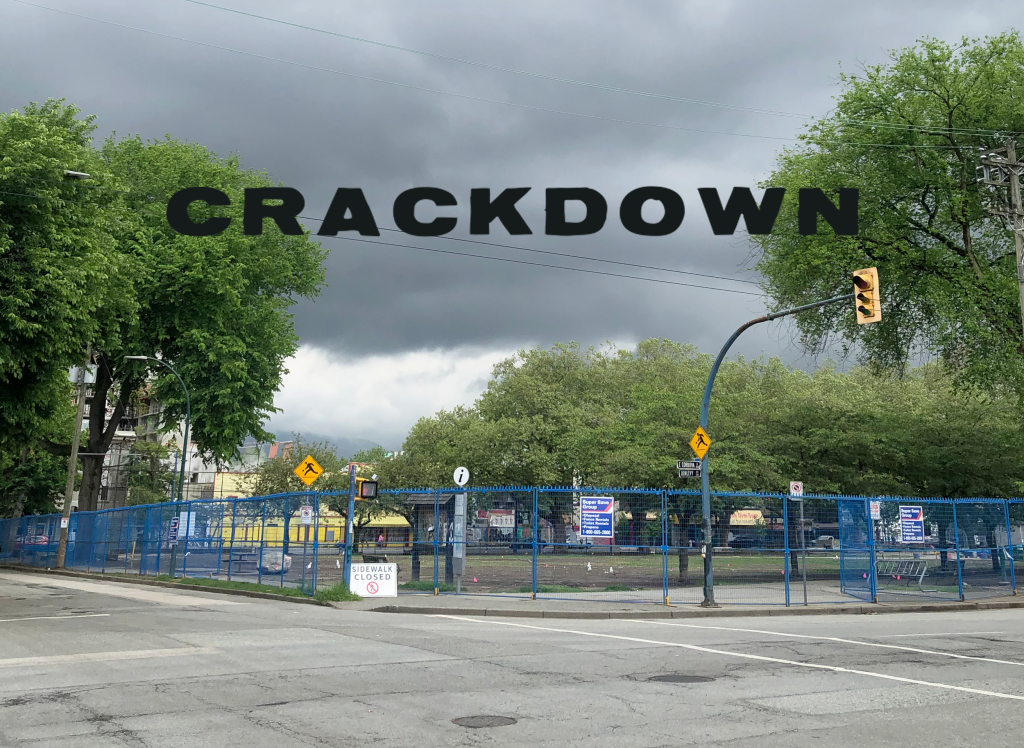
Seriously though, check out the Crackdown podcast linked above about Oppenheimer Park being shut down

It’s not just Vancouver, and that’s my point. An encampment in Prince George was evicted as well, leading the federal housing advocate to call it a “human rights violation” based solely on the fact that it was evicting people from somewhere with nowhere else for them to go. Federally, the Conservatives have been railing against the science of harm reduction, going so far as to blame every last drug overdose death in BC on decriminalization – a pilot project meant to reduce police interactions with drug users (not actually reduce drug deaths) which was a thrilling success, with a 77% decrease in possession charges and a 96% decrease in drug possession seizures! The problem was that people started to see more drug use – the exact opposite of erasure – and that made them uncomfortable. This discomfort unfortunately is the perfect gateway drug to emotionally-driven tripe like that being peddled by Gunn! (Of note, Gunn claims that police don’t actually harass drug users, which is clearly not borne out by the statistic that 96% of police seizures were under the 2.5 grams for personal use before that amount was decriminalized – perhaps this was part of when he mentions that police will “stop and talk to people on the street.” Even if someone isn’t being locked up, that doesn’t eliminate the harassment!)

I’m sure Gunn would comply without complaint to enduring this repeatedly and without reason

What if we could reduce the harms of hard drugs to such an extent that they were no more harmful than alcohol (which in social costs is technically higher than heroin, but haha who cares, right!?). Anyway, let’s say that the drug supply was sufficiently harmonized that it was no longer causing overdoses, that the tools to use it safely were widely available to eliminate the threat of diseases, that the crimes associated with its sale were eliminated, and so on. It is possible – remember we literally used to give legal opiates to children! This is what Gunn fears – he’s actually quite explicit in this when he cites the dangers of “normalization.” What if opiates became so banal that their use was equivalent to enjoying a beer at a hockey game? Or equivalent to cigarettes, where they were discouraged but still mostly tolerated? Perish the God damned thought!

To bring things back to Anita Bryant, it’s important to remember that talking about doing anything about the AIDS epidemic was fearfully seen to be “normalizing” homosexuality. If the homosexuals are dying, well, that’s only because they’re sinners. We’re the only ones trying to save them by praying the gay away, and anyone trying to increase their life expectancy is actually endorsing homosexuality – they’re basically sinners themselves. The parallels to Vancouver Is Dying are endless, and the previous allusion to conversion therapy is depressingly apt. If drug use becomes normal, then people might start being accepting toward drug users!!
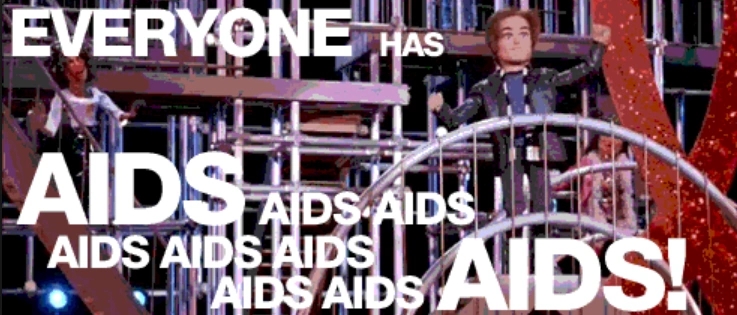
Eagerly awaiting the parody that sings about how everyone has unmanaged childhood trauma to a catchy tune!

In my professional life as a health care social worker, I came across multiple people who saw this film and were swayed by it – people who ought to have known better – but I get it! Emotions run deep, and playing to them is a likely way to win in politics, particularly on the right. Crime is scary! The stereotypical drug user, an unkempt man covered in filth and drool with a needle sticking out of his arm, is gross! These are valid emotions! But manipulating those emotions to erase a vulnerable population because you think their lifestyle is a sin has been done before with similarly deadly consequences. Between 1981 and 1988 in the United States, there were 46,134 deaths related to AIDS. In Canada, with a fraction of the American population, there have been 42,494 deaths between 2016 and 2023 related to opiates. I know that it’s not a contest, but my point is that the fear, the moralizing, and the disinformation being put out is just as disgusting now as it was then and that this shit matters. These deaths matter. Anyone who seeks to erase a population is contributing to those deaths because the outcome is essentially the same – the drug user exists no longer by one means or another, and the likes of Gunn don’t seem to mind which route they follow. They don’t see a disease, just a people they define as a disease.

To conclude this excruciatingly long series of posts, Aaron Gunn, your film is toxic and manipulative, degrades human beings, and encourages their deaths. Now you are hoping to become a federal Conservative, with looming control over these people’s lives. A pie to your face is the least you deserve.

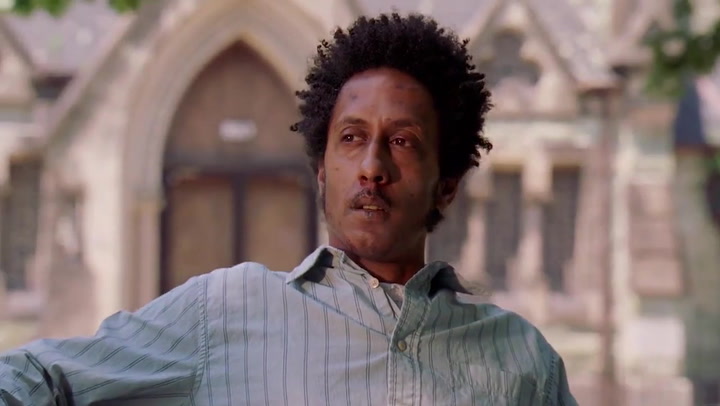
The Wire came out during a time when television producers realized that they could make shows that were actually good in a meaningful way. The Sopranos sparked a golden age of television, and The Wire was hot on its heels to become arguably the best television show of all time.

I recently rewatched the series from start to finish, and genuinely found it better the second time. The slowness of season two was more compelling because I saw it in a wider context than I had my first time through. Season five is still hot garbage, but the overarching narrative throughout the show more than makes up for it.

The final season of The Sopranos didn’t exactly do much better. I’m still waiting for the Golden Age of Series Finales.

What I found compelling this time around was being reintroduced to Jimmy McNulty. The first time I watched the show, I was convinced that Jimmy was the main protagonist of the series. He’s not killed off, he’s charming and handsome, his character is explored in detail, and he has that infallibility in his detective work that is common across all cop show protagonists – they always catch the bad guy due to their unfailing ingenuity, even if the Bosses do everything they can to get in the way.

The Wire is special because there are no clear “good guys” and “bad guys” in the show. The most sympathetic characters are indeed those involved directly in the drug trade; this could be because they are children which naturally plays to our sympathies, but it can be said more generally that the creative team goes to great lengths to humanize a demographic that is almost unanimously depicted as one-dimensionally violent or evil in every other piece of media. The drug dealer exists as an evil scourge plaguing our world, but in The Wire, D’Angelo Barksdale is far more appealing and likeable than any other character portrayed in season one – except for maybe Bubbles.

One of the few redeemable qualities of season five

So in a show without clear heroes and villains, how can I say that Jimmy McNulty is the villain? Particularly when he’s on the side of police, no less; the side that doesn’t overtly use murder to negotiate their business dealings. I am definitely not saying that Jimmy is the villain because of his infidelity or even his show-polluting atrociousness in season five. That’s the flavour to his character and is irrelevant to his villainy.

Jimmy McNulty is the show’s villain because in his heart of hearts he wants the War On Drugs to continue. He might want it to be fought with more resources and to go after the generals instead of the soldiers, but ultimately, he is so passionately committed to the War On Drugs that the show portrays it as his literal vice. Policing is Jimmy’s drug; he is addicted to the War On Drugs. We are sucked into enabling his addiction because of his charisma and charm, and believe along with him that maybe we just need an extra few days on the wire, and drug crime will be eliminated forever. We’ll shut down Avon Barksdale; we’ll shut down Marlo Stanfield; these are the outcomes we cheer for. They don’t get to win!

The Wire is about the institutions of Baltimore, and in this depiction, speaks about the institutions of America more broadly. We see quite clearly how these institutions function only to perpetuate themselves – through policing stats, through political ambition, through an educational system detached from the realities of the children it is ostensibly there to educate. All of them function in ignorance of the actual problems because all of them are hyper-focused on keeping their heads above the water in an unsustainable status quo. The reality that they all seem to ignore is the reality created by the War On Drugs. This ideology manifests this problematic reality that all of these institutions do their best to dance around because denouncing the actual problem would mean confronting the status quo – likely ending their career.

Or being condemned to the “sympathetic” villainy of modern Marvel movies.

In season three, we see two approaches to dealing with the actual problems of the War On Drugs. The first is put forward by Major Bunny Colvin who creates safe zones where drugs can be sold without police interference. It is a very clear indictment of the pointlessness of the War On Drugs. What is less clear, but equally compelling, is the equivalent mirror being put forward by Stringer Bell. Bell and Prop Joe put together a co-op to try a new form of drug dealing – one closer akin to a normal business than to the “gangster shit” that dominates the Game in most other circumstances. They hold votes, they negotiate territory, they resolve differences diplomatically – all in an attempt to distance themselves from the widely acknowledged problems of illegal drugs: murders, insecurity, unpredictability, and police interference. Both factions want a better way to accommodate the hard reality that drugs will never go away.

Jimmy is mostly ambivalent to Colvin’s experiment. He looks more favourably at fucking over the Bosses than he is at what Colvin is actually trying to accomplish, and in no way sees the connection to what Bell is trying to do. He even resists focusing on the target of Major Crimes who is actively killing people, preferring to fixate on Stringer Bell because he knows that’s where the War belongs. Bell sees the wisdom of what Colvin is trying, and is explicit in this when he comes to Colvin at the end of the season to betray Avon. They both are trying to find a way to get around the dysfunctional status quo. It can be just a business as much as any other; the bodies are created by the War.

All the bodies.

The second nice thing I’ll say about season five is that it showcases the Sisyphean meaninglessness of the War On Drugs. The police win. Marlo and Avon are arrested; their gangs dispersed. But we see as the season ends that Michael turns into the new Omar, that Kima becomes the new Jimmy, Carver becomes the new Daniels, and Duquan becomes the new Bubbles. The pawns have already been replaced so often throughout the show that the bottomless pit from whence they come has already been well-established. The boulder goes up the mountain once again, and the War continues – and for what? A few people got promoted, and many more died. Jimmy’s belief that policing ought to confront the War On Drugs more effectively is only a means of finding a more efficient way of getting the boulder up the mountain.

The War On Drugs is the villain of The Wire. The champions that we’re used to seeing from other cop shows are seen here perpetuating it in all its pointless glory. There cannot be any heroes because all of the characters are produced by a villainous system. There are only survivors, mercenaries, and profiteers. The only reasonable heroics would be to challenge that system itself, and under that rubric, ironically it is Stringer Bell who ends up on a pedestal higher than Jimmy McNulty.

The communist that everyone loves to hate, Joseph Stalin, is credited with having said that, “The death of one is a tragedy, but the death of millions is just a statistic.” This obviously refers to the intimate heartbreak of having some one person in our lives pass away versus the math class-styled boredom humanity possesses toward the deaths of millions of “other” people. Now I can very easily link this to the anti-vaxxers who either shrug off or outright deny the literal millions of people who have died from Covid-19, but I’m not going to because the vast majority of Canadians have recognized the severe nature of the disease and acted accordingly. The point I’m actually going to make is that the response to this pandemic refutes the quotation: millions died, but there was action taken to mitigate those deaths on a global scale. Despite the impossibility of connecting on a personal level to all of those who were dying, we all got together to do something about this catastrophe. Covid is more than just a statistic; it’s human enough to elicit a response.

On the other hand, we have the communist that everyone hates to love, Karl Marx, being credited with having stolen this line from Friedrich Engels, “First as tragedy, then as farce.” This is referring to the notion that when tragic history repeats itself, the second instance is often a cruel parody of the first. If the deaths from Covid are the tragedy, then drug overdose deaths are the on-going farce.

And we all know Marx liked to party.

In British Columbia, we’ve had 3,547 deaths from Covid so far; in contrast, since the start of the pandemic until March of this year, there have been 4,552 deaths from drug overdoses, with 2022 set to outpace the previous record from the year before. Certainly the measures taken to limit the impact of Covid have significantly reduced the number of deaths that we would have faced otherwise, but we have harm reduction measures to mitigate drug deaths too with remarkable success (no one dies from overdose at safe injection sites, for instance). My point is that one set of deadly statistics was collectively agreed upon to be a tragedy, and the other was not.

Some might argue that a drug overdose death isn’t the same because they cynically believe addiction to be a choice, and therefore, a death arising from that choice is the addict’s own fault. I don’t think that this belief is as prevalent as it used to be. BC just decriminalized small amounts of all drugs, and even the conservative news outlet, the National Post, is framing this decision as being in response to a health crisis. Obviously it’s a health condition, right? Everyone is saying so.

This looks like candy, and I want to eat it.

In response to this fading belief of personal choice resulting in death, alleged advocates will point out that many of the overdose deaths are not regular substance users, but result from those who casually use drugs receiving a sketchy concoction that they were not physiologically prepared for. This is trying to paint a picture where real humans are dying from drug overdoses, so please care about them! Don’t think this is just sub-human junkies! This could just be someone who likes to party! You like to party, right? Even Marx liked to party!

This mad dash to declare addiction a health crisis to eliminate stigma is inevitably destined to fail. During the AIDS epidemic, people were stigmatized not because of the disease ravaging their bodies, but because they were gay. Everyone knew it was a health crisis, but nobody cared because it was ideologically chained to the homos. Similarly with opioid deaths: you can scream all you want that it’s a health crisis, but no one is going to detach drug use from drug users. Destigmatizing drug use will never work so long as we’re ignoring the stigma attached to the users themselves.

I expect that a drug user Pride event would be less colourful, but probably more fun… cuz, ya know, the drugs

If we see stigma as being attached to the addict in the same way that AIDS stigma was attached to the gay community, then what is it about filthy junkies that we just hate so much!? What biblical sin have drug users committed that earned them this stigma? Well, drug users are racialized, for one. They’re poor. They’re abused. They’re hobbled. They’re men (not in a femi-nazi way, but in a “failed men deserve to be discarded” way). Drug users are imbued with the sin of being socially despicable across all fronts. When society starts to embrace its homeless, when Indigenous people stop being followed around in stores, when we stop pitying the disabled, and when we allow diversity within masculinity, then maybe, the stigma against drug users will wane. Unfortunately, we’re nowhere near that.

The ads I see around town regarding substance use these days are linked to the Drug Free Kids organization which, hence the name, advocates an abstinence-based approach to drugs. We’re still teaching our kids abstinence-only programs like we were sex educators in 1950s America. It’s like we haven’t progressed at all since Nancy Reagan told us to just say no. We seem to have evolved passed the puritanism that demonized sex before marriage, accepting that kids are gonna bone and that’s okay, but we have not yet exorcized the demons from the devil’s weed.

I haven’t seen the show, but I wouldn’t believe you if you told me that none of these kids bone

Remember when sex would immediately result in pregnancy and syphilis? From my old textbook on addiction, “Estimates are that only around one-third of people who have injected heroin become addicted, compared to 22% for cocaine and 8% for marijuana. Only one drug causes addiction among a majority of its users—nicotine.” This little tidbit is completely irrelevant because we don’t want our babies to grow up to be crippled natives living on the street, and complete abstinence is the only way to be sure. Our reaction to drug users is an emotional response curated by centuries of racist, ableist, and classist attitudes, and patriarchal definitions of men. Any kind of drug education or strategy that isn’t addressing that is actively harming our chances at overcoming the opioid crisis.

The millions of deaths from Covid-19 are a tragedy because in theory, if not in practice, it can impact anyone regardless of status. There’s no stigma to it. I got Covid. You probably got Covid. Overdose deaths are for “them.” No matter how much the term “health crisis” gets bandied about to proselytize a benign neutrality, it won’t stop drugs from being a social issue. When we stop the farce and address those social issues, then maybe it will be just as okay for people to use drugs as it is for kids to bone.