Archives for category: Politics

The Queen is dead. Long live the King. The monarchy must endure because reasons.

The Queen is fondly eulogized by continents of people because she was symbolically connected to so many of them. Not for anything in particular she did; she is remembered for her grace, dignity, etc. all the things that can’t actually be pointed to. She’s a celebrity, famous for being famous. Like if Paris Hilton had a colonial empire, but for whatever reason, was mourned like Robin Williams.

You might gather by my tone that I am a republican, in the European sense of the word, with no apparent shame in demeaning the recently deceased. But this is no ordinary death, it is the death of a dictator. An autocrat by any other name would smell as sweet. I would be just as sardonic over the death of Vladimir Putin, I assure you. However, for the sake of argument, let’s say she was just a sweet old lady, and all those stories about racism are irrelevant. A benevolent Queen, a loving shepherd tending to her flock.

Don’t worry baby, you know I always treat you right!

There are a surprising number of people who want to believe in the benevolent dictator. The millions of Trump supporters hoping to overthrow democracy to install their glorious leader see him as benevolent to their interests, at least, apathetic to the interests of everyone else. But even on the left, there exists among some the wish for a politician who could get into power and just ram through environmental protections irrespective of lobbyist interference or whiny pipeline apologists. The world is dying, and the efficiency of a single-minded focus to overrule the profit-driven oil and gas industries and enforce measures to ensure our existential survival is quite seductive. And honestly pretty logical too, since accommodating the bad faith actors and those with suicidal profit motives may mean we don’t make it as a species given our limited timeframe. A benevolent dictator also means we don’t have to worry about these problems because we’ve got absolute power taking care of things for us – it’s the allure of a kind and caring god, answering our prayers, and abdicating us of any responsibility.

The problem with autocracy is that there’s just one ruler with absolute power. And despite millennia of precedent, we won’t assume that absolute power is going to corrupt our benevolent dictator because benevolence is right there in the name. Our hypothetical framework does not extend to advisors, sycophants, and other surrounding officials, however. Even a dictator with good intentions is still open to corrupting influences, especially if our ruler is siloed away in some government office or palace or whatever era you want to place our hypothetical. People are going to seek to gain from that absolute power, and it’s beyond even the naivety of those who believe in benevolent dictators to suggest that they will all bear equal levels of benevolence to our ruler. With an institution of absolute power, coups are inevitable, and benevolence does not provide immunity from harm.

Caesar counts as a benevolent dictator, right?

Let’s indulge that naivety and suggest that our wise ruler is incorruptible, impervious to influence, and their aristocrats or children don’t think to overthrow them. Our autocrat, however close to a god their champions want them to be, is not omniscient. Benevolence is a mere disposition, and while there requires a degree of wisdom to impose philanthropic decrees, being one person limits our dictator in what they can possibly be philanthropic about. Our environmental autocrat from earlier may have spent their life studying environmental engineering to determine what practical solutions are necessary to reverse climate change, but ultimately that means that they’re pretty ignorant in a lot of other areas. What do they know of labour relations, racial equity, First Nations sovereignty, prison and police reform (or abolition), and all those other things our leftist dreamers might want from a benevolent dictator? No matter how benevolent or wise, it’s impossible for one person to know enough about everything to be benevolent toward every facet of society.

Along similar lines, our ruler is going to come from a certain location that is going to influence the way they see the world. Our dictator will necessarily come from a culture, and from this, will necessarily have an in-group. This doesn’t imply that our dictator will be malevolent toward the out-group, we’ve established our parameters forcing them otherwise, but it does imply they will have biases and blind spots. That’s why people love Trump: he shares and reinforces their biases, so they’re not worried about a tyranny with him at the helm, blind spots be damned. But even our benevolent dictator won’t be able to act on things alien to them, leaving the out-group at a disadvantage in reaping the benefits of their lord’s benevolence.

It might be argued that our benevolent dictator would delegate in arenas where they lack the expertise or background to be effective rulers. However, that leads us back to our original problem: we can’t extend benevolence indefinitely, nor can we assume that our autocrat would have the wisdom to appoint appropriate delegates to the right position. Sycophants gonna sycophant, after all. If we allow other factors to determine how these people become appointed, then our dictator is no longer such, and the hypothetical fails.
I’m sure giving a German absolute power has no possibility of backfiring!

Let’s indulge in comatose levels of naivety and suggest that everything up until this point is irrelevant, and our dictator is righteous enough to avoid influence, knowledgeable enough to implement policy across all fields, and is connected to their people enough to avoid bias and blind spots. An omnipotent leader who is all-good, all-knowing, and ever-present across their realm. I’ve essentially described God, not-so-subtly alluding to the fictitious nature of our hypothetical dictator. However, even if all of these things were miraculously true, our divine dictator has one fatal flaw: mortality. Even Jesus Christ died on the cross, leaving His rule to the fallible.

Constructing an institution of absolute power means that even if such a fantasy as a benevolent dictator came to life like Geppetto’s marionette, they too would then die, leaving in place a vacuum which would need to be filled. Monarchs typically leave their power to their progeny, just as the British kingdom will inevitably pass to Elizabeth’s children once Charles kicks the bucket. Can you imagine if the next in line was Jeffrey Epstein’s buddy Andrew rather than William? Queen Elizabeth could have been the best fucking monarch the world had ever seen, but it means nothing if her successor pisses it all away.

Who would want a King that couldn’t sweat?

I like to think of the great Shah Akbar, the third Mughal ruler of India. He unified the subcontinent, was loved by non-Muslims and Muslims alike for his fair accommodation to diversity, and invested in art and culture to create a peaceful, prosperous land. He was succeeded by his son, Jahangir, who was fine, but the cracks began to form as he had to stave off his own son who attempted a coup against him. He had similar interests in art and culture to his father, but he didn’t have the same authority. Next up was a non-coup son, who became Shah Jahan. He started being a bit more militaristic, expanding the empire – up to you whether you think it’s still benevolent to violently seize and annex new territory. He’s the guy who commissioned the Taj Mahal for his favourite dead wife, so he left behind some pretty architecture at least, but it does seem like we’re starting to lose track of the citizenry here.

The next son is Aurangzeb, who basically ignored his father’s wishes of who would succeed next, and took leadership by force, imprisoning his father in the process. He was very militaristic, and expanded the Mughal empire to its largest point. Aurangzeb was a strict Muslim, and demolished a bunch of Hindu temples during his reign, abandoning all pretenses of tolerance once proudly exhibited by his great-grandfather. His militarism drove the empire to bankruptcy, and he didn’t name a successor so his sons fought it out amongst themselves: a civil war that effectively cemented the downfall of the Mughal dynasty.

He has a bird! What could possibly go wrong?

When looking at those with power, we must keep in mind the institutions that legitimize them. The Queen no longer governs in the traditional sense, ruling now only symbolically, but still: a symbol of what? What does her elegance and grace mean to the people of India or Palestine, to the Indigenous peoples of British colonies? Hell, what does it mean to the working classes of England who derive no benefit from, or indeed are actively harmed by, an institution of incestuous nepotism? We’ve romanticized Kings and Queens, knights and princesses, to the point where the fiction feels more real than the reality. The best kind of power is the one that is diffused as thinly as possible among those who are impacted by its influence. Pretending a dictator can be benevolent ignores the tyranny inherent in the institution.

The nicest thing one can say about Queen Elizabeth is that she existed as a benign tumor. The cancer remained dormant. How long do we have to wait before it begins to metastasize? Even if we want a god to save us from ourselves, such a thing is impossible. God is dead; the Queen is dead. Maybe we should start taking responsibility.
There’s a common conservative trope in America that responds to any demand for gun reform after a mass shooting with a disappointment in “the left” for making the tragedy “political.” In the most considerate light, this is the assertion that one ought to focus instead on processing grief rather than… what? What are politics? I mean… what am politics? I did a whole bit with my title; I should probably refer back to it for some degree of continuity. So what am politics?

Politics am the process by which a system functions and is successfully navigated. Think of office politics: if I want this report submitted, I know I have to get it in before noon because Pam in accounting has liquid lunches every day and is too sauced later in the afternoon to get any meaningful work done. If I want that promotion, I need to laugh at Scott’s jokes because he is the boss and has a fragile ego and holds a grudge. You have to recognize the power dynamics at play, understand everyone’s role and the eccentricities that inform their behaviour within that role, and perform your own role accordingly in order to meet your own needs within that system.

Politics!

Government isn’t politics; it’s an institution of politics for the functionality of the society that it governs. If I want any hope of a clean energy deal, I have to give Joe Manchin a rusty trombone in order to get it. This is no different than getting Pam to process your TPS reports quicker by buying her a nice vodka cran, if tasting slightly worse. It doesn’t even necessarily matter what the goals are; politics can just as easily gum up a system as it can loosen it. An obstructionist can use all sorts of political tools and rhetoric to achieve the self-interested goals of whatever lobby group is paying for their motivation: that’s also politics. It’s just that the system that it’s sustaining is plutocratic rather than serving the needs of the demos. Systems are legion and intersect in all sorts of ways.

My first example was an office because I specifically wanted to distance politics from government to make it clear that politics exists anywhere. Politics exists across the whole spectrum of governments, and if you think about the vast differences between a democracy and an autocracy, and the different maneuvers that would be required to function within each of them (e.g. how one goes about satisfying the needs of the many compared to satisfying the needs of the one), it’s obvious that politics can be everywhere, even when it’s defined by only its most overt form. Remember, it’s the process by which we function within a specific system. It doesn’t matter what the system is, whether a workplace, a nation, or a relationship, politics is there. When you successfully answer whether those pants make her ass look fat, you’ll likely be congratulated by being told that you provided a satisfactorily diplomatic response: a distinctly political term.

In short, dismissing gun reform by saying, “it’s easy to go to politics” is by definition, politics. If you are carefully considering your words in order to maintain the functionality that serves you within the system you’re navigating, you’re doing a politics. The far more interesting question is, I think, what is political?

What am political?

When something is political, it means that it is attached to a particular system’s functionality. Laughing at Scott’s jokes is a political act. It is conforming to a persona of flirtatiousness in order to succeed within a business dominated by men informed by a lecherous patriarchal worldview. This is why they say that the personal is political: our individual actions either conform to or rebel against the systems within which we function as our means of navigating them (see code-switching as another example). In Scott’s instance, we have to navigate the system of interpersonal relationships wherein we behave in a particular way to avoid ostracization, the system of a workplace wherein we need to perform in a certain way in order to pay for food and rent, and the system of patriarchy wherein I actually don’t have to worry about this part because I’ve been a dude this whole time.

It would actually be a much shorter list if we try to think of things that are not political. Come to think of it, even an act of God like Hurricane Katrina is still political because it showcased the failures and successes of a variety of systems. Similarly with Covid-19, it too stress-tested the functionality of our various systems. These supra-human events are just as political as, say, the Civil Rights movement because if we are paying attention, we can use politics to adjust our systems accordingly to prevent future failures. Or, alternatively, condemn the system as a whole if we see its successes as abhorrent when the veil is ripped away. Anything can be political if it highlights the (dis)functionality of a systemic response, so our short list is a list of zero. Who knew.

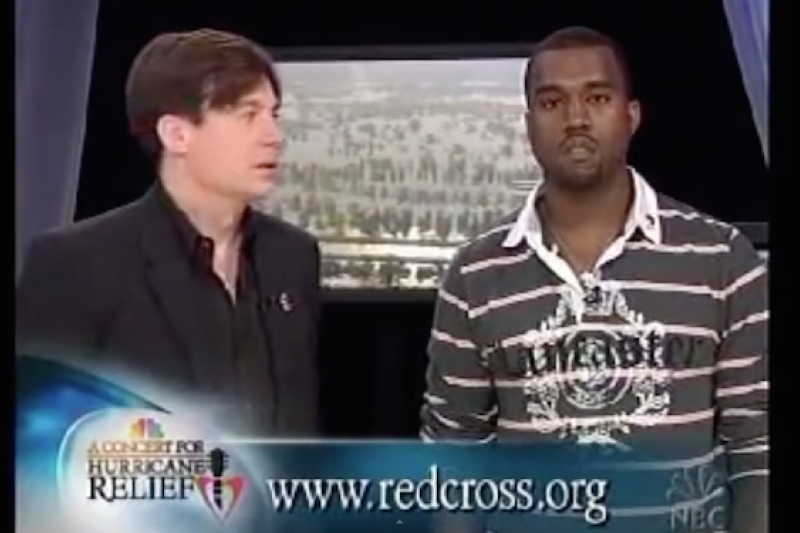
Remember when Kanye cared about black people?

All this boils down to a belief that guns, and all the deaths that inevitably accompany them, transcend literal acts of God in that they cannot be politicized. Right? Something that is embedded in the United States constitution, itself another institution of politics, would defy all reason if we approached it politically. It’s seemingly okay to politicize mental health, and I would genuinely love to see massive increases in expenditures to bolster social supports for those with mental illness, but somehow I don’t think that that governmental response is in the cards either. It would be fun to call the Republican bluff and table legislation that did exactly this to see how Republicans find a way to weasel their way out of it, but Democrats have their own systems they’re trying to protect.

A belief that guns are inevitable does not want the system to change; mass shootings are indeed emblematic of its success. Guns mean freedom! All those dead children are the broken eggs intrinsically linked to this omelet of ambiguous “freedom.” Unadulterated “freedom to” with no regard to “freedom from,” this is what the success of that system looks like. Those who use politics in order to hide the abhorrence of that success using the denunciation of “politics” to do so are the vilest of hypocrite.

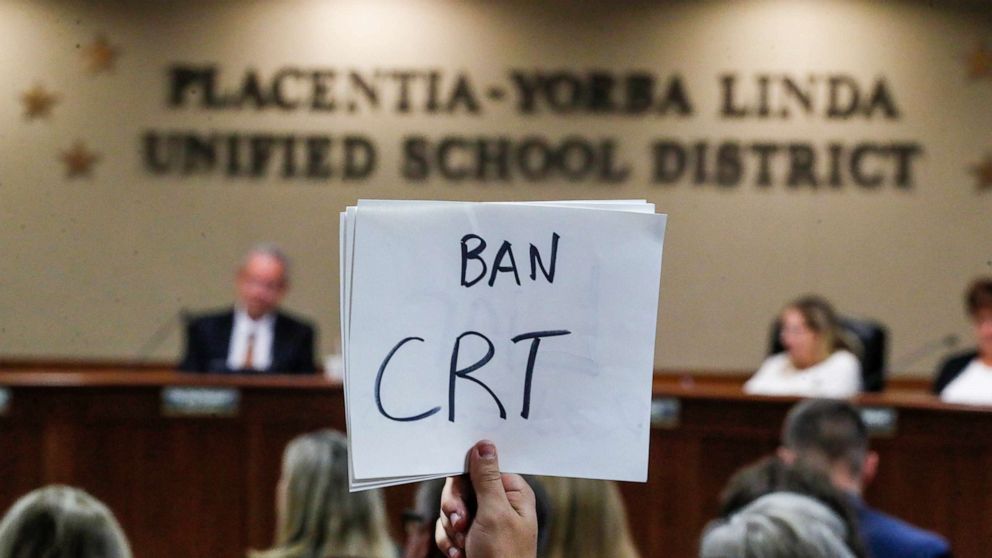
Depending on who you ask, Critical Race Theory (CRT) is potentially one of the biggest threats to society that the West has ever faced. It’s being fed to our children and making them grow up to become beta cucks who are unable to properly defend their country against all the Alphas in China and Russia, or even worse, grow up to become women. With a nation of self-hating, over-educated snowflakes, the West is sure to crumble under the weight of its own wokeness. And this shit is starting in our schools! Our babies! If they start teaching our babies about CRT, what’s next? That gay people exist!?

If children are exposed to non-derogatory images of homosexuality at a young age, they might grow up thinking that it’s normal! Heavens to Betsy!

Of course, we all know about gay people because we’ve had such an thorough and well-balanced exploration of homosexuality in our publicly-funded sexual education previously to now. But what is CRT? How can a race be critical when it doesn’t even have a mouth? Unfortunately, I didn’t grow up in the United States so I didn’t have CRT shoved down my young throat when I went to elementary school. I had to wait until my Master’s degree to learn about it, so my education came much too late.

What I learned is that one can frame racism beyond personal prejudice. CRT asks us to imagine a world where interpersonal racism evaporated overnight, and wonder whether racial disparities would still exist. Given that it’s easy enough to see that they would, CRT opens up a conversation as to what contributes to racial disparities beyond subjective attitudes.

It turns out that holding hands was not enough to end the stratification created by centuries of injustice

CRT is a legal lens in that it focuses primarily on how laws that can appear neutral on their face represent a history of laws that originated in more overt forms of discrimination. The case I’m most familiar with, since that’s what I did my studies on, are drug laws that seemingly apply to everyone equally (they don’t use the n-word in the legal code, for instance), but in their history and implementation primarily target people of colour. Drug laws, in both the United States and Canada, were implemented entirely to control immigrant populations and prevent the mixing of races. Famously, in 1907, there was a massive race riot in Vancouver’s Chinatown because White people believed that Asian men were seducing White women using that sweet, sweet opium. Future Prime Ministry William Lyon Mackenzie King went and “investigated” the riot, and when he returned to Ottawa, criminalized opium because that was clearly the issue. Today, even though racial minorities are generally harassed by the legal system disproportionately to their White counterparts, the criminalization actually surges when the excuse being used for that harassment is drugs. Politicians will use the dog whistle “tough on crime” to stoke racialized fears without actually saying the n-word repeatedly, and that’s because crime and in particular drug crime have been so embedded into our cultural psyche as being linked to dangerous racial minorities that we can’t escape it. Therefore, the enforcement of drug laws is inherently racist even if there are a few good apples in the police force with open and progressive values.

And that, my friends, is what I learned CRT to be. It’s the deconstruction of seemingly neutral laws through a historical lens to ascertain why their outcome today disproportionately beleaguers people of colour. There’s more to it than that, such as a look at the impotence of current civil rights laws to address the so-called neutral laws adjacent to them in the legal code that are harming the people the civil rights laws are ostensibly there to protect, but that’s the most simplistic way of understanding CRT.

Ban the questioning of why things are the way they are! You were supposed to stop asking “why” when you turned three!

What does the historical deconstruction of laws have to do with elementary school kids? It would be bizarre to teach a postmodern philosophy of law to a child who doesn’t even have an understanding of how a bill becomes a law yet. In my ignorance, I only learned about CRT from the academic journals exploring the topic. Little did I know that social media and television pundits have different sources for their understanding of CRT; namely, from all the way up their own ass.

So what is CRT, really? Well, according to timeless sage and general polymath Tucker Carlson, CRT teaches us, “if you’re a straight White American, even if you’re a very small child, you’re guilty. It’s your fault. You’re a bad person.” This is the greatest threat to American society, and “everything’s at stake” because “[CRT is] civilization-ending poison.” The group Moms for Liberty, famous for putting out a $500 reward for catching teachers daring to educate their students on CRT, describe it as categorizing people into a binary of “oppressors” and “victim” based exclusively on the colour of that person’s skin. “That means the two million union soldiers who fought in the civil war to end slavery were also oppressors!” These people must be the experts to address it with such civilization-ending gravitas to put bounties on school teachers.

How do they know this is happening? Well they can point to facts like the National Education Association wanting to include in its curriculum the “truthful and age-appropriate accountings of unpleasant aspects of American history” and “the continued impact this history has on our current society.” Our Moms for Liberty heroines cite school assignments that ask their kids to reflect on what privileges they might have within their social standing.

If your university library didn’t have major budget cuts, that makes you an oppressor!

But hold on, my fancy university degree is tingling. How does acknowledging say, slavery, categorize White children today into an oppressor class? Should we not be teaching kids about slavery? Or do they disagree that history has an on-going influence on modern society, and perhaps have different beliefs as to why racial disparities still exist? Will acknowledging where we might have benefited from our station in life truly be the end of civilization as we know it? Seems pretty… hyperbolic, to say the least. It’s also not CRT. If you’ll recall, CRT is the postmodern deconstruction of laws to disentangle them from their colour-blind neutrality to show how racist origins influence the structure of society today. Very little to do with privilege, nor is there any categorization of people within that perspective. Its entire deal is to look away from people to look at the theory of law – remember how it said nobody had to be personally racist for these problems to continue? Frankly, it’s barely a history lesson and more of a lens through which to view a history lesson, and my guess is that school kids aren’t deconstructing drug laws in their grade 10 social studies classes even if they’re carrying forward historical events to see their influence today.

If CRT isn’t actually CRT, then what is CRT? Well, if we listen to how CRT is being described, it’s an attack on White children, bullying them into self-effacing beliefs. The threat isn’t to civilization, it’s a threat to White civilization. There does not appear to be any concern for Black children learning CRT. Presumably Black children are benefiting from this new narrative since they are now the social victors while their White peers exist only under their woke boots.

Bow before your new king!

You know how when a politician is asked a question they don’t want to answer, they don’t answer it, and respond instead to an imagined question that allows them to answer in the way they want? That’s what’s happening with CRT. No one is actually responding to CRT, they’re creating a strawman of CRT that allows them to tell susceptible White folks that they are under threat from the woke mob. What will never be discussed is the demographics of that mob: logically, in order for CRT to make sense as a threat, it has to be made up of people of colour and their allies, or, n______ and n_____-lovers. Truly a civilization-ending threat to put those people in charge!

The pandering to White Fright is not even subtle! It’s those coloureds and those coloured-lovers (that’s probably safer, right?) coming to brainwash our precious White darlings! It’s so obviously race-baiting that CRT literally has “race” in the name. Florida, known for being vociferously against censorship and cancel culture, is now banning math textbooks for things like CRT and social-emotional learning (because building a relationship toward a subject rather than embodying a stoic disinterest in rigorous scholarship at six years old is for pussies – and only pussies care about racial relations). It must only be the speech of certain types of people that is worth protecting.

Don’t worry, it’s only the books that talk about White Supremacy as a bad thing that are being burned because that’s divisive!

Racism never went away. The Southern Strategy may have changed racist language from repeatedly using the n-word to dog whistles with plausible deniability like “tough on crime”, but it was always there. The backlash to CRT shows a regression away from the dog whistle. Today’s Lee Atwater is probably out there now wondering whether political speech can start using the n-word again. If demagogues are already comfortable raising a racial panic over the threat to all of the White babies, and this becomes normalized, it’s not like racism is going to content itself with eliminating the discussion of race in schools.

Dog whistles exist for terrible people to raise the specter of what ought to be obsolete ideologies. As we see the dog whistles get put away to allow room for the more overt integration of those terrible ideologies into the mainstream, it really ought to be a wake-up call that something much worse is coming.