I’ve been having a hard time with the recent Dallas shooting of 12 police officers, almost entirely because the progressive people who I have on my Facebook friends list, who make a point of acknowledging that the terrorists attacks in Turkey or Sudan are just as worthy of sympathy as the ones in France or Belgium, are noticeably silent about it. My guess is because they interpret Martin Luther King’s quote, “Injustice anywhere is a threat to justice everywhere” as applicable only to the dominant group. Of course, there are far more victims of police shootings than officers being shot, but when violence is carried out in the name of a progressive movement, and to be clear that is exactly what happened, then a good, hard look is required.

Our first look needs to be this. This is a photo of a Dallas police officer who made it home:

13590497_10153759734922473_2012298315114065061_n

This image is equally necessary to all the images of the black victims of police shootings to create the full context of that discussion.

There are five families who didn’t get to have this moment. Injustice anywhere is a threat to justice everywhere.

Yet I am conflicted. One of the things I did soon after the shooting was reread a previous blog I had written about violence as a response to oppression. I was not unambiguously against it, and was clear in reminding people that violence is often a reflection of the extent of oppression being committed against that populace. Black people face disproportionate violence from police officers, that is incontestable. Is the extent of that oppression creating this violent response? Are we just living in a time of revolution, and learning the humbling tragedy that revolution inflicts on everybody?

Malcolm X is famous for fighting for the rights of black people “by any means necessary.” He believed that without a violent response, “whites would not have to worry about a revengeful response to their brutality.” His unflinching rhetoric made no distinction between enemies and allies in the white race, and he made claims like all whites are responsible for “urban black ghetto[s] where drugs, poverty, crime, unemployment, and bad housing are its defining characteristics.”

Malcolm’s success was in the creation of a proud black identity. He advocated that “black people wherever possible, however possible, patronize their own kind … and start to build up the black race’s ability to do for itself.” He believed that black people had the ability to be exceptional, and he fought for those beliefs. One article that I desperately searched for but could not find suggested that without Martin Luther King, black people would not have the vote, but without Malcolm X, black people would not have their identity.

Now, Malcolm had interesting goals. He believed in creating a nation within the United States where black people could live autonomously outside of the rest of white America. He actually conferred with white supremacists, who were quite happy to kick black folk out of their towns, toward the achievement of this goal. To Malcolm, “segregation is that which is forced upon inferiors by superiors. But separation is that which is done voluntarily by two equals – for the good of both.” Now one could simply look at India and Pakistan to see how effective that would be in practice, but those were his views.

Most importantly, Malcolm’s actions and rhetoric reflected his plans. He could promote violence against white people because they did not have a place in his society. He could make blanket statements about white people because they were irrelevant to his goals. Malcolm has often been criticized for his open hatred of white people, but when his goals are considered, his hatred is reasonable toward their achievement.

What about the Black Lives Matter movement? They practice non-violence, so they must be more akin to Martin than Malcolm, right? I mean sure, there are fringe groups chanting for dead cops, but the vast majority choose non-violent methods. Martin said, “We can’t solve this problem through retaliatory violence… We must meet violence with nonviolence… Love your enemies; bless them that curse you; pray for them that despitefully use you. We must love our white brothers… no matter what they do to us.” Surely a movement that hearkens to Martin’s methodology would mirror his rhetoric, but that does not seem to be the case.

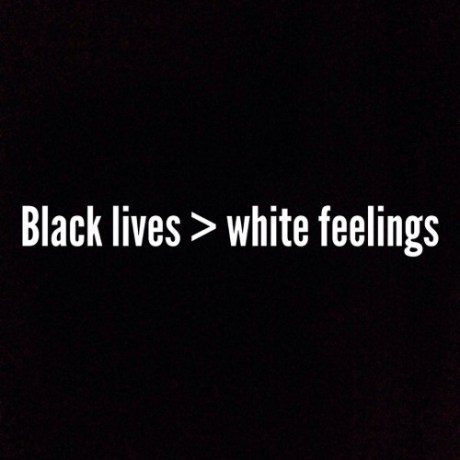
Advocates against racism today frequently use generalized language, directing their messages toward ‘white people’. Examples here, here, here, here, here… I’m not arguing that the information that’s being given is incorrect, but the way that it’s being presented paints the clear villains as ‘white people’. A feature length film was even created called Dear White People that examines this phenomenon. The systemic racism in North America is still being attributed to ‘white people’, and that sounds a lot more like Malcolm than Martin. Memes such as this:
BlackLivesvsWhiteFeelingscr

literally put black people and white people on opposing sides, as if there is a necessary conflict between the two. This article calls the Dallas shooting unsurprising considering the state of American affairs on racial inequality. The author uses a cake metaphor to illustrate this lack of surprise, whereas Malcolm simply said about the national tragedy of his day, “The chickens were coming home to roost.” Even the fight for the exclusion of police officers from the Toronto Pride festival is reminiscent of Malcolm’s aim of separation.

So what did Martin say? Well, he said in his I Have A Dream speech that, “The marvelous new militancy which has engulfed the Negro community must not lead us to a distrust of all white people, for many of our white brothers, as evidenced by their presence here today, have come to realize that their destiny is tied up with our destiny. And they have come to realize that their freedom is inextricably bound to our freedom.” His dream was “that one day on the red hills of Georgia, the sons of former slaves and the sons of former slave owners will be able to sit down together at the table of brotherhood.” He dreamed that one day the “little black boys and black girls will be able to join hands with little white boys and white girls as sisters and brothers.” He acknowledges all the troubles of black people, but his rhetoric is firmly entrenched in an alliance with white people. Memes like this:

13615240_1099525933470665_2594435964447142529_n

People in glass houses…

illustrate the ignorance people have of Martin’s beliefs because his dream, if you listen to the recording, was a lot closer to the message of #AllLivesMatter than anything else. He was very purposeful and clear about his inclusion of whites, and going by the themes of his speech, he would likely have said that “white lives are inextricably bound to black lives.” Martin believed in the supremacy of unity. He wasn’t about anger, but hope. It was this oration of hope and unity that got him the ear of two presidents to fix the systemic problems of his time, whereas Malcolm only raged in the streets.

Even Malcolm rescinded a lot of his rhetoric after his pilgrimage to Mecca, and afterward he said, “I’m a human being first and foremost, and as such, I’m for whoever and whatever benefits humanity as a whole.” He also cites regret at having dismissed a potential white ally on the steps of a college in his fight for the black race:

Well, I’ve lived to regret that incident. In many parts of the African continent I saw white students helping Black people. Something like this kills a lot of argument. I did many things as a [Black] Muslim that I’m sorry for now. I was a zombie then — like all [Black] Muslims — I was hypnotized, pointed in a certain direction and told to march. Well, I guess a man’s entitled to make a fool of himself if he’s ready to pay the cost. It cost me twelve years.

When the grandfather of anger-based identity politics likens that approach to being a mindless zombie, that is a harsh indictment.

Yet I do not believe that Martin could have succeeded without Malcolm. In my blog I refer to a yin yang approach, and Malcolm even addressed this when he said, “If white people realize what the alternative is, perhaps they will be more willing to hear Dr. King.” It’s the good cop/bad cop routine, but with racial politics.

Today though, the only rhetoric allowed is that of Malcolm. Identity politics rules. People are angry, and rightfully so, of course, but we’re missing our Martin. The methodology is meaningless if it does not match the rhetoric or the goals. Are people screaming to love the police, no matter what atrocities they commit? No, they’re banning them from progressive events. The most prominent criticism of the Black Lives Matter movement is the #AllLivesMatter campaign, which is typically dismissed as white ignorance, when really it’s a question about the role the rest of society has within the movement. A Martin today would address that question rather than pass it over with disdain as Malcolm would.

I really don’t know if this is the result of a lack of clear progressive leadership, or the degradation of political movements over time, but Black Lives Matter really needs to analyse its goals to see if they truly match its rhetoric and actions. Is the goal separation or unity? Hatred or love? Identity politics or actual politics? Violence against police officers and racial divisions can only increase given the current discourse because, as it stands right now, the dream is dead.

Post-script: all quotations, unless otherwise cited, have come from here.

Pride is a canonically sinful act, yet this must be understood in the context of a time when passivity and conformity were considered virtues. Pride is no sin. Arrogance is the destructive assumption that, “I am better!” whereas pride is a pure, “I am!” Pride is the act of looking at ourselves and celebrating who that person is, who that person can be. It is acknowledging the beauty of our differences, as history has proven that pride cannot exist in conformity.

With difference, however, comes fear. With fear comes hate, and violence. But rather than cower or be shamed, pride rises against it. Pride exists in defiance, as a challenge to those who, out of their fear, seek to belittle or degrade those beautiful differences in which pride thrives. To be proud is to stand up no matter the number of times we are knocked down.

Pride demands the courage to be different. Pride demands the integrity to be the best possible version of ourselves we can muster. Pride demands the honesty to bare our genuine souls to the world. All these attributes are the most admirable qualities a human being can embody, and it these aspects of ourselves that we honour.

To tell others to be proud is to empower authenticity in a world overrun by self-doubt and humiliation. It asks that you celebrate yourself, that you celebrate your community. Celebrate what separates you from your neighbour, and celebrate what separates your neighbour from you. So be brave. Be true. Be proud.

Everyone wants to be happy. Being happy is so critically important that the pursuit of it is literally a right guaranteed by the American Declaration of Independence. Thousands of books have been written about that pursuit, and given their continued publication one can only assume that the pursuit has yet to be concluded. Happiness is always just one more life-affirming meme away, ever out of our grasp. Perhaps this is due to the elusive definition of happiness, for what does it mean to be happy? Wikipedia defines it as “a mental or emotional state of well-being defined by positive or pleasant emotions ranging from contentment to intense joy.” So, accordingly, happiness is varying degrees of synonyms for happiness. That is super helpful.

Since I’ve already ragged on memes once, let’s see if they can redeem themselves, and we’ll try to learn what they can teach us about defining happiness since the ever-infallible Wikipedia ended up being a disaster. This website has a collection of “Happiness Is” memes that describe various instances when the word ‘happy’ seems appropriate, such as not having to set your alarm clock for the next morning, or finding an old family album. These examples give quite an accurate depiction of how many people view happiness: ephemeral events that elicit an upswell of positive emotion. Happiness can’t be defined linguistically because it exists beyond descriptive vocabulary as an almost spiritual experience, and it arrives in a way that we only recognize when we feel it.

Now when we live by the maxim that “if it’s in a meme then it is factually improbable,” as we all should, we’re forced to analyze this version of happiness more discerningly. If happiness is as laudable as the profit-driven self-help industry claims it to be, then we’re dedicating all of our life goals to a fix. We hop from island of bliss to island of bliss, desperately searching for that next dopamine rush, dreading the moments in between. That sounds a lot less like a fulfilling existence and more like Jennifer Connelly’s character at the end of Requiem for a Dream. Is most of life utterly without value? Discounting the feelings outside of happiness is the pinnacle of delusion. Creativity requires a good deal of personal suffering and frustration. Inside Out taught us that even sadness has its own virtue, and anger is often the healthiest response to unjust events. Happiness has never once moved the world forward, and if we only celebrate positive emotion then we are putting pacification above progress.If our sole focus is maintaining a happy persona, we may even disregard warning signals of an impending crisis simply because to acknowledge it would get in the way of our placid, happy thoughts.

Regardless of my argument, people will still pursue happiness. Not because they’re meme-loving sycophants abstaining from reasonable thought to endorse the epidemic cult of positivity, but because as human beings we intrinsically strive for it. Even a curmudgeon like myself still seeks to find the light in this world of darkness. The Founding Fathers were not dumb, and their inclusion of happiness was not a mistake. Even Aristotle suggested that a life of happiness ought to be a person’s ultimate goal. Aristotle, however, had a different definition of happiness from today’s life coaches peddling their snake oil. He believed that a happy life was one of virtue, and happiness was derived from adhering to the golden mean rather than embodying the hedonistic platitudes of fucking internet memes.

Of course there are plenty of faults in Aristotle’s Virtue ethics, but he began a philosophy of happiness where it wasn’t understood as an emotion, but as a way of life. Nietzsche expanded on this philosophy by saying that the happiest people were those who thrived in suffering, and could create meaning through it. Have some irony:

Wisdom without context. The highest plateau a meme can achieve.

Wisdom without context: the highest peak a meme can achieve.

Here is a happiness that could weather any negativity, for it is a way of life that thrives in any emotional state. It is a happiness that demands value and purpose to enhance our life, rather than a narcotic high to dull it. Nietzsche’s philosophical meaning is somewhat controversial, but the brilliant Viktor Frankl survived the culmination of Nietzschean values, and in doing so, created his much more widely accepted interpretation. According to Frankl, a meaningful life is found through our works, our connection to others, and/or our attitudinal outlook.

This last point may seemingly endorse a meme-spirited happiness delusion, so let’s address that nonsense before it gets out of hand. Have another meme:

This post is now officially my least favourite blog.

This post is now officially my least favourite blog.

I sincerely doubt that this meme is referring to a meaning-based form of happiness, given the message of its sister-meme here:

It's because I hate memes. That's why it's my least favourite blog. I really shouldn't have to spell this out.

It’s because I hate memes. That’s why it’s my least favourite blog. I really shouldn’t have to spell this out.

but we’ll give them an intellectual boost and just assume that some degree of intelligence went into their production, and that they are in fact referring to Frankl’s attitudinal outlook dictating happiness as the representation of purpose.

Frankl viewed the attitudinal approach to meaning as the absolute last resort. He saw it as the only option in approaching the Nazi gas chambers with either dignity or shame. This isn’t a Godwin argument; look him up. He says that if there is even a chance at overcoming a negative situation, to adopt a positive outlook in spite of it is to embrace irrational masochism. The solution is always to change the circumstances, not the attitude.

There is also an underlying tone of condescending individualism in these insipid and ridiculous memes. To say that the person who is wealthy and employed has the same choice to be happy as the broke bum who just lost their job is statistically wrong. Saying happiness is a choice is being oblivious to the countless circumstances that have a direct impact on our well-being. Oh, you lost your baby in a miscarriage after five years of trying for a child? All you need is a change of perspective, and you’ll feel better! That’s an asshole thing to say. Like the worst thing. Never say that. To reiterate: other emotions are necessary parts of our lives, to demand happiness at all times is unnatural and cruel, and to call emotions a choice is completely ignorant of our instinctual reactions. It’s wrong no matter how you define happiness.

At what level are we responsible, if at all, for the happiness of others? Meaning is entirely unique and subjective, so we can’t exactly create it for other people. However, Frankl’s second aspect of meaning is a connection to others, which does suggest that if we are open and caring then we create meaning both for ourselves and for those with whom we come into contact. That sounds like a good start.

What about collective responsibility? If we recognize happiness as meaning, and Mazlow’s hierarchy of needs puts “self-actualization” at the top of the pyramid, wouldn’t that mean that a country that promises its citizens the right to pursue happiness must accommodate all the underlying needs in order for that promise to be fulfilled? Happiness can’t even begin to be pursued until the third level of “love and belonging,” and even then there would need to be a societal agreement and plan to abolish discrimination of all kinds. The progress on that 240 year old promise is a little slow. Way to make liars out of the Founding Fathers, America.

Happiness as an emotional state is nice, I guess, but when planning out one’s life that version should only play the most minor of roles. Pursue meaning. Pursue purpose and value. Treat the happiness that we strive for as a way of being that incorporates the full spectrum of emotion. Live a fulfilling life, and allow that life to connect with others. Define happiness properly, and stop learning how to live from fucking memes!

Have some links:

Say No to Happiness – Ideas with Paul Kennedy: A CBC radio show investigating the philosophical implications of happiness and meaning, and which is more important.

Smile Or Die – Barbara Ehrenreich: The social implications of the cult of positivity.

Why Be Happy When You Can Be Interesting? – Slavoj Žižek: Žižek is a combination of popular neo-communist philosophy and that one scene from Dazed and Confused. These are his thoughts on happiness.