Archives for category: Social Criticism

A few years ago, I worked in a butcher shop. I learned the different cuts of meat, learned the value of a sharp knife, and ingested probably more than my fair share of raw meat juice by grabbing snacks after handling ground beef. Just a bit of extra iron; it’s fine. Anyway, while I was there, I accidentally stabbed myself in the face. I was tying up a roast, holding my knife point-up as I did so (don’t do this), and when the twine broke, my hand shot up, and the tip of the knife entered my forehead, just above my right eye. Another thing I learned at the butcher shop is that foreheads bleed quite profusely.

For a few weeks, I had a very noticeable red gash on my face, or alternatively, a conspicuous Band-Aid that didn’t quite give me the same tough-guy edge as Nelly’s. I spent these weeks contemplating what it would mean to have facial scarring.

Obviously it would not change anything about me. My personality had not been altered, my essential biology remained the same, even my apathy toward basic food safety when it comes to what I put in my mouth continued at its same charming rate. I had a scar, a mark on my skin. Nothing more.

the-elephant-man-still2-526x284

Elephant Man: A Social Construction

What I wondered about was how others might see me. If they were to stare, would they look away embarrassed if I caught them, or would they continue unashamed? Would they ask me how I got it, demanding I retell the same ridiculous story over and over, or would they uncomfortably skirt around it, pretending they don’t even notice? Would I be treated as an incompetent buffoon, someone worthy of pity and paternalistic “helping”? Laughed at?

How would I handle that? At what point would I start to question my self worth? How long would it take me to ignore the stares, absorbing them into my new normal, or would I always have to endure noticing them? Would I internalize their attitudes and begin to believe myself to be “scarred” rather than someone who just happens to have a scar? Would I act “scarred”? Would I start wearing hats and become less confident around women? Would I start associating any kind of rejection as an expansion of the way “unscarred” people would shun me?

5768145-finch1

How long of being treated like a monster before you become a monster?

I am fortunate enough that the scar is hardly visible now. Just another scratch on a Jackson Pollock of pockmarks covered by the unkempt scruff and bangs of someone who is too lazy to regularly shave or get a proper haircut. The stares are gone and nothing was internalized. However, the scar, pockmarks, and eternal five o’clock shadow all reside on the same surface: white skin.

If people had the potential to treat me very differently based on an etching on my skin, what about the skin itself? When people say that something like race is a social construction, they don’t mean that blackness and whiteness don’t exist. I have a scar. It’s definitely real, and that’s definitely how I got it. Social constructions are attitudes people adopt based on traditions and shared values toward things that don’t mean anything in and of themselves. Something as superficial as a scar, for instance. They are “constructed” because they are built by social perception.

Does a bombardment of beauty standards define how people might look at a scarred face? How about movies where darker foes are vanquished by whiter heroes? Or a Eurocentric history that teaches a dichotomy between white civilization and coloured savages? What about timid news stories about violence committed by those with white skin compared to the more harrowing tales of violence committed by those with darker skin? Every act of racism perpetuates attitudes which further shapes the construction. By the virtue of something as arbitrary as my skin, I am automatically treated differently by society based on how it constructs the image of “whiteness”. How much of that have I internalized? How often do I act “white”? What parts of “whiteness” have been absorbed into my normal?

collar11

At least I don’t give a shit about Pumpkin Spice.

Not everything that is a social construction is as controversial as race and gender (or beauty standards, for all my facially-scarred homies). Money is a social construction, for instance, as is the authority of a uniform. It is not necessarily a pejorative, but an appropriate description of how society functions. When the construction becomes particularly harmful is when we have to take a step back, collectively, and reexamine what is real, and what has value in and of itself.
It seems almost unconscionable to ascribe a moral quality to ill health. It’s absurd to think that someone who has caught the common cold is some kind of sinister deviant, but as far back as the lepers being shunned and shuttered out of society, humanity has pointed at the unwell and called them devils.

Europe blamed the Black Death on the wrath of God, who was furious over the alleged impiety of His people. The mentally ill used to be incarcerated alongside criminals, their characters indistinguishable. Even lately, the AIDS epidemic of the 1980s seemed only to punish those considered perverse. Consider how we inquire after cancer: did they smoke? Did they eat processed foods? Did they stay too long in the sun? What was their lifestyle like that earned them a terminal illness?

Disease is an unquestionable evil, but why are we so quick to point to its host as having responsibility for it? When disease becomes a moral choice, the pure among us become immortal. The myth that bad things only happen to bad people convinces us that if only we maintain our righteousness, we will be spared. Righteousness only as a veneer, of course, as compassion for the ill could only ever be a supererogatory act. Far simpler to pillory the sick and use the blind luck of our good health as evidence of our sanctity.

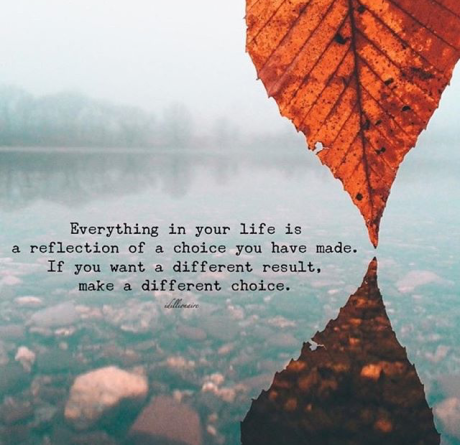
everything-in-your-life-is-a-reflection-of-a-choice-you-have-made-if-you-want-a-different-

A meritocracy of health. God, I hate memes.

Where this demonization of illness is most prevalent is the disease that seems to be built on a long series of choices: addiction. It’s so immoral that it is literally a crime. Mitch Hedberg satirizes this mentality with his quip:

Alcoholism is a disease, but it’s the only one you can get yelled at for having. “Goddamn it, Otto, you’re an alcoholic!” “Goddamn it, Otto, you have lupus!”

One of those two doesn’t sound right.

Addiction is a reaction to trauma, neglect, and mental illness. Addiction is what happens when reality is so brutal that the body seeks any kind of escape from it. Addiction isn’t so much of an illness as it is the medication for when life is a sickness, and then through the obsession of escape it becomes a part of that sickness. Any sense of “choice” in the matter is illusory, any kind of “morality” illegitimate.

But people continue to yell at those whose lives have become diseased. Consider the top rated comment on a CBC article saying that in the first 8 months of 2017, the number of overdose deaths in BC had reached 1,013, compared to the entirety of 2016 which was 922:

I have a real hard time feeling sympathy for these people who have died. They knew fentanyl was out there. They knew that over doses were on the rise and out of control. There’s absolutely no way they didn’t know the risk that they were taking! Yet, they chose to anyways. So no. Finding sympathy is very hard for me.

1,013 human lives extinguished. That’s 1,013 families that have to deal with the grief and guilt of a loved one they will always wonder if they could have done more to save. Of course addicts know that there is Fentanyl in the streets. Some of them ask for it directly. The “risk” isn’t the point. The cure may be worse than the disease, but for many of them it’s the only option available, and some might see the risk of overdose as a potential escape from their sickness altogether. Can we truly judge those adrift at sea who drink saltwater rather than endure the agony of thirst?

But it’s fine. Sympathy is for the bleeding hearts. That could never happen to me because I am morally righteous. I am pure. I am better than them because I wasn’t raped, or abandoned, or abused, nor do I have voices in my head that only shut up when I shoot heroin into my veins. I get to tell myself that it’s my choices that make me noble. My fear of death, a bold reminder in the face of an addict, is well hidden behind the vitriol I espouse. But death cannot come for me. I am pristine. I am immortal.

To understand postmodernism, one must first have a basic understanding of modernism. Luckily, modernism is far less complex than postmodernism, which hopefully makes understanding postmodernism easier as well. Modernism is a paradigm that says that we’ve figured everything out, science has won, our current institutions never need to change again, and any form of progress will only be the refinement of things that we currently have got going for us right now. It’s the paradigm of Fukuyama’s “End of History.” There’s no point in talking about things anymore; this is it.

Postmodernism is the reply to that which says, “Wellllllll….. I mean…. really? Literally everyone in the past has said that their way of thinking is irrefutably true, but you’re super sure that you’ve got it this time?”

This of course is completely reasonable. Modernists give primacy to science; science is about the refutation of existing theories (except apparently when it comes to the primacy of science and other modernist principles which can never possibly be refuted), so why is there such blowback against attempts to refute existing theories? Postmodernism is applying rational skepticism to firmly entrenched ideas and values. This is usually done by looking at an idea that is taken for granted as true, analyzing its history, and then pointing out flaws that have been imbued in that idea since its inception. Postmodernists usually leave it up to us to decide what to do with their criticism, but it’s generally assumed that a revaluation of that idea is the implied minimum.

For a couple of examples, capitalism is an economic system founded in colonialism and slavery. Tracing its history to today, one can see threads of that continuing in the exploitation of third world countries for first world profits. Postmodernism stops there. It has never been big on solutions, just pointing out the problems. I’ve also outlined the general thesis of Foucault’s evolution of punishment here. This blog is essentially a postmodern analysis of contemporary justice. Basically if you’re criticizing something by looking at how its history has shaped its current incarnation, you’re doing postmodernism. Nietzsche was actually one of the first postmodernists. In The Genealogy of Morals, he takes the firmly established Christian way of life, and then deconstructs it as the “slave morality” response to the Roman “master morality”, thus leading to the insipidness of his time. The difference I guess is that Nietzsche offered a solution.

Here’s the thing: nobody likes postmodernists. Which is weird because skepticism has been around for a looonnnng time. Postmodernists are attacked for not liking science and reason; David Hume posited that causality is unknowable; Renee Descartes suggested that mathematical truths could be the deception of an evil demon, and thus could not be held self-evident; Sextus Empiricus, one of the most famous Greek skeptics, provided proofs both for and against the gods; Socrates denied traditional piety, values, language, epistemology, justice… so many things. Much like Socrates, postmodernists get a lot of grief because they attack the paradigm of those in power. They are the gadflies of modernity.

If you watch any video on postmodernism, you’ll probably see somewhere in the comments advice from helpful Youtubers to check out Jordan Peterson, because he knows about postmodernism, and he says it’s bad. Let’s look at some of his criticisms:

It’s an attack on rationality/empiricism/science: That’s one way of framing it, sure, but that isn’t unprecedented even in the most enlightened of circles, and it’s not actually the case. Postmodernism appreciates other ways of knowing, rather than baldly accepting the deification of reason. Maybe beauty has some truth worth knowing, or empathy might reveal something about the universe. Ask yourself, “How can I prove that reason is the ultimate way of knowing?” You can answer either with reason, which would lead to an infinite regress (proving reason with reason would require further reason to prove the second reason), or with some other way of knowing, which shows the value of an alternative. It’s not that science is wrong or bad, it’s that it’s not alone.

It suggests multiple viewpoints, which means there can be no true viewpoint. The only reason we have an agreed upon viewpoint is because it belongs to those in power: Well, yeah. Read a book. History belongs to the victors, right? Those with the most power are going to organize things so that they keep winning. It doesn’t take a rocket scientist to figure that out. Everyone knows politicians are corrupt because they do everything to keep their power, but nobody can make the leap to other facets of our society functioning on the same premise? Please.

Next would be the relativism implied in the criticism: the difficulty we have with truth does not mean that there cannot be a best viewpoint, and deciding which is best is a lot more complicated than accepting the current system simply because that’s the way it has always been. Perhaps with a postmodern lens, we can better understand which viewpoint has the greatest benefit.

There is no individual in postmodernism, just identity. It splits people into an oppressor and oppressed class: Again, yes. Economists and statisticians split people into identifiable variables all the time. It makes measuring trends easier. It’s a way of analyzing social phenomena. If one group is lumped together into an oppressor class, that’s because historically that group has tended to behave in that pattern and now benefits from that history, even if you don’t accept that that practice continues today. It’s not complicated.

Postmodernists are all Marxists. They don’t engage in dialogue. They want to destroy everything: To sum up, postmodernism corrupts the youth. Peterson is famous for wanting to shut down university courses that he believes perpetuate postmodern ideas and “cultural Marxism.” This is the exact charge the Athenians levied against Socrates. There is a lot of propaganda against postmodernists by those who stand to lose under their dissecting eye. Peterson is a buffoon.

There are some valid criticisms of postmodernism, even in this blog. You may have noticed I repeatedly pointed out that it doesn’t offer solutions. Beyond this, it denies any Grand Narrative, which in theory could be used to unify people even if today they are mostly used for jingoist purposes. When people call postmodernism a philosophy I usually cringe because I see it more as sociology rather than philosophy. A postmodernist is more likely to criticize bourgeois philosophy than participate within it, and fair enough.

The true skeptic holds that every belief must be questioned, including the belief that every belief must be questioned. Postmodernism is not beyond criticism, and nobody says it should be. It’s just that too much of its criticism has been coming from people who lump it in with “Cultural Marxism“, and those people are just so, so dumb and are ruining things for everyone. I just want to go back to writing about how empathy isn’t real and the Marxist implications of Facebook, but NOOOOooooo! I have to write out entire blogs explaining why alt-right talking points are wrong.

Post-script: In that Jordan Peterson video, he says that he read Foucault’s Madness and Civilization, and then says that its theme is that the presentation of mental illness is shaped by the conditions of its surrounding environment. That’s… not what the book is about at all. The book is about showing how mental illness is framed in moral terms, as a manifestation of an unreason contrasting the social norms of its environment. Kind of like how being transgender is seen as morally deviant because it flies in the face of the traditional understandings of gender. It’s actually exactly like that. Peterson either never actually read the book and is posturing (so smugly) to seem smart to his followers, or he’s just really, really dumb and didn’t pick up what Foucault wrote out explicitly like, a bunch of times throughout the book. It really seems to me that Jordan Peterson learned about postmodernism from a Jordan Peterson video, and didn’t investigate further because whatever, he gets to be famous for being the stupid man’s smart person.